Category: Psychology

  • Why Do Dogs “Lean” On You: It’s Not Always About Affection

    Why Do Dogs “Lean” On You: It’s Not Always About Affection

    The 100-Pound “Lean”: More Than a Canine Hug (why do dogs lean on you )

    You’re standing in the kitchen or chatting with a neighbor, and suddenly, you feel the full weight of your dog pressing against your shins. If you have a large breed, it might even be enough to knock you off balance. Most owners view this as a “canine hug”—a simple show of love. While affection is certainly part of the equation, the “lean” is actually a complex behavioral tool used to navigate the world.

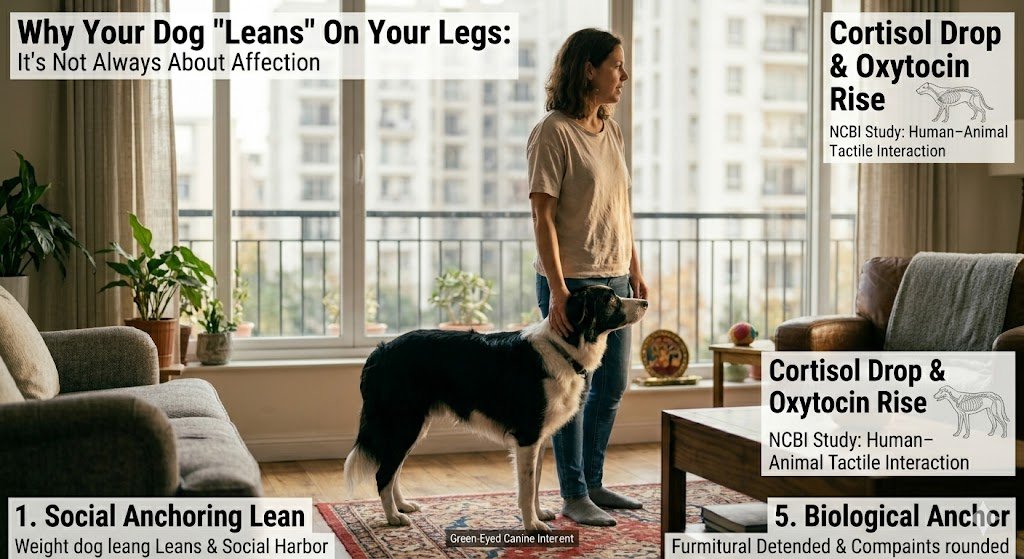
    In the world of canine science, this is known as Social Anchoring. Because dogs are pack animals, they use physical contact to gauge the stability of their environment. By pressing their body against yours, they are doing more than just being close; they are performing a “biological check-in” to ensure their primary security provider is still standing firm.

    Why Your Dog “Leans” On You (NLP Snapshot): While leaning is often a sign of Affiliation (affection), it is primarily a Social Anchoring behavior. Dogs lean to seek Physical Grounding during times of uncertainty, to Claim a Resource(you) in social settings, or as a form of Anterior Pressure Therapy to lower their own cortisol levels. It is the canine equivalent of reaching for someone’s hand in a crowd to ensure you aren’t lost.

    The Science of “Social Anchoring”

    To understand why your dog leans, you have to understand how they process sensory data. For a dog, touch is just as important as scent. By leaning against your legs, they are turning you into a Biological Anchor.

    Physical Contact as Data

    When a dog leans, they are “mapping” your presence. This allows them to monitor your movements and emotional state without having to physically look at you. If you tense up, shift your weight, or start to move, the dog feels it instantly through their skin and fur. This constant stream of tactile data allows them to stay connected to their “Safe Harbor” while their eyes and nose are busy scanning the environment for other variables.

    The Anchoring Effect

    Just like a ship at anchor stays steady despite the waves, a dog leans to feel stable when the world feels unpredictable. This is why you’ll often see a dog lean more heavily in “High-Chaos” environments:

    • The Vet’s Office: The “Insecure Lean” helps them feel grounded amidst scary smells.
    • The Dog Park: The “Social Lean” helps them feel safe while strange dogs zoom past.
    • Loud Noises: During thunderstorms or fireworks, the lean acts as a Stabilizing Force for their nervous system, physically preventing the “flight” response from taking over.

    The Three Types of “The Lean”

    Not every lean carries the same emotional weight. As an owner, distinguishing between these three types will help you understand your dog’s current state of mind.

    The Affectionate Lean (The Canine Hug)

    This is the most common type. The dog’s body is relaxed, their tail may be wagging slowly, and their eyes are soft. In this context, the dog is simply seeking Affiliation. It is a low-energy way to say, “I enjoy being near you.” This often happens when you are relaxed, such as standing in the kitchen or watching TV.

    The Insecure Lean (The Shield)

    If your dog’s muscles feel tense or they are tucked slightly behind your legs, they are using you as a Physical Shield. You’ll often see this when a vacuum cleaner is running, during a thunderstorm, or when a stranger approaches. The dog is literally putting your body between themselves and the “threat.”

    The Dominance/Claiming Lean (Social Resource Guarding)

    This lean is firm and deliberate. It usually happens when another dog or person enters your personal space. By pressing against you, the dog is “claiming” their resource. They are signaling to the newcomer, “This human is my Safe Harbor, and I am anchored here.” It isn’t necessarily aggressive, but it is a clear statement of possession.

    “Deep Pressure Therapy”: The Biological Chill-Pill

    There is a scientific reason why leaning feels so good to a stressed dog. It involves a biological process known as Deep Pressure Therapy (DPT).

    The “Weighted Blanket” Effect

    Just as humans use weighted blankets to calm anxiety, dogs use your weight (and theirs) to regulate their nervous system. Physical pressure triggers the brain to switch from the Sympathetic Nervous System (Fight or Flight) to the Parasympathetic Nervous System (Rest and Digest).

    Cortisol vs. Oxytocin

    When a dog leans firmly against you:

    • Cortisol Levels Drop: The hormone responsible for stress and hyper-vigilance decreases.
    • Oxytocin Rises: The “cuddle hormone” floods the dog’s system, creating a sense of security and bonding.

    Service Dog Science

    This is exactly why Psychiatric Service Dogs are trained in “Deep Pressure Therapy.” They are taught to lean their body weight against their handler or lie across their lap to stop panic attacks. Your dog may not be “trained,” but they are instinctively performing this same therapy on themselves—and you—to keep their world in balance.

    Breed Predispositions: Why Large Dogs are the “Kings of Leans”

    If you own a Great Dane, a Saint Bernard, or a Mastiff, you’re likely very familiar with the “Giant Lean.” While any dog can exhibit this behavior, larger breeds are notorious for using their body mass as a primary communication tool.

    The “Gentle Giant” Logic

    For large breeds, spatial awareness is different. Because they take up so much physical space, they often use their weight to maintain a high-intensity connection with a low-energy effort. To a 150-pound Mastiff, leaning against your legs is the most efficient way to stay in your “Inner Circle” without having to constantly move to keep up with you.

    Working Heritage

    Many “leaning” breeds, like the Bernese Mountain Dog or the Newfoundland, have working backgrounds where staying close to their human partner was a job requirement. For these dogs, the lean is a vestigial trait from their days as cart-pullers or guardians—a way of saying, “I am here, and I am ready.”

    When Leaning Signals a Medical Problem: The Red Flags

    As much as we love the “Canine Hug,” it’s critical for every owner to know when a lean is actually a plea for help. If the behavior is sudden or looks “heavy” and uncoordinated, it might be a medical symptom rather than a social one.

    Balance and Vestibular Disease

    If a dog that never used to lean suddenly starts pressing against you, walls, or furniture just to stay upright, they may be suffering from Vestibular Disease. This is essentially “vertigo” for dogs.

    • What to look for: A persistent head tilt, flickering eyes (nystagmus), or a “drunken” gait. In these cases, the dog isn’t leaning for love; they are leaning because the world is spinning.

    Weakness and Joint Pain

    In senior dogs, leaning can be a way to take the weight off a painful limb. If your dog has Osteoarthritis or hip dysplasia, they may lean against your legs to distribute their weight and reduce the pressure on their joints. [Image highlighting dog joint pain: shifting weight and stiff leaning]

    Dr. Emily’s Rule: “If your dog is leaning specifically to stay upright, or if they seem disoriented or ’tilted’ while leaning, this isn’t affection—it’s a neurological or orthopedic red flag. If you see stumbling or eye flickering alongside the lean, schedule a vet visit immediately to rule out vestibular dysfunction or spinal issues.”

    Common Questions (FAQ)

    Why does my dog lean on me but look away?

    This is often called the “Trust Tilt.” In the wild, animals never turn their back on something they don’t trust. By leaning on you while looking at the rest of the room, your dog is signaling that they consider you their “Safe Harbor.” They trust you to have their back, which frees them up to scan the environment for potential threats or interesting smells. It’s the ultimate compliment to your bond.

    Should I push them off if they are too heavy?

    If the lean is coming from a place of insecurity or affection, pushing them off abruptly can increase their anxiety. Instead, use the “Step Into” technique. Gently take a step toward the dog; this usually causes them to shift their weight and stand on their own four feet. This resets their balance without making them feel rejected.

    Does leaning mean they are trying to be “Alpha”?

    No. Modern veterinary behaviorism has largely moved past the “Alpha” myth. Leaning is almost always about Social Anchoring or Deep Pressure Therapy. If your dog is leaning, they aren’t trying to dominate you; they are trying to connect with you. If the lean is too forceful, it’s a matter of teaching better “body awareness” and boundaries, not a struggle for power.

    Dr. Emily’s Final Take

    To be leaned on is to be chosen. In a dog’s world, being a “Biological Anchor” is the highest position a human can hold. It means that when the world gets loud, confusing, or just a bit too big, you are the one thing that feels solid.

    At Dog Vet Expert, we encourage you to embrace the lean. Whether it’s a 10-pound Terrier or a 100-pound Mastiff, that physical pressure is a sign that your dog feels safe in your shadow. As long as they are healthy and standing strong, let them lean. You aren’t just supporting their weight; you are supporting their soul.

    💤 From Leaning to Sleeping

    Does your dog lean against you all day and then sleep right at your feet at night? It’s all part of the same biological need to stay connected to their pack for safety.

    Read: Why Does My Dog Sleep Near Me? →

    🚻 The Shadow Instinct

    Leaning is the “static” version of following. Whether they are pressing against your legs or following you into the bathroom, your dog is using you as their primary security anchor.

    Learn: Why Dogs Follow You to the Bathroom →

    Reference

    To provide the scientific “backbone” for the Social Anchoring and Deep Pressure Therapy concepts, you should cite research that discusses how tactile contact reduces physiological stress in canines.

    • Study Title: Effect of Human–Animal Interaction on Bovine and Canine Cortisol Levels (Specifically the sections on canine tactile stimulation).
    • Source: National Center for Biotechnology Information (NCBI) / Frontiers in Psychology.
    • Key Finding: Physical contact between humans and dogs has been shown to significantly lower cortisol (stress) and increase oxytocin (bonding) in both species, validating the “Biological Anchor” theory.
    • Direct Link: https://www.ncbi.nlm.nih.gov/pmc/articles/PMC5568470/
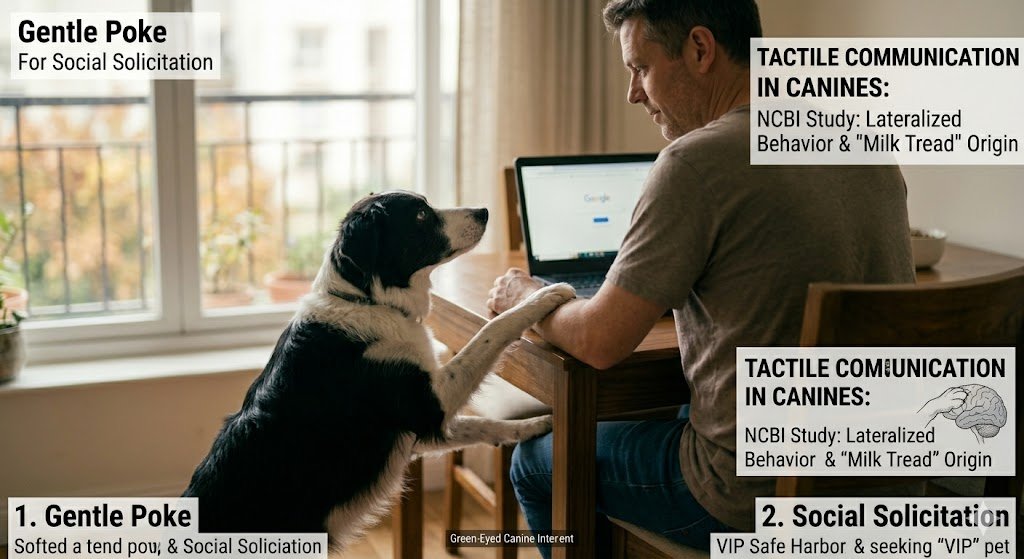
  • Why Does My Dog Tap Me With His Paw: The Physical Attention-Seeking Guide

    Why Does My Dog Tap Me With His Paw: The Physical Attention-Seeking Guide

    The Gentle Poke: More Than Just a Greeting (why does my dog tap me with his paw)

    You’re sitting on the sofa or working at your desk, and suddenly, you feel a rhythmic, insistent poke on your arm. You look down, and there’s a paw. It isn’t a scratch, and it isn’t a playful swipe; it is a calculated, deliberate touch.

    While it’s easy to dismiss this as your dog simply being “cute,” the canine paw is actually a sophisticated communication tool. In the world of animal behavior, this is known as a Tactile Communication Signal. Because dogs lack the vocal complexity of humans, they rely on physical contact to bridge the gap and ensure they are being “heard.”

    Why Your Dog “Taps” You (NLP Snapshot): When a dog taps you with their paw, they are engaging in Social Solicitation. Rooted in puppyhood nursing behaviors, the tap is a multi-functional tool used for Resource Requesting(food/walks), Affiliation (seeking a bond), or Anxiety Signaling. It is the canine equivalent of a human tapping someone on the shoulder to say, “Excuse me, I need your attention right now.”

    The Biological Origin: The “Milk Tread”

    To understand why your dog uses their paws to get what they want, we have to look back at their very first days of life. This behavior is not just learned; it is deeply evolutionary.

    The Neonatal Reflex

    Newborn puppies are born with a reflex known as “kneading” or the “Milk Tread.” While nursing, puppies instinctively push their paws against their mother’s mammary glands to stimulate milk flow. In this stage of life, “Pawing = Survival.” It is the first time a dog learns that physical pressure results in a positive reward (food and comfort).

    The Transition to Learned Strategy

    As dogs mature and integrate into human households, this instinct undergoes a process called Operant Conditioning.

    1. The Action: The dog accidentally (or instinctively) paws at a human.
    2. The Reaction: The human smiles, says “Aww,” and pets the dog or gives them a treat.
    3. The Result: The dog’s brain creates a “Success Loop.” They realize that while barking might get them scolded, the “Gentle Tap” is a social superpower that almost always results in a positive outcome.

    Over time, this survival reflex evolves into a Learned Communication Strategy. Your dog isn’t just “touching” you; they are utilizing a biological legacy to manage their relationship with you, their primary provider.

    The “Paw Language” Dictionary (Deciphering the Intent)

    Not all taps are created equal. To become a “Dog Language” expert, you need to look at the intensity, frequency, and accompanying body language. Your dog is likely using one of these four distinct “paw dialects”:

    The “I’m Bored” Tap (Social Solicitation)

    This is usually a short, repetitive poke. You’ll notice the dog has relaxed ears and might offer a “whale eye” (showing the whites of their eyes) while waiting for your reaction. They are simply checking to see if you are available for a play session.

    The “Resource” Tap (The Demand)

    This is a heavy, insistent paw placed firmly on your knee or arm. It often happens when you are eating, or when it is nearing “walkie” time. This is a Demand Signal. The dog is asserting a need for a specific resource (food or the outdoors).

    The “Apology” Tap (The Pacifier)

    If you have just scolded your dog or if they sense tension, they may offer a slow, soft pawing gesture. In canine behavior, this is a Pacifying Signal. They are trying to “lower the temperature” of the room and restore social harmony between the two of you.

    The “Anxiety” Tap (The Grounding Request)

    This tap is often frantic and accompanied by panting, pacing, or trembling. In this context, the dog is seeking Physical Grounding. Much like a human child reaching for a hand during a storm, the dog is using physical contact with you to lower their own cortisol levels.

    The “Left vs. Right” Paw Theory: Brain Lateralization

    Did you know that your dog might be “left-pawed” or “right-pawed”? Emerging research in Canine Neurosciencesuggests that the paw your dog chooses to tap you with can reveal their emotional state.

    The Science of the Hemispheres

    Like humans, a dog’s brain is divided into two hemispheres that process different types of information:

    • Left Hemisphere (Controls the Right Paw): Generally associated with approach behaviors, calm logic, and positive emotions.
    • Right Hemisphere (Controls the Left Paw): Often linked to the “withdrawal” response, intense emotions, and processing perceived threats or high-stress situations.

    What the Tap Tells You

    While not every dog follows this rule perfectly, some studies suggest that a dog using their left paw to tap you might be experiencing a more intense emotional “high” or “low” (such as fear or extreme excitement). A right-paw tap is often seen as a more calculated, routine request for a known reward.

    Tracking which paw your dog uses most frequently can give you a “window” into their dominant temperament—helping you understand if they are a “thinker” (Right-Pawed) or a “feeler” (Left-Pawed).

    When “Tapping” Becomes “Demanding”: The Power Shift

    While a paw on the arm is often endearing, it can quickly evolve into a behavioral issue if the boundaries aren’t clear. If you pet, feed, or play with your dog every single time they tap you, you are participating in a Reinforcement Loop.

    Accidental Training

    By reacting immediately, you are teaching your dog that they are the “Director” of the household’s activities. Over time, this “Gentle Tap” can escalate into Demand Barking or more forceful scratching if they don’t get an instant result. In their mind, they have successfully trained you to respond to their touch.

    The “Ignore to Reward” Solution

    To keep your “VIP” status intact, you must be the one to initiate the interaction.

    • The Wait: When your dog taps you, wait 5–10 seconds until they stop.
    • The Command: Ask them for a “Sit” or “Down.”
    • The Reward: Once they have complied with your request, give them the attention they wanted. This subtle shift ensures that the dog feels heard, but understands that you are the one in control of the resources.

    Is it a Medical Issue? (The Vet Check)

    As a dog owner, you must distinguish between a social tap and a physical symptom. Sometimes, what looks like a request for a scratch is actually a sign of discomfort.

    The “Itch” Factor

    If your dog is pawing at you and then immediately licking their own paws or rubbing their face against the carpet, they might be dealing with Pododermatitis (inflammation of the paw skin) or environmental allergies. Gurgaon’s seasonal dust and pollen can often cause “itchy feet” that lead to obsessive pawing.

    Joint Pain and Arthritis

    If an older dog suddenly starts pawing at you and then favoring that limb, it could be a sign of Osteoarthritis or a soft tissue injury. The “tap” in this context is a request for help or an attempt to shift their weight to a more comfortable position.

    Dr. Emily’s Rule: “If the tapping is accompanied by redness between the toes, a ‘corn chips’ smell from the paws (indicating yeast), or a sudden change in how they bear weight, it’s time to move past the behaviorist and see a veterinarian. We need to rule out pain before we address the personality.”

    Common Questions (FAQ)

    Why does my dog paw at the air?

    This is often called a “Displacement Behavior.” If your dog wants to tap you but realizes they shouldn’t (or can’t reach you), they may paw at the air instead. It’s a sign of internal conflict or excitement. Think of it as the canine version of a human fidgeting or tapping their pen during a meeting.

    Why does my dog “hold” my arm with their paw?

    This is the “Claiming” Gesture. By hooking their paw around your arm and holding on, your dog is creating a physical “lock” to ensure you don’t walk away. It is a very high-level sign of attachment and a desire for constant proximity. It is most common in “Velcro” breeds like Vizslas or Labradors.

    Does pawing mean my dog is trying to be “Alpha”?

    No. The “Dominance Theory” has been largely debunked by modern veterinary science. Pawing is almost always a Social Solicitation or a request for a resource. Your dog isn’t trying to “rule” you; they are trying to “talk” to you. If the pawing is too forceful, it’s a lack of manners, not a bid for the throne.

    Dr. Emily’s Final Take

    A tap from a paw is one of the most intimate ways a dog communicates. It requires them to invade your personal space and initiate physical contact—a move that requires immense trust.

    At Dog Vet Expert, we see the “Canine Tap” as a bridge between two different species. While we have words, they have touch. If your dog is tapping you, they are inviting you into their world. Listen to what they are saying, respect their medical health, and set healthy boundaries. When you respond to a “tap” with a calm, directed command, you aren’t just petting a dog; you are refining a lifelong conversation.

    🦷 From Tapping to Mouthing

    When a paw tap isn’t enough, some dogs escalate to “mouthing” your hand. Learn why this gentle use of the mouth is actually a sophisticated form of social solicitation.

    Read: Why Dogs Mouth Your Hand →

    😤 The “Huff” and the “Tap”

    Pawing and “huffing” are two sides of the same coin: quiet, non-aggressive requests for affection. Discover how to decode these low-arousal signals before they turn into barking.

    Learn: Why Dogs “Huff” at You →

    Reference

    “Research published in NCBI regarding lateralized behavior suggests that a dog’s choice of paw is not random; it is often a reflection of which side of the brain is processing their current emotional state.”

  • Do Dogs Feel “Jealousy” When You Pet Another Dog? The Science of Social Guarding

    Do Dogs Feel “Jealousy” When You Pet Another Dog? The Science of Social Guarding

    The “Green-Eyed” Canine (do dogs feel jealousy )

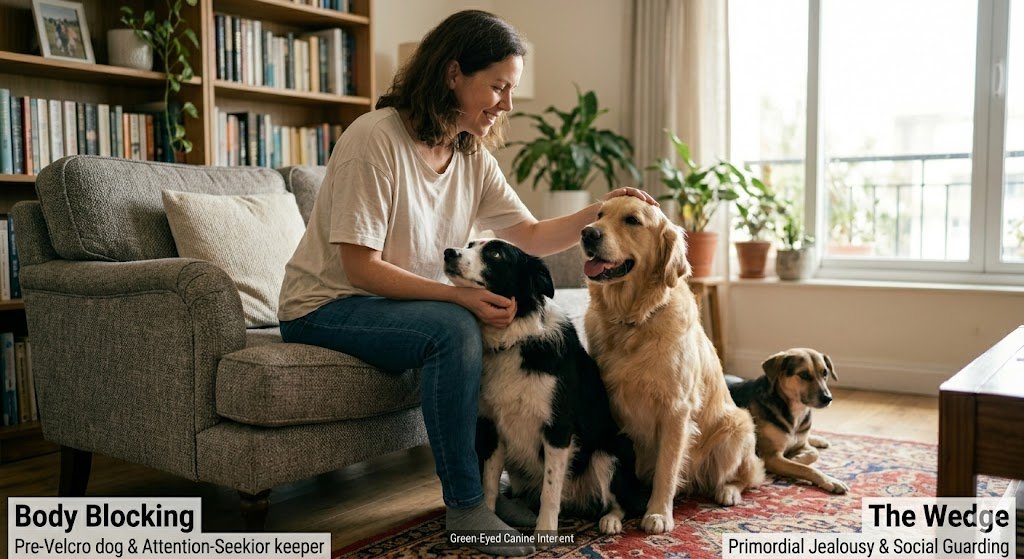
    You’re at the park, and a friendly Golden Retriever wanders over. You lean down to give it a quick ear scratch, and suddenly, your own dog is there. They wedge themselves between your legs, paw at your hand, or let out a low, vibrating grumble.

    We often joke that our dogs are “jealous,” but for decades, the scientific community dismissed this as anthropomorphism—the act of projecting human emotions onto animals. However, new research in canine cognition suggests that what we’re seeing isn’t just our imagination. It is a primitive, powerful emotional response designed to protect the most important relationship in a dog’s life.

    Do Dogs Feel Jealousy? (NLP Snapshot): Yes, dogs experience a form of primordial jealousy. Unlike human envy (wanting what someone else has), canine jealousy is a socially motivated guard response. It is triggered when a “social rival” threatens the dog’s exclusive access to their primary attachment figure. This behavior is an evolutionary survival mechanism intended to secure their place in the pack and maintain their “Safe Harbor.”

    The UCSD “Fake Dog” Study: The Proof in the Science

    The turning point for the “jealousy debate” came from a landmark study at the University of California, San Diego (UCSD). Researchers wanted to know if dogs were truly jealous of a rival or if they were simply frustrated that their owner was distracted.

    The Experiment

    Owners were asked to ignore their dogs while interacting with three different objects:

    1. A realistic, animatronic toy dog (that barked and wagged its tail).
    2. A plastic jack-o’-lantern bucket.
    3. A pop-up book.

    The Results

    The reaction was overwhelming. 86% of the dogs exhibited jealous behaviors when the owner petted the “fake dog.” These behaviors included snapping at the toy, pushing the owner away, and wedging themselves between the owner and the rival.

    Crucially, the dogs were significantly less concerned when the owner “petted” the bucket or read the book. This proved that the behavior wasn’t just about seeking attention; it was specifically triggered by the presence of a social rival. To the dog’s brain, the fake dog was a threat to their “VIP” status, proving that the emotional hardware for jealousy is hardwired into the canine mind.

    Primordial Jealousy vs. Human Envy

    To understand your dog, we have to strip away the human complexity of “envy.” In humans, envy is often about wanting what someone else has (like a bigger house or a promotion). Canine jealousy is Primordial—it is a “building block” emotion that doesn’t require complex thought about self-esteem or fairness.

    The “Security File” Logic

    Humans feel complex jealousy (“Does this mean my partner is leaving me?”). Dogs feel Functional Jealousy. In their minds, you are a “resource” that provides safety, food, and emotional stability.+2

    • Human Envy: “I wish I had that toy.”
    • Dog Jealousy: “That rival is stealing my security provider. I must break up this interaction to protect my status.”

    Survival of the Bond

    In a pack environment, being the “favorite” isn’t just about cuddles; it’s about survival. The dog closest to the leader gets the best food and the most protection. When you pet another dog, your dog’s brain triggers a motive to regain your attention and block the “usurper” before they lose their priority status in your “Inner Circle.”

    How Dogs Show Jealousy (The “Red Flags”)

    Jealousy in dogs isn’t always a dramatic growl. It often manifests as subtle “nuisance” behaviors that owners mistake for being “cute” or “clingy.”

    The “Wedge” and the “Block”

    The most common sign is the Physical Intervention. If you are talking to another person or petting another animal, your dog will physically push their body between you and the rival. By “wedging” themselves in, they are literally breaking the social connection and forcing you to acknowledge them instead.

    Strategic Attention-Seeking

    If wedging doesn’t work, a jealous dog will cycle through their “best hits” to grab your focus:

    • The “Nuzzle-Intervention”: Forcefully poking your hand with their nose or pawing at your arm.
    • Performing Unprompted Tricks: Suddenly sitting, shaking, or rolling over without a command—this is a “look at me, I’m a good dog” move to reclaim the spotlight.
    • The “Sad” Withdrawal: Some dogs won’t fight for attention; they will sulk or leave the room entirely. This avoidance behavior is a sign of high social stress.

    The Aggression Threshold

    In more intense cases, jealousy turns into Resource Guarding of the Human. This includes:

    • Lip curling or low growling when the other dog approaches you.
    • Snapping at the air near the rival’s face.
    • “Body Guarding”: Hovering over you or sitting on your feet to “claim” you as theirs.

    Is it Love or Resource Guarding?

    From a human perspective, we want to believe our dogs are “protecting their love” for us. However, from a veterinary and behavioral standpoint, this behavior is a specific form of Resource Guarding.

    You as the “High-Value Resource”

    In the canine world, a “resource” is anything that contributes to survival or well-being—food, toys, a prime sleeping spot, and social affection. Because you are the source of all good things (the “Safe Harbor”), your attention is the highest-value resource in the house. When you pet another dog, you are “spending” that resource on someone else.

    Oxytocin Competition

    When you interact with your dog, both of your brains release Oxytocin. This creates a biological “high” that reduces stress. When your dog sees you giving that same interaction to a rival, they experience a drop in these feel-good chemicals and a spike in Cortisol (the stress hormone). To your dog, jealousy isn’t an “attitude”—it’s a physiological drive to get their “bonding fix” back.

    How to Manage the “Jealous” Dog

    The goal isn’t to punish the jealousy, but to transform the dog’s mindset from “This rival is stealing my person” to “When this other dog is around, good things happen to me too.”

    Equalizing the Reward

    This is the most effective way to break the jealousy cycle.

    • The Strategy: When you pet another dog, use your other hand to toss a treat to your dog.
    • The Result: Your dog begins to associate the presence of the “rival” with receiving high-value rewards. This is called Counter-Conditioning. You are rewriting their emotional response from fear/anger to anticipation/pleasure.

    The “Sit-Stay” Anchor

    If your dog tries to “wedge” between you and another pet, do not pet them. If you pet a dog that is pushing in, you are rewarding the pushy behavior.

    1. Ask your dog to “Sit” or “Go to Place.”
    2. Reward them only when they are calm and waiting their turn.
    3. This builds Impulse Control, teaching them that they get your attention by being patient, not by being pushy.

    The “Parallel Play” Technique

    If you have two dogs in the house, engage them in activities that require them to focus on a task rather than on you. Using “sniff mats” or separate puzzle toys in the same room helps them coexist in a high-dopamine state without competing for your physical touch.

    Safety First: If your dog’s jealousy escalates into “Resource Guarding” aggression where they bite, snap, or attack other animals when you are present, this is a dangerous behavioral threshold. This is no longer “cute” jealousy; it is a liability. Keep the dogs separated and consult a certified veterinary behaviorist immediately.

    Common Questions (FAQ)

    Do dogs get jealous of new babies?

    Technically, yes, but it is more about a disruption of resources. For years, the dog has been the center of your “Inner Circle.” When a baby arrives, the dog’s access to your time, touch, and even their sleep schedule is suddenly restricted. They aren’t “mad” at the baby; they are stressed by the loss of their predictable “Safe Harbor.” Gradual introduction and maintaining a “special time” for the dog can help mitigate this.

    Can dogs feel jealous of a phone or laptop?

    Recent behavioral studies suggest they can! While your phone isn’t a “social rival” in the biological sense, dogs are masters at tracking where your visual attention goes. If you are staring at a screen for hours instead of engaging with them, they may perceive the device as a barrier to their primary resource. This often leads to “pawing” at the phone or wedging their head between you and the screen.

    Is jealousy more common in specific breeds?

    While any dog can feel jealous, high-drive and “velcro” breeds—such as Border Collies, Australian Shepherds, and certain Terriers—tend to show more intense guarding behaviors. These breeds are biologically wired to work closely with a human partner, making them more sensitive to any perceived “threat” to that exclusive bond.

    Dr. Emily’s Final Take

    Jealousy is one of the most visible proofs of the deep emotional intelligence of dogs. It’s a testament to the strength of your bond; your dog values you so much that they are willing to “guard” you against the rest of the world.

    However, at Dog Vet Expert, we emphasize that a secure dog is a happy dog. While a little bit of “attention-seeking” is harmless, you want to ensure your dog feels confident enough to know that your love isn’t a finite resource that can be “stolen” by another pet. By using Consistency and Equalizing the Reward, you can transform a competitive household into a harmonious pack. Your heart is big enough for more than one dog—you just have to teach your dog how to share the “Safe Harbor.”

    ⚠️ Jealousy or Fear?

    When a social rival pushes your dog to their emotional threshold, they often display “Whale Eye” (the whites of the eyes). Discover why this is a critical warning sign that your dog needs space.

    Read: Understanding Whale Eye →

    🐾 The “Look at Me” Tap

    Does your dog paw at you the moment you pet another animal? This is a deliberate tactile solicitation designed to reclaim your attention from a social rival.

    Learn: Why Dogs Tap You With Their Paw →

    Reference

    Study Title: Jealousy in Dogs

    Authors: Christine R. Harris and Caroline Prouvost

    Journal: PLOS ONE

    Direct Link: https://journals.plos.org/plosone/article?id=10.1371/journal.pone.0094597

  • Why Your Dog Trusts You But Not Visitors: The Science of the “Inner Circle”

    Why Your Dog Trusts You But Not Visitors: The Science of the “Inner Circle”

    The Two-Faced Companion (why your dog trusts you but not visitors )

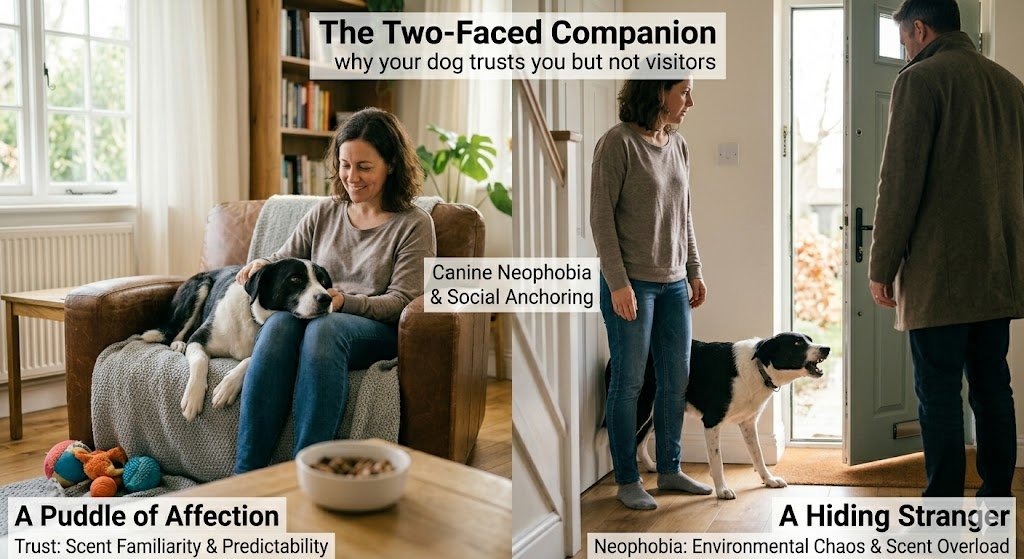
    It is a common source of embarrassment and confusion for dog owners: at home with just the family, your dog is a “puddle of affection”—relaxed, obedient, and constantly seeking cuddles. But the moment the doorbell rings and a visitor steps inside, that same dog transforms into a stiff, growling, or hiding stranger.

    Why is it that your dog can’t see your best friend or your relative the way you do? It isn’t that your dog is “mean” or “unfriendly”; it’s that a dog’s trust is not a blanket emotion. It is highly specific and deeply rooted in their need for environmental control.

    Why Your Dog Trusts You But Not Visitors (NLP Snapshot): A dog’s trust is context-dependent. Your dog trusts you because of Predictability and Scent Familiarity. You are a “known variable.” Visitors, however, represent “Environmental Chaos.” They bring unpredictable scents, unfamiliar vocal pitches, and physical movements that trigger a dog’s natural Neophobia (fear of the new) or an instinctive drive to protect the “Safe Harbor” of the home.

    The “Safe Harbor” Concept

    To understand why your dog is suspicious of guests, you first have to understand the role you play in their biological world. In a dog’s mind, you are the Primary Attachment Figure.

    You are the Source of Safety

    Because you provide food, shelter, and consistent positive reinforcement, your presence acts as a “biological anchor.” When you are alone with your dog, their cortisol (stress hormone) levels stay low because the environment is predictable. Your scent is the “all-clear” signal that tells their brain they are in a Safe Harbor.

    The Intruder Alert

    When a visitor enters, they “pollute” this safe environment. To a dog, a guest isn’t just a person; they are a walking collection of foreign pheromones and unpredictable energy.

    • Olfactory Overload: A guest carries the scent of other environments, animals, and chemicals that your dog’s “security system” hasn’t authorized.
    • The Broken Routine: Dogs thrive on patterns. A visitor breaks the pattern of the home, which moves the dog from a state of “Rest and Digest” into a state of “Hyper-Vigilance.” By entering the home, the guest has essentially “invaded” the dog’s most sacred space, forcing the dog to decide if this new variable is a friend or a threat to the pack’s stability.

    Canine Neophobia: The Evolutionary Guard

    To understand your dog’s suspicion, we have to look back at their ancestors. In the wild, “new” almost always meant “dangerous.” This survival instinct is known as Neophobia—a natural cautiousness or fear toward unfamiliar people, animals, or objects.

    The Survival Instinct

    A dog that immediately trusts a stranger is a dog that, in a wild setting, might not survive a territorial dispute. Your dog’s hesitation is actually their brain performing a high-speed Risk Assessment. They are checking the guest’s posture, scent, and intent before lowering their guard.

    The Socialization Gap

    Most of a dog’s “Trust Directory” is written during the critical socialization window (between 8 and 16 weeks of age).

    • The “Inner Circle”: If a puppy isn’t exposed to a wide variety of people (different heights, voices, ethnicities, and outfits) during this time, their “Inner Circle” stays very small.
    • The Stranger Danger: To an under-socialized dog, any human who doesn’t look or smell exactly like “their people” is categorized as a potential threat.

    Why Visitors Are “Scary” (From a Dog’s Eye View)

    One of the biggest reasons your dog trusts you but not your guests is Human Body Language. Humans have a habit of greeting dogs in ways that, in canine language, are incredibly rude or even aggressive.

    The “Looming” Effect

    When a guest sees a cute dog, their first instinct is often to lean over them and pat the top of their head. To a dog, a large silhouette leaning over them is a Dominant/Threatening Gesture. You can do it because you are a “Safe Variable,” but a stranger doing it triggers a “Fight or Flight” response.

    The Stare-Down

    In the human world, eye contact is polite. In the dog world, prolonged direct eye contact is a challenge or a threat. Well-meaning guests often stare at the dog, waiting for them to come closer, which the dog perceives as a “stand-off.”

    Unpredictable Scent Profiles

    Your guest isn’t just one person; they are a walking library of scents. They carry the smell of their own pets, their car, and their environment. If your guest has a cat at home, your dog might perceive that scent as a Territorial Intrusion, making them defensive before the guest even speaks.

    The “Protective” Fallacy: Resource Guarding “You”

    It is a common mistake to assume a dog is being “protective” because they love you. While loyalty is real, the behavior you see when a visitor approaches is often a form of Resource Guarding. In this context, you are the resource.

    You Are the Ultimate Prize

    Because you provide everything—food, comfort, and emotional stability—you are the most valuable “object” in your dog’s world. When a stranger enters and tries to interact with you, your dog may feel their access to their “Safe Harbor” is being threatened.

    • Body Blocking: Does your dog wedge themselves between you and your guest?
    • Nudging: Do they try to push the guest’s hand away from you? This isn’t necessarily a “heroic” act; it is often an anxiety-driven attempt to maintain exclusive access to their primary security provider.

    Territorial Mapping

    To a dog, the home is a fixed, safe territory. They have mapped every corner and every scent. A visitor is an “unauthorized entry” into this map. If the dog doesn’t feel the guest has been “vetted” by the pack leader (you) in a way they understand, they remain in a state of High-Alert.

    Steps to Bridge the Trust Gap

    You cannot “force” trust, but you can create a controlled environment where a dog feels safe enough to lower their guard. The goal is to move the guest from the “Threat” category to the “Neutral/Positive” category.

    The “No Touch, No Talk, No Eye Contact” Rule

    The best thing a guest can do for a suspicious dog is to ignore them. By pretending the dog doesn’t exist, the guest removes the “threat” of a social confrontation. This allows the dog to sniff the guest’s shoes and hem of their pants (their “data gathering” phase) without the pressure of being touched.

    Treat Tossing (The “Search” Game)

    Never have a guest hand-feed a fearful dog. This creates a “Conflict of Interest”: the dog wants the food but fears the hand. Instead, have the guest toss treats behind the dog.

    • The Logic: This rewards the dog for being in the room but encourages them to move away from the guest to get the treat, lowering their overall pressure.

    The Designated “Safe Zone”

    Always provide a “Place” (a crate, a specific rug, or a separate room) where the dog knows they are 100% safe from guest interaction. If the dog feels they have an “escape hatch,” they are much less likely to feel the need to growl or snap to create space.

    Safety First: If your dog shows signs of lunging, snapping, or extreme “fear-aggression” toward guests, do not attempt to “force” a meeting. This is a deep-seated behavioral issue. Consult a professional behaviorist to implement a controlled desensitization plan to ensure the safety of your visitors and your dog.

    Common Questions (FAQ)

    Why is my dog okay with women but not men?

    This is a very common observation. It usually boils down to two factors: stature and frequency. Men tend to be taller and have broader shoulders, which can be perceived as “looming.” Furthermore, lower-frequency male voices can mimic the low-pitch growls dogs use to signal a threat. If a dog wasn’t socialized with a variety of men during puppyhood, these physical traits can trigger a defensive response.

    Can a dog “sense” a bad person?

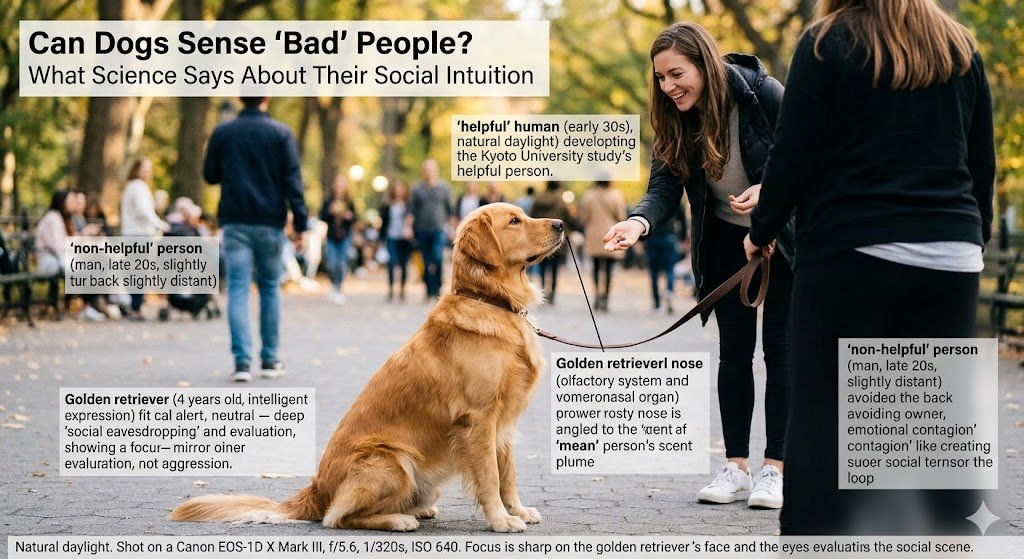
    While we love the idea of a dog having a “moral compass,” science suggests they are actually sensing micro-tensions. When you are uncomfortable around a visitor, your body releases subtle pheromones and your muscles tense. Your dog, being a biological mirror, picks up on your “alert” state and assumes the visitor is the cause of the danger.

    Should I let my guest give my dog a treat immediately?

    Actually, no. Hand-feeding a fearful dog creates a “Motivation Conflict.” The dog wants the treat but fears the hand. This can lead to a “snap” once the treat is gone and the dog realizes how close the stranger’s hand is. It is much better to have the guest toss treats onto the floor, allowing the dog to move toward the “reward” on their own terms.

    Dr. Emily’s Final Take

    We often feel social pressure to have a “friendly” dog that greets everyone with a wagging tail. However, as a veterinarian, I want you to remember that respecting your dog’s “Inner Circle” is a sign of good leadership. Not every dog is a social butterfly, and that is okay. Your dog trusts you because you are predictable and safe. When you protect their boundaries from well-meaning but “pushy” visitors, you actually strengthen the bond between you. At Dog Vet Expert, we believe the goal isn’t to force your dog to love everyone—it’s to make them feel safe enough to be indifferent.

    🕵️ Intuition or Instinct?

    Is your dog actually sensing a “bad” person, or are they just reading your own micro-tensions? Discover the science behind how dogs evaluate the character of a visitor.

    Read: Can Dogs Sense Bad People? →

    ⭐ The Chosen One

    Your dog trusts you above all others because you have passed the ultimate test. Learn the specific criteria dogs use to ‘choose’ their favorite person in a household.

    Learn: How Dogs Choose Their Favorite Person →

    Clinical & Behavioral Authorities (Expertise)

    Use these to back up the biological claims about cortisol and stress responses.

    • American College of Veterinary Behaviorists (ACVB): dacvb.org – The gold standard for clinical animal behavior.
    • Journal of Veterinary Behavior: journalvetbehavior.com – Perfect for citing studies on canine stress in domestic environments.
  • How Dogs “Choose” Their Favorite Person: Is It Food, or Something Deeper?

    How Dogs “Choose” Their Favorite Person: Is It Food, or Something Deeper?

    how dogs choose their favorite person

    In every multi-person household, there is a silent hierarchy that every dog owner eventually notices. Despite everyone sharing the chores—walking, petting, and filling the water bowl—there is usually one person the dog gravitates toward with a different level of intensity. This is the person they follow from room to room, the one they lean against during a thunderstorm, and the one whose arrival produces the most frantic “helicopter tail” wags.

    Is it simply the person who provides the best treats, or is there a deeper, biological thread connecting a dog to their “VIP”? Understanding this choice reveals the true complexity of the canine heart.

    How Dogs “Choose” Their Favorite Person (NLP Snapshot): While food is a powerful motivator, dogs “choose” a favorite based on a combination of Social MirroringQuality of Interaction, and Oxytocin Synchronization. They don’t necessarily pick the person who gives the most treats; they pick the individual who provides the most consistent “Safe Harbor” and whose energy levels best match their own temperament.

    The “Early Bond” Window: The 6-Month Rule

    Just as humans have formative years that shape their personalities, dogs have a critical Socialization Window that occurs between birth and approximately six months of age.

    The Puppyhood Blueprint

    During this time, a puppy’s brain is like a sponge, soaking up social cues and determining who is “safe” and who is “family.” If a specific person is the primary caregiver during this phase—handling the vet visits, the early training sessions, and the midnight bathroom breaks—that person becomes the dog’s permanent emotional North Star.

    The “First Impression” Impact

    In rescue dogs, this window is equally vital. If a dog had a positive experience with a specific “type” of person during their first six months (for example, someone with a soft voice or a specific scent), they are biologically predisposed to “choose” a similar person as their favorite later in life.

    The Loyalty Anchor: This early bond creates a sense of Primary Attachment. Even if that person stops being the one to provide food later in the dog’s life, the “Security File” created in those first six months remains the strongest emotional anchor in the dog’s memory.

    Beyond the Bowl: The “Quality vs. Quantity” Interaction

    There is a common misconception that the person who puts the food in the bowl is automatically the favorite. While dogs are certainly food-motivated, their “favorite” status is rarely bought with kibble alone.

    The Food Myth

    In a household where one person feeds the dog and another plays high-intensity games, the dog will often choose the “Playmate” over the “Provider.” Why? Because dogs prioritize High-Value Interaction. Food is a resource, but engagement is a social bond.

    High-Value Interaction

    Dogs value three specific types of engagement above all else:

    • Physical Touch: Not just a passing pat, but intentional, calm grooming or “leaning.”
    • Focused Play: 15 minutes of dedicated fetch or tug-of-war where the human is 100% present.
    • Clear Communication: Dogs gravitate toward the person whose body language is the easiest to “read.” If you are consistent with your rules and signals, the dog feels safer with you than with a person who is affectionate but unpredictable.

    Energy Matching: The “Mirror Neuron” Connection

    Dogs are biological mirrors. Their survival has always depended on their ability to read and match the energy of their pack leaders. This is where Mirror Neurons—specialized brain cells that fire both when an animal acts and when it observes the same action performed by another—come into play.

    Temperament Alignment

    A dog will often “choose” the human whose natural energy levels align with their own breed’s “factory settings.”

    • The Active Pair: A high-drive cattle dog will often choose the marathon runner of the house because their shared “mission” creates a mutual dopamine loop.
    • The Calm Anchor: A sensitive or older dog will often choose the person who spent the most time sitting quietly reading a book.

    The “Safe Harbor” Effect

    Beyond just matching “high energy,” dogs choose the person who acts as their Emotional Regulator. If one person in the house is frequently stressed or loud, and another is consistently calm and grounded, the dog will “choose” the calm person as their primary attachment figure. In their mind, that person is the “Safe Harbor” where they can lower their own cortisol levels.

    The “Eye Contact” Chemical: Oxytocin Loops

    While we often talk about “love,” science has a more specific name for it: Oxytocin. Often called the “cuddle hormone” or “bonding molecule,” oxytocin is the biological glue that cements the relationship between a dog and their favorite person.

    The Positive Feedback Loop

    A landmark study led by Takefumi Nagasawa found that when dogs and their owners gaze into each other’s eyes, both experience a significant spike in oxytocin levels. This is a unique inter-species phenomenon—it is the same hormonal spike that occurs between a human mother and her infant.

    Physiological Synchronization

    When a dog “chooses” you, they aren’t just following you; they are synchronizing with you. Studies have shown that a dog’s heart rate and cortisol levels actually begin to mirror their favorite person’s. If you are their “person,” your presence alone acts as a biological regulator that lowers their stress and boosts their happiness.

    Signs You Are the “Favorite” (The Checklist)

    Not sure if you’ve officially secured the “VIP” title? Look for these specific behavioral markers. If your dog consistently directs these toward you more than anyone else, you are likely their primary attachment figure.

    The “Velcro” Behavior

    Does your dog follow you into the bathroom? (The “Bathroom Bodyguard” effect). This is a sign of high trust and a desire for constant proximity. They feel most secure when you are within their line of sight.

    The Lean

    When you are standing or sitting, does your dog press their body weight against your legs? This “Lean” is a physical claim. It’s their way of seeking comfort and showing that they trust you to support them—both literally and emotionally.

    The “Check-In”

    In a new or stressful environment (like a park or a vet’s office), who does the dog look at first? If they constantly glance back at you to gauge your reaction or seek “permission,” you are their leader and their source of truth.

    Sleeping Proximity

    Does the dog choose to sleep on your side of the bed or rest their head on your feet? Physical contact during sleep is the ultimate sign of vulnerability and trust in the canine world.

    Safety First: While being the “favorite” is a wonderful feeling, be wary of extreme “Velcro dog” behavior. If your dog cannot function, stops eating, or becomes destructive the moment you leave the room, this has escalated into Separation Anxiety. Consult a certified behaviorist to help build their confidence and independence.

    Common Questions (FAQ)

    Can a dog change their favorite person?

    Absolutely. While the early socialization bond is strong, a dog’s “favorite” status is not set in stone. If a new person enters the household and consistently provides high-value play, calm leadership, and clear communication, the dog’s primary attachment can shift. This is a survival mechanism—dogs are wired to bond with whoever is most relevant to their current safety and happiness.

    Why does my dog choose my partner over me, even though I do all the “work”?

    This is a common source of “owner envy.” Often, the person doing the “work” (baths, nail trims, medicine) is associated with “maintenance,” while the other person is associated purely with relaxation or play. If you want to climb the ranks, try shifting the “maintenance” tasks to your partner for a while and focus exclusively on high-reward training and play.

    Do dogs have “favorite” genders or physical traits?

    There is no scientific evidence that dogs prefer men over women (or vice versa) by default. However, they do have a preference for frequencies. Dogs often respond better to lower, calmer voices or, conversely, the high-pitched “baby talk” that triggers their play drive. If they seem to “prefer” one person, it’s usually their energy and vocal tone, not their gender.

    Dr. Emily’s Final Take

    Being “chosen” by a dog is one of the most rewarding experiences a human can have. It is a silent vote of confidence in your character and your ability to provide a “Safe Harbor.”

    At Dog Vet Expert, we see that the strongest bonds aren’t built on bags of treats, but on the quiet moments of synchronization—the long walks, the calm eye contact, and the mutual understanding of each other’s energy. If you are your dog’s favorite person, remember that you are their entire world’s sense of security. Cherish that “VIP” status; you’ve earned it through more than just food. You’ve earned it through the heart.

    🔒 The “Inner Circle” Trust

    Suspicion toward visitors is simply the flip side of your dog’s devotion to you. Discover why their loyalty is so selective and how you became the anchor of their “Inner Circle.”

    Read: Why Your Dog Trusts You but Not Visitors →

    🌙 The Ultimate Sign of Trust

    In the wild, sleeping near a pack mate is a high-stakes decision. If your dog chooses your bedside every night, they have officially crowned you as their primary protector.

    Learn: Why Dogs Sleep Near Their Favorite Person →

    Scientific Research & Journals (Authoritativeness)

    For articles about “How dogs think” or “Do they remember?”, use these to cite the actual studies (like the 2016 fMRI study).

  • Why Does My Dog Wake Me Up At 5 am: Circadian Rhythms vs. Boredom

    Why Does My Dog Wake Me Up At 5 am: Circadian Rhythms vs. Boredom

    The Dawn Patrol (why does my dog wake me up at 5 am )

    It is a scenario played out in bedrooms across the world: it’s 5:00 AM, the sun hasn’t quite crested the horizon, and your alarm isn’t set for another two hours. Yet, a cold nose, a heavy paw, or a persistent, rhythmic tail-thump against the mattress signals that the day has officially begun.

    Why is your dog so incredibly punctual, and why does their energy peak just as you are entering your deepest stage of REM sleep? Understanding this isn’t just about training; it’s about understanding the internal clock that has governed canine behavior for millennia.

    Why Your Dog Wakes You Up (NLP Snapshot): Your dog’s early rising is driven by a combination of Crepuscular instincts and External Entrainment. While humans are primarily diurnal (active during the day), dogs are naturally wired to be most active at dawn and dusk. In a domestic setting, this biological urge is often reinforced by “Learned Anticipation”—where the dog associates waking you up with immediate rewards like a bathroom break, a walk, or a bowl of kibble.

    The Biological Clock: Understanding Circadian Rhythms

    To solve the 5 AM mystery, we have to look at the Pineal Gland and the hormonal shifts that happen inside your dog’s brain as the world transitions from night to day.

    Crepuscular Roots

    Evolutionarily, dogs are Crepuscular. Their ancestors, wolves, did most of their hunting during the “twilight” hours of dawn and dusk when their prey was most active but the low light provided a tactical advantage. Even though your dog doesn’t have to hunt for their dinner, their DNA still tells them that 5:00 AM is “prime time” for activity.

    The Melatonin-Cortisol Switch

    Just like humans, dogs rely on light to regulate their sleep-wake cycle. Even through closed eyelids, a dog’s brain can sense the subtle increase in blue light as dawn approaches.

    • Melatonin Drop: As light increases, the production of melatonin (the sleep hormone) decreases.
    • Cortisol Spike: Simultaneously, the body releases a small “pulse” of cortisol to prepare the muscles and mind for wakefulness.

    The “Scent of Morning”

    It isn’t just light; it’s also sound and smell. At 5 AM, the world is quiet, making the sound of a neighbor’s car or the first chirps of birds sound like a starting whistle. Furthermore, the atmospheric shift at dawn changes how scents travel—suddenly, the world smells “fresh” and full of information, making it impossible for a curious dog to stay asleep.

    Digestive Punctuality: The “Breakfast” Trigger

    While light starts the engine, the stomach often keeps it running. Dogs possess an incredible “metabolic memory.” If you have a strict routine of feeding your dog the moment you roll out of bed, you are effectively training their internal organs to wake them up.

    Metabolic Anticipation

    About 30 to 60 minutes before your dog’s usual mealtime, their body begins a process called Cephalic Phase Response. Their brain signals the stomach to start secreting digestive enzymes and acid in anticipation of food. This causes physical sensations of hunger that make it biologically difficult for a dog to remain in a deep sleep.

    The Blood Sugar Drop

    If your dog’s last meal was at 6 PM the previous evening, by 5 AM, they have been fasting for 11 hours. A natural dip in blood sugar can trigger a “searching” behavior. For many dogs, the “5 AM Nudge” isn’t a desire to annoy you—it’s a physical need to refuel a tank that has hit empty.

    Boredom and the “Mental Load”

    For a modern pet, sleep is often a byproduct of boredom during the day. If your dog spends eight hours napping while you work, they reach their “sleep quota” long before you do.

    The Energy Surplus

    A dog that hasn’t been mentally or physically challenged the day before wakes up with a “fully charged battery.” By 5 AM, their brain is craving dopamine, which they get through interaction with you. If the previous day lacked a “mental load” (puzzles, training, or new smells), they will view the early morning as the best time to start their “job” for the day.

    [Image showing the difference between a tired dog’s sleep cycle vs. an under-stimulated dog’s sleep cycle]

    Environmental “Start” Signals

    Because a bored dog is in a state of light sleep, they are hyper-aware of environmental triggers that a tired dog would sleep through:

    • The Garbage Truck: A distant rumble that signals “action.”
    • The “Bird Alarm”: High-frequency chirps that perfectly match the frequency of a squeaky toy.
    • The Bathroom Trip: If you get up once at 4 AM to use the restroom, a bored dog views that as the official “opening ceremony” for the day’s activities.

    The “Learned Anticipation” Trap

    The most common reason for a 5 AM wake-up call isn’t biology—it’s Operant Conditioning. Dogs are master observers of cause and effect. If their persistent staring or gentle pawing has ever resulted in a “win,” they will repeat that behavior with the mechanical precision of a slot machine.

    Accidental Reinforcement

    Many owners accidentally reward early rising without realizing it. Even if you don’t get out of bed, doing any of the following confirms to your dog that their “alarm” worked:

    • The “Shush”: Talking to your dog, even to tell them to go back to sleep, provides the social interaction they crave.
    • The Phone Check: The blue light from your screen signals to the dog that you are conscious and available.
    • The “Fine, Just This Once”: Getting up to feed them early just to get them to stop barking is the ultimate reward.

    The Slot Machine Effect

    In psychology, this is known as Variable Ratio Reinforcement. If you resist for four days but give in on the fifth, you have taught your dog that they just need to be more persistent to get a result. To a dog, a delayed reward is still a reward worth working for.

    How to Reset Your Dog’s Internal Clock

    Reclaiming your sleep is a process of Extinction (breaking the old habit) and Re-entrainment (setting a new biological schedule).

    Blackout Curtains and White Noise

    Since dogs are light and sound sensitive, the goal is to “mute” the world. Blackout curtains prevent the morning cortisol spike triggered by blue light, while a white noise machine can drown out the 5 AM birds or early commuters that act as “start” signals.

    The “Delayed Reward” Strategy

    This is the most critical step. You must break the link between your feet hitting the floor and the dog getting a reward.

    • The 15-Minute Rule: When you get up, ignore the dog. Brush your teeth, make coffee, or check the news for at least 15–20 minutes before feeding them or taking them out.
    • The Alarm Association: Set a specific phone alarm sound for your dog. They will eventually learn that the “day” only starts when the phone makes that specific noise, not when you shift in bed.

    The Late-Night Brain Drain

    Physical exercise isn’t enough; you need to tire out the brain. Giving your dog a “sniff mat” or a frozen puzzle toy 30 minutes before bed ensures they hit a deeper level of exhaustion, making them less likely to be triggered by minor 5 AM disturbances.

    Safety First: If an older dog suddenly starts waking up early, panting, or acting disoriented, this may be a sign of Canine Cognitive Dysfunction (CCD) or a medical issue like a UTI. Consult your vet to rule out physical discomfort before assuming it’s just a behavioral habit.

    Common Questions (FAQ)

    Does the change in seasons affect their wake time?

    Absolutely. Because dogs are sensitive to blue light, the shifting sunrise can act as a natural alarm clock. As days get longer in the spring and summer, your dog’s melatonin levels will drop earlier in the morning. Using blackout curtains is the most effective way to keep their “biological clock” consistent year-round.

    Why does my dog wake me up even if they don’t have to pee?

    In many cases, it’s about social connection. After 8 hours of sensory deprivation (sleep), your dog is essentially “bored” and seeking the dopamine hit that comes from interacting with their pack leader. To them, the 5 AM nudge is a way to verify that the social unit is active and they are still a part of it.

    Can I use a “Sunlight Lamp” to train them?

    Yes! Much like humans use “SAD lamps,” you can use a smart light bulb in the room where your dog sleeps. Program it to turn on at your desired wake-up time. Over two weeks, your dog will begin to associate the light—rather than your movement in bed—as the official signal that the day has begun.

    Dr. Emily’s Final Take

    Waking up at 5 AM isn’t a sign that your dog is being “difficult”—it’s a sign that their ancient, crepuscular biology is working perfectly. However, in a modern home, your sleep is vital to your own health and your ability to be a patient owner.

    By understanding the difference between a biological need (hunger/bathroom) and a learned habit (boredom/attention), you can gently shift their schedule. Patience is key; you are quite literally “resetting” a clock that has been ticking for thousands of years. At Dog Vet Expert, we believe that the best morning starts with a dog that knows how to wait for the alarm.

    🐾 The Tactile Alarm Clock

    When a cold nose isn’t enough, many dogs use their paws to ensure you’re awake. Discover the psychology behind why your dog taps you and how they’ve turned it into a ‘Success Loop.’

    Read: Why Dogs Tap You With Their Paw →

    🌙 Sleeping Near the “Dawn Patrol”

    A dog that sleeps by your side at night but nudges you at dawn is simply waiting for their primary attachment figure to ‘activate.’ Learn why dogs choose to sleep so close to their favorites.

    Learn: Why Your Dog Sleeps Near You →

    Reference

    Sleep Foundation for data on mammal sleep cycles.

  • Do Dogs Remember Their Past Owners? The Science of Long-Term Memory in Shelter Dogs

    Do Dogs Remember Their Past Owners? The Science of Long-Term Memory in Shelter Dogs

    The “Forever” Memory (do dogs remember their past owners )

    We have all seen the heart-wrenching viral videos: a soldier returns from a two-year deployment, or a dog is reunited with a previous owner after nearly a decade, and the recognition is instantaneous. The dog’s reaction isn’t just polite—it is a full-body explosion of joy. But for the millions of dogs sitting in shelters, this same cognitive power raises a haunting question: Do they “forget” their past to survive, or do those memories of a previous life linger?

    To understand a rescue dog’s behavior, we must first understand that their brain doesn’t store the past quite like ours does.

    Do Dogs Remember Past Owners? (NLP Snapshot): Yes, dogs possess a robust long-term associative memory. While they do not “reminisce” about the past in a linear, storytelling way (episodic memory), they store permanent emotional and olfactory blueprints of their primary caregivers. In shelter dogs, these memories can be triggered by specific scents, vocal frequencies, or visual silhouettes for the rest of their lives.

    Associative vs. Episodic Memory: How Dogs “Record” Life

    To understand how a dog remembers a person from five years ago, we have to distinguish between the two ways brains process the past.

    Associative Memory (The Dog’s Strength)

    Dogs navigate the world primarily through associations. This is why your dog gets excited when you pick up a leash or head toward the pantry. To a dog, a past owner isn’t a “name” or a “date”; they are a bundle of associations: a specific scent + a feeling of safety + the sound of a specific whistle. These associations are etched into the brain’s reward center and can remain dormant for years until the specific trigger reappears.

    Episodic Memory (The “Story” Memory)

    Humans rely on episodic memory—the ability to remember specific events in a timeline (e.g., “On my 10th birthday, we went to the park”). While a 2016 study published in Current Biology suggests dogs have a “passing” version of this, it is not their primary way of thinking.

    The Shelter Reality: A shelter dog likely doesn’t spend their day “thinking” about the home they lost in a narrative way. However, they carry the “Emotional Residue” of that home. They don’t remember the day they were left at the shelter, but they remember the feeling of abandonment associated with that specific environment.

    The “Scent Signature”: The Memory That Never Fades

    For a human, a memory might be a photograph or a story. For a dog, a memory is a chemical map. The olfactory bulb in a dog’s brain is significantly larger (proportionally) than a human’s, and it is directly hardwired to the amygdala and hippocampus—the areas responsible for emotion and memory.

    The Olfactory “Hard Drive”

    A past owner’s unique chemical signature—a mix of their natural skin oils, laundry detergent, and even their breath—is stored in a dog’s brain as a permanent “Friend” file.

    What fMRI Scans Reveal

    In a landmark study, researchers used fMRI (Functional Magnetic Resonance Imaging) to watch dog brains in real-time. When presented with the scent of a familiar human they hadn’t seen in years, the caudate nucleus—the brain’s reward center—lit up significantly more than it did for food or the scent of a strange dog.

    • The “Ghost” Scent: This explains why a rescue dog might suddenly stop in their tracks on a walk. They aren’t just sniffing the air; they may have caught a microscopic whiff of a perfume or detergent that matches a “Safety File” from years ago.

    Shelter Dogs and “Emotional Residue”

    One of the most misunderstood behaviors in shelter dogs is their ability to “suppress” memories. When a dog enters a high-stress shelter environment, their brain enters a state of Survival Adaptation. To cope with the noise and isolation, they may stop displaying the behaviors they once had with their past owners.

    The Trigger Response

    This isn’t “forgetting”—it’s a defensive shutdown. However, that past life exists as “Emotional Residue.” This is why many new adopters experience “trigger moments”:

    • The “Man in the Hat”: A dog that was treated poorly by someone wearing a baseball cap will retain a deep-seated associative fear of all baseball caps.
    • The “Engine Sound”: A dog may become frantic with joy when they hear a specific type of diesel engine because it matches the car of a beloved past owner.

    The Adaptation Gap

    Because dogs live in the “now,” they are remarkably resilient. They don’t let the memory of a past owner prevent them from forming a new bond. Instead, they “shelf” the old associative file and begin building a new one with you. The old memory is still there, but it no longer dictates their daily survival once they feel safe in their new “pack.”

    Can Dogs Feel “Grief” for Past Owners?

    When a dog is surrendered to a shelter or rehomed, they don’t just lose a house; they lose their primary attachment figure. While they don’t experience “grief” through the lens of human philosophy, they experience it through the lens of Biological Loss.

    The Cortisol Spike

    The immediate aftermath of losing an owner causes a massive spike in cortisol (the stress hormone). This is often why shelter dogs develop “kennel cough” or skin issues shortly after arrival—their immune systems are literally suppressed by the stress of the broken bond.

    The “Wait” Behavior

    You may have noticed a rescue dog sitting by the front door or staring out a specific window for the first few weeks. In their brain, they are awaiting the return of the “Safety Association” they lost. They aren’t mourning the “past”; they are experiencing an unfilled expectation of a return.

    Building a New “Memory File”

    The most beautiful aspect of canine neurology is its Plasticity. While a dog never truly “erases” the memory of a past owner, they have a remarkable capacity to “overwrite” it with a new, stronger primary bond.

    Overwriting the Past

    Think of your dog’s brain like a hard drive. The old files are still there, but by providing high-value treats, consistent routines, and calm energy, you are creating a “New Primary Association.” Because you are the source of their current survival (food, shelter, and dopamine-inducing play), your “Scent Signature” eventually becomes the most important one in their database.

    Patience and Consistency

    It takes time for a shelter dog’s brain to switch from Survival Mode (where they are constantly scanning for old triggers) to Bonding Mode. This transition usually follows the “3-3-3 Rule”:

    1. 3 Days to decompress.
    2. 3 Weeks to learn the routine.
    3. 3 Months to realize they are home for good.

    Safety First: If a rescue dog shows extreme fear or aggression toward specific triggers (like men in hats or loud voices), do not force a confrontation. This is a deep-seated traumatic associative memory. Consult a certified behaviorist to help desensitize these associations safely through positive counter-conditioning.

    Common Questions (FAQ)

    How long does it take for a dog to forget a past owner?

    Science suggests they likely never truly forget the scent or vocal frequency of a primary caregiver. However, “forgetting” in dogs is actually a shift in priority. While the memory remains in long-term storage, it loses its emotional “charge” as the dog builds a new, more relevant life with you.

    Do dogs remember their siblings or mother?

    Yes, but primarily through kin recognition. If a dog is separated from its litter after the socialization period (around 8–12 weeks), they can recognize the scent of their mother or siblings even years later. In the wild, this was an evolutionary mechanic to prevent inbreeding.

    Can a dog be “re-traumatized” by seeing a past owner?

    It depends on the dog and the nature of the previous bond. For some, a reunion is a joyful burst of dopamine; for others, it can cause confusion or “relapse” anxiety. If a dog has spent months settling into a new routine, a sudden encounter with the past can briefly disrupt their sense of security in their current home.

    Dr. Emily’s Final Take

    The resilience of the canine heart is perhaps the most incredible thing I see in my clinic. A dog’s ability to store deep, long-term memories doesn’t stop them from loving in the present—it actually makes their loyalty more profound.

    When you adopt a shelter dog, you aren’t bringing home a “blank slate.” You are bringing home a complex library of past associations. By understanding that they might still carry the “scent” of a previous life, you can be more patient as they write their new favorite chapter with you. At Dog Vet Expert, we believe that while dogs may remember where they came from, they are experts at choosing who they belong to now.

    ⭐ The Loyalty Anchor

    Your dog’s choice of a ‘favorite’ is often influenced by the ‘Security Files’ they created in puppyhood. Discover the specific criteria dogs use to choose their primary attachment figure.

    Read: How Dogs Choose Their Favorite Person →

    🧠 The Mirror Effect

    Dogs don’t just remember people; they remember feelings. This high emotional sensitivity is why your dog copies your current mood while still holding onto the residue of their past.

    Learn: Why Dogs Copy Your Mood →

    Reference

    Smithsonian Magazine for insights on how dogs perceive time and memory.

  • Do Dogs Recognize Themselves in Mirrors? The “Red Dot” Test Results

    Do Dogs Recognize Themselves in Mirrors? The “Red Dot” Test Results

    The Mirror Mystery

    It is a classic “viral” moment for many pet owners: your puppy catches a glimpse of their reflection for the first time and immediately enters a frantic play-bow, lets out a series of confused barks at the “stranger,” or cautiously creeps behind the glass to find the other dog. Over time, most dogs eventually learn to ignore the mirror entirely, treating it as nothing more than a dull piece of furniture.

    This lack of interest often leads people to wonder: are dogs simply not self-aware? Do they lack the cognitive “spark” that allows them to recognize themselves as individuals? For decades, the answer seemed to be “no”—at least according to human-centric science.

    Do Dogs Recognize Themselves in Mirrors? (NLP Snapshot): Most dogs fail the visual “Red Dot” test (the standard measure of self-recognition). However, this does not mean they lack self-awareness. Because a dog’s primary sense is smell rather than sight, a mirror is essentially a “broken” sensory experience—it provides a visual image but lacks the olfactory signature required for a dog to verify an identity. Recent breakthroughs suggest dogs have a highly developed “Olfactory Mirror” instead.

    The Classic Mirror Test: Why Dogs “Fail”

    To understand the debate, we first have to look at the gold standard of animal psychology: the Gallup Mirror Self-Recognition (MSR) test. Developed in the 1970s, this test was designed to determine if an animal possesses a “concept of self.”

    The Gallup Protocol

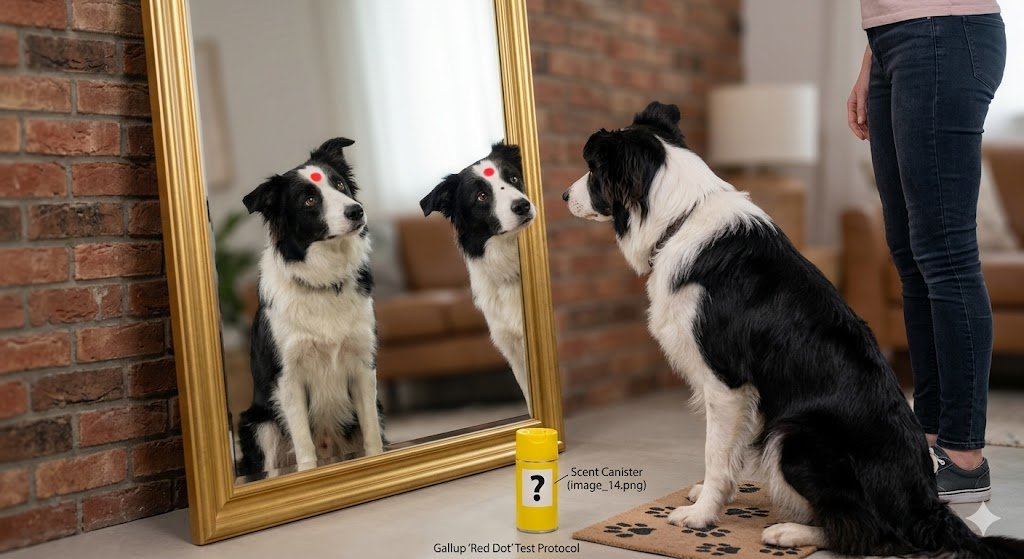
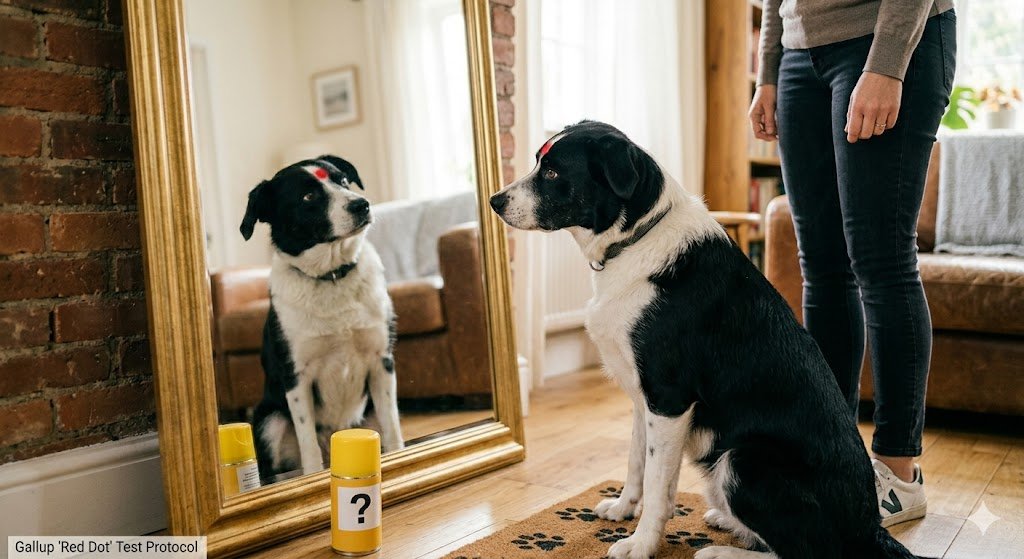
    Researchers place a small, odorless red mark (often a dot of dye) on an animal’s body—usually the forehead or ear—in a spot they cannot see without a mirror. The animal is then presented with a mirror. If they see the reflection and immediately touch or try to remove the mark on their own body, they pass. It proves they understand that the “image in the glass” is actually “me.”

    The “Hall of Fame” vs. The Canine Reaction

    Only a handful of species have consistently passed the red dot test:

    • Apes: Chimpanzees, Orangutans, and Gorillas.
    • Aquatic Mammals: Bottlenose Dolphins and Orcas.
    • Others: Eurasian Magpies and even some species of ants.

    Why Dogs Fail: When dogs look in a mirror, they generally treat the reflection as a social stimulus. They may sniff the glass, look for a “scent trail,” or bark. When they realize the “stranger” has no smell and doesn’t react like a real dog, they simply stop caring. To a dog, if it doesn’t have a scent, it isn’t “real”—and therefore, a red dot on a scentless image is irrelevant information.

    The “Yellow Snow” Study: Alexandra Horowitz’s Breakthrough

    If you wanted to test a human’s self-awareness, you’d use a mirror. If you want to test a dog’s, you have to use their nose. This was the realization of Dr. Alexandra Horowitz, a leading canine cognition researcher. She hypothesized that dogs have an “Olfactory Mirror” rather than a visual one.

    The “Scent-Mark” Experiment

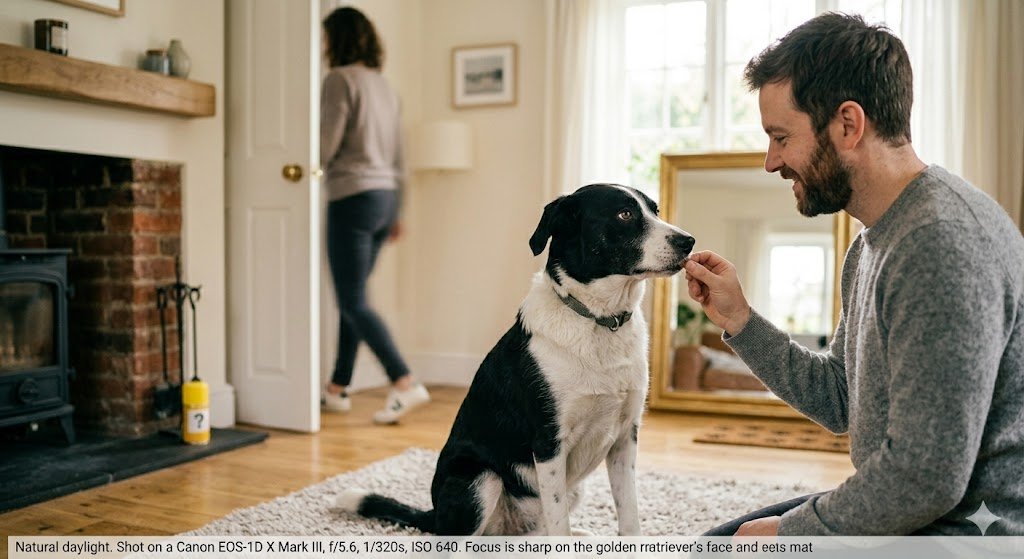
    Dr. Horowitz designed a clever variation of the red dot test using urine samples. Dogs were presented with several canisters:

    1. Their own scent.
    2. Their own scent with an “odor mark” added (a chemical change).
    3. A stranger’s scent.

    The Results

    The dogs spent significantly more time investigating the “modified” version of their own scent compared to the clean version. Just as a human would linger at a mirror if they noticed a sudden smudge on their face, the dogs recognized that their “smell-identity” had been tampered with.

    The Conclusion: Dogs have a powerful sense of “Self-Scent.” They know exactly what they are supposed to smell like, and they notice when that identity changes. They are self-aware; we were simply testing them in the wrong language.

    Body Awareness: The “Mat Test”

    Self-awareness isn’t just about identity; it’s also about understanding your physical presence in the world. In 2021, researchers at Eötvös Loránd University in Hungary conducted the “Body as an Obstacle” test to see if dogs understand their own size and weight.

    The Challenge

    A dog was asked to stand on a small mat. Attached to that mat was a toy. The trainer then commanded the dog to “give” them the toy.

    • The Catch: Because the dog was standing on the mat, they couldn’t lift the toy without moving their own body off the mat first.

    Passing with Flying Paws

    The dogs quickly realized that they were the obstacle. They understood that their physical weight was keeping the toy anchored to the ground. To complete the task, they had to step off the mat—effectively showing they recognize their body as a distinct physical entity that interacts with the environment.

    The “Proprioception” Factor: This test proved that dogs possess Proprioception—the unconscious perception of movement and spatial orientation arising from stimuli within the body itself. Even if they don’t care about their “look” in a mirror, they are intimately aware of where their body begins and ends.

    Why the Mirror is a “Liar” to a Dog

    To a human, a mirror is a source of truth. To a dog, it is a sensory paradox. The reason most dogs eventually ignore mirrors isn’t because they are “failing” a cognitive test; it’s because the mirror is failing their reliability check.

    The Multi-Sensory Conflict

    For a dog, an identity is a multi-dimensional “file” containing visual, auditory, and most importantly, olfactory data.

    • The Sight: There is a dog in front of them.
    • The Sound: Silence. No panting, no clicking of claws, no heartbeat.
    • The Smell: Glass and cleaning spray.

    Sensory Habituation

    Because the “mirror dog” provides 50% of the visual data but 0% of the “truth” (the scent), the dog’s brain eventually categorizes the reflection as background noise. They habituate to it, much like we do with the sound of a refrigerator hum. It isn’t that they don’t see it; they simply realized long ago that the “liar in the glass” isn’t worth their energy.

    Signs Your Dog is Truly “Self-Aware”

    If the mirror isn’t the right measuring stick, how do we know our dogs are self-aware? Look for these “Agency” behaviors in your daily life. They prove your dog understands themselves as an independent actor.

    Proprioception and Spatial Awareness

    Ever wonder how a large dog can navigate a coffee table full of glass coasters without knocking one over? This is Proprioception. They are aware of where their back paws are without looking at them. This physical “map” of the self is a foundational level of self-awareness.

    Social Agency

    When your dog nudges your hand to get pets or drops a ball at your feet, they are demonstrating Social Agency. They understand that their action (“The Nudge”) will result in a specific change in your behavior (“The Petting”). This requires an understanding that they are an individual who can influence the world around them.

    Resource Ownership

    A dog that distinguishes between “my toy” and “the cat’s toy” (even if they choose to steal the cat’s toy anyway) is showing a concept of self-possession. They recognize that certain objects are tethered to their own identity and needs.

    Safety First: If your dog becomes obsessed with mirrors—spinning, barking, or lunging at them for extended periods—this may be a sign of Canine Compulsive Disorder (CCD). This behavior is often triggered by stress or lack of mental stimulation. Consult a vet to discuss environmental enrichment strategies.

    7. Common Questions (FAQ)

    Do puppies react differently to mirrors than adult dogs?

    Yes. Puppies are in a critical “socialization” phase where they are learning to identify their own species. An 8-week-old puppy will almost always treat a mirror as a playmate, performing “play-bows” or trying to get behind the glass. As they mature and their olfactory (scent) system becomes their dominant way of processing reality, they eventually realize the reflection is a “scentless dud” and begin to ignore it.

    Why does my dog look at me in the mirror?

    This is a high-level cognitive skill! If your dog sees your reflection and then turns around to look at the actual you, they are using the mirror as a tool. It shows they understand the mirror’s reflective properties and are using it to track your movements or position without having to move their head.

    Can dogs recognize other dogs on TV?

    It depends on the TV. Older monitors had a “flicker rate” that looked like a strobe light to dogs. Modern 4K and high-refresh-rate screens, however, look quite realistic to them. While they can recognize the shape and movement of a dog on screen, they are often confused by the lack of scent, which is why some dogs will bark at the TV once and then walk away disappointed.

    Dr. Emily’s Final Take

    The question “Do dogs recognize themselves?” shouldn’t be answered with a simple yes or no. Instead, we should ask how they recognize themselves. Humans are visual creatures, so we use mirrors. Dogs are olfactory creatures, so they use scent.

    Just because a dog doesn’t care about a “red dot” on their forehead doesn’t mean they aren’t brilliant. It just means they aren’t vain! They possess a deep, physical, and scent-based self-awareness that is perfectly adapted to their lives as hunters and companions. At Dog Vet Expert, we believe that understanding your dog’s unique way of “seeing” themselves is the first step toward truly seeing them for the intelligent beings they are.

    🕵️ The Observational Stare

    Does your dog track your reflection in the glass? This is the same analytical curiosity that leads them to watch you in the shower. Discover the psychology behind why dogs stare when you’re most vulnerable.

    Read: Why Dogs Stare in the Shower →

    👻 Ghosts or Geometry?

    When a dog stares at a “scentless” mirror, they feel the same confusion as when they stare at a blank wall. Explore the science behind whether dogs are sensing ghosts or just detecting subtle environmental shifts.

    Learn: Can Dogs See Ghosts? →

    Reference

    Eötvös Loránd University study on canine body awareness.

  • Why Does my Dog Copy my Mood: The Mirror Effect in Dog-Human Bonds

    Why Does my Dog Copy my Mood: The Mirror Effect in Dog-Human Bonds

    The Emotional Echo (why does my dog copy my mood)

    It is a phenomenon most dog owners have witnessed firsthand: you come home after a grueling, high-pressure day at the office, and before you’ve even set down your keys, your dog’s behavior shifts. Instead of their usual high-energy greeting, they approach with a quiet, subdued intensity, leaning against your legs or resting their head on your lap. Conversely, when you are buzzing with excitement, they seem to vibrate with the same frequency.

    This isn’t a coincidence, nor is it just your dog reacting to the tone of your voice. You are witnessing a deep biological phenomenon where your dog’s internal state becomes an “echo” of your own.

    Why Your Dog “Copies” Your Mood (NLP Snapshot): Dogs mirror human emotions through a process called Emotional Contagion. This is driven by Mirror Neurons—specialized brain cells that allow an animal to “map” the actions and feelings of another onto their own nervous system. Through centuries of co-evolution, dogs have developed a unique ability to synchronize their oxytocin and cortisol levels with their owners, effectively sharing a single emotional “wavelength.”

    The Science of Mirror Neurons

    To understand how your dog “catches” your mood, we have to look at the motor and emotional centers of the canine brain. The secret lies in a neural mechanism known as the Mirror Neuron System (MNS).

    The Brain’s Reflection

    Mirror neurons are a class of cells that fire both when a dog performs an action and when they observe you performing that same action. For example, when you yawn, your dog’s mirror neurons fire as if they were yawning.

    Neural Coupling

    In the context of mood, this creates a state of Neural Coupling. When you are stressed, your body language becomes stiff and your movements become sharp. Your dog’s brain simulates these movements internally, which in turn triggers the emotional state associated with that physical tension. They aren’t just observing your stress; their brain is “rehearsing” it, leading them to feel the same unease.

    Evolution of the “Social Bridge”

    Unlike wolves, domestic dogs have evolved a heightened sensitivity to human social cues. Scientists believe this mirror effect was a survival advantage; by accurately mirroring the “leader’s” mood, the dog could stay in sync with the pack’s needs—whether that meant being alert for a hunt or remaining calm in the den.

    The Oxytocin Feedback Loop

    The mirror effect isn’t just a one-way street; it’s a biological conversation. This is most evident in what researchers call the Oxytocin Gaze Positive Loop. Oxytocin, often dubbed the “cuddle chemical” or “bonding hormone,” plays a central role in maternal bonding and romantic love—and it is equally powerful in the dog-human relationship.

    Chemical Synchrony

    A landmark 2015 study revealed that when dogs and their owners gaze into each other’s eyes, both species experience a significant surge in oxytocin. This creates a chemical “lock-on” where your sense of calm and affection is literally mirrored in your dog’s bloodstream.

    The “Pulse” of the Pack

    When you feel a rush of joy, your body releases these bonding hormones. Because dogs are hyper-attuned to the scent and micro-signals of oxytocin release, their own endocrine system follows suit. They aren’t just “acting” happy because you are; they are chemically experiencing a version of your joy. This loop is the foundation of why dogs are such effective emotional support animals—they amplify your positive states through mutual reinforcement.

    Decoding the “Stress Mirror”

    While sharing joy is the highlight of the bond, the mirror effect has a darker side: Cortisol Contagion. Just as dogs catch our calm, they are also highly susceptible to catching our chronic stress.

    Long-Term Synchronization

    A study from Linköping University in 2019 analyzed hair-cortisol concentrations (a measure of long-term stress) in both dogs and their owners. The results were staggering: the stress levels in the dogs mirrored the stress levels of their owners over several months.

    [Image showing a comparison chart of human and dog cortisol levels over time]

    The Silent Absorption

    Interestingly, the study found that the dog’s personality (whether they were shy or bold) didn’t matter as much as the owner’s personality. Owners who scored high on traits like neuroticism or chronic anxiety had dogs with significantly higher stress markers.

    • The “Sponging” Effect: Your dog acts as an emotional sponge. If you carry the weight of a high-pressure job or personal turmoil home with you, your dog’s body processes that “environmental” stress as if it were their own.
    • The Physical Toll: Over time, this mirrored stress can lead to visible changes in your dog, such as excessive shedding, pacing, or a decreased interest in play. They are physically “carrying” your bad day long after you’ve forgotten about it.

    Subtle Cues: How They “Read” the Room

    Your dog doesn’t need a mood ring to know how you’re feeling. They are biological surveillance experts, picking up on tiny, subconscious signals that even other humans might miss. This high-speed data processing allows them to mirror your mood almost instantaneously.

    Facial Micro-Expressions

    Dogs process human faces in the right hemisphere of their brain, which is the side specialized for processing emotions. They specifically look for a “left-gaze bias”—the tendency to look at the left side of a human face first (your right side), where emotions are often more visibly expressed. They can detect the slight tightening of your jaw or the softening of your brow in milliseconds.

    Auditory Sensitivity

    Your dog’s hearing is not just about volume; it’s about frequency analysis. They can distinguish between a “happy” laugh and a “stressed” laugh by the pitch and breathiness of the sound. When your voice carries the sharp, clipped tones of frustration, their brain triggers a “caution” response long before you actually say something “mean.”

    The Olfactory Link

    As mentioned in our discussion on social intuition, you literally smell like your mood. When you are anxious, your sweat glands produce a specific chemical profile. To your dog, being near an anxious person is like standing next to a loud alarm bell—the scent is so pervasive they can’t help but be affected by it.

    Breaking the Negative Mirror

    Knowing that your dog is an emotional sponge can feel like a heavy responsibility. However, the mirror effect can also be used as a powerful tool for mutual healing. If you notice your dog absorbing your stress, you can use these strategies to “reset” the energy in the room.

    The “Calm Command”

    Because the mirror works both ways, you can use your own physiology to regulate theirs. If your dog is pacing because you are stressed, sit on the floor and focus on deep, diaphragmatic breathing. As your heart rate slows and your muscles relax, your dog’s mirror neurons will begin to “rehearse” your calm state, eventually bringing their own heart rate down.

    Physical Separation (The Healthy Break)

    If you are having an intense emotional moment, it is perfectly okay to give your dog a high-value chew in another room. This gives them a “job” to focus on and physically removes them from the “stress plume” of your adrenaline, preventing them from absorbing the peak of your anxiety.

    The Power of Play

    Laughter and play are the fastest ways to flush cortisol out of both your systems. A quick five-minute game of tug doesn’t just distract the dog; it physically forces your body to release endorphins, which the dog then mirrors back to you.

    Safety First: While mood-mirroring is a sign of a healthy bond, if your dog shows extreme lethargy, loss of appetite, or sudden aggression that perfectly tracks with your own moods, they may be suffering from “Secondary Stress.” Consult a vet to ensure your emotional bond isn’t causing them chronic physiological harm.

    Common Questions (FAQ)

    Can dogs sense depression?

    Dogs are highly sensitive to changes in social patterns. While they may not understand the human concept of “depression,” they notice the behavioral withdrawal, decreased activity levels, and the shift in your scent profile. Many dogs respond with “prosocial” behaviors—increased nuzzling or staying physically closer—in an attempt to provide comfort and maintain pack cohesion.

    Why does my dog get “hyper” when I’m angry?

    This is often a displacement behavior. When you are angry or shouting, your dog experiences a massive spike in adrenaline. If they don’t have a “job” to do or a way to protect you, that energy has nowhere to go. They may start zoomies, bark, or grab a toy frantically as a way to “bleed off” the intense tension they are mirroring from you.

    Do some breeds mirror more than others?

    Generally, working and herding breeds (like Border Collies and Vizslas) tend to be higher “mirrorers” because their survival once depended on being hyper-aware of a human’s slightest command or mood shift. Independent breeds (like Afghan Hounds or some Terriers) may still feel your mood but are less likely to let it dictate their own immediate behavior.

    Dr. Emily’s Final Take

    The “Mirror Effect” is one of the most profound aspects of the human-canine bond. It proves that our dogs aren’t just living with us; they are living in our emotional world. While it can be sobering to realize our stress affects our pets, it is also an incredible gift.

    By prioritizing your own mental well-being and practicing calm, you aren’t just helping yourself—you are literally changing your dog’s biology for the better. At Dog Vet Expert, we believe the healthiest dogs are those whose owners understand that a “Shared Heartbeat” is the strongest medicine.

    🤝 The Physical Echo

    When your dog mirrors your sadness or stress, they often seek physical contact. Discover why the ‘Lean’ is a biological tool used to stabilize both your heart rate and theirs.

    Read: Why Dogs Lean on You →

    🔒 Mirroring Your Alert State

    Your dog doesn’t just mirror your calm; they mirror your suspicion. If you’re tense around a visitor, your dog will mirror that ‘alert’ state instantly. Learn how to manage the trust gap.

    Learn: Why Your Dog Trusts You but Not Visitors →

    Reference

    Scientific American or Cell Press for research on inter-species emotional transfer.

  • Can Dogs Sense “Bad” People? What Science Says About Their Social Intuition

    Can Dogs Sense “Bad” People? What Science Says About Their Social Intuition

    The “Judgmental” Best Friend

    It is a scenario that has launched a thousand “my dog is a genius” stories: you meet a new neighbor or a potential date who seems perfectly pleasant, yet your usually gregarious dog refuses to enter the room. They might hide behind your legs, let out a low, vibrational growl, or simply stare with an unblinking, suspicious intensity.

    Many owners take this as a sign of supernatural insight—as if the dog can see a “dark cloud” around a person’s character. But is your dog actually a moral psychic? According to the latest research in cognitive ethology, the answer is even more fascinating than a “sixth sense.”

    Can Dogs Sense “Bad” People? (NLP Snapshot): While dogs do not possess a moral compass that defines “good” or “evil,” they are world-class experts at Social Eavesdropping. They judge humans based on their observed helpfulness toward others and their chemical “honesty”—the alignment between a person’s outward behavior and their internal physiological state (stress, adrenaline, and cortisol levels).

    The Kyoto University Study: “Social Eavesdropping”

    One of the most compelling pieces of evidence for canine social intuition comes from Kyoto University in Japan. Researchers wanted to know if dogs could evaluate a person’s character simply by watching how that person treated others.

    The “Helpful vs. Mean” Experiment

    In the study, dogs watched their owners try to open a container. One person (the “helper”) would assist the owner, while another person (the “non-helper”) would turn away or actively refuse to help. A third person remained a neutral observer.

    The Results

    When the people offered the dogs a treat afterward, the dogs showed a clear preference for the “helper” or the neutral observer. They significantly avoided the “non-helper.”

    • The Takeaway: Dogs perform what scientists call Social Eavesdropping. They gather information about a person’s social value by watching how they interact with the pack.
    • The “Jerk” Filter: If a person is rude to you or shows social aggression, your dog isn’t “sensing a soul”—they are logically concluding that this person is a poor social partner for the pack and, therefore, a potential threat.

    The Chemical Signature of “Bad” Intentions

    While we rely on what we hear and see, a dog’s primary world is built of molecules. They don’t need to see a person act “badly” to feel uneasy; they can often smell the physiological shift that accompanies hostile or deceptive intent.

    The Scent of Adrenaline and Cortisol

    When a human is experiencing anger, fear, or predatory aggression, their endocrine system releases a cocktail of chemicals, specifically adrenaline and cortisol. These hormones have a distinct scent that is imperceptible to humans but smells like a flashing red light to a dog.

    • The “Lie” Detector: If a person is acting overly friendly but is internally feeling aggressive or tense, their chemical signature doesn’t match their body language.
    • The Vomeronasal Organ: Using their Jacobson’s organ (vomeronasal organ), dogs can “taste” these chemical shifts in the air. To your dog, a “bad” person smells like a contradiction, which triggers an immediate defensive response.

    Mirrors of Your Own Emotion

    Sometimes, your dog isn’t judging the stranger at all—they are judging your reaction to the stranger. This phenomenon is known as Emotional Contagion, and it is one of the most powerful bonds in the human-canine relationship.

    The Invisible Feedback Loop

    Dogs are hyper-attuned to the heartbeat, breathing rate, and muscle tension of their owners. If you meet someone who makes you feel subconsciously uneasy—perhaps because of a past experience or a subtle “vibe”—your body will react before your mind even processes it.

    1. Your Response: Your grip on the leash tightens slightly, your heart rate increases, and your shoulders stiffen.
    2. The Dog’s Perception: Your dog feels the tension through the leash and smells the sudden spike in your sweat.
    3. The Conclusion: The dog assumes you are afraid of the stranger. Therefore, the stranger is a threat.

    In these cases, your dog isn’t “sensing” that the person is a villain; they are loyally taking their cues from you. If the “Alpha” is worried, the dog is on guard.

    Subtle Body Language “Tells”

    In the canine world, “politeness” is defined very differently than it is in human society. Often, a person isn’t “bad,” but their body language is “rude” or “threatening” in dog-speak. Dogs are masters of reading micro-expressions—the split-second facial movements we aren’t even aware we’re making.

    Staring vs. Soft Eyes

    In the human world, direct eye contact is a sign of honesty. In the dog world, a direct, unblinking stare is a sign of active aggression. A person who “loves dogs” but stares them down while leaning over them is inadvertently acting like a predator. Your dog’s “bad vibe” about that person might simply be a response to what they perceive as a physical challenge.

    Stiff Posture and “Unpredictability”

    Dogs crave predictability. A person who is stiff, has an unusual gait, or carries a large, unfamiliar object (like an umbrella or a heavy box) can trigger a dog’s “threat detection” system. Furthermore, people who don’t like dogs often hold their breath or freeze when a dog approaches. To a dog, this stillness is suspicious—it’s what a predator does before it strikes.

    When Your Dog’s Intuition is “Wrong”

    It’s tempting to believe our dogs are infallible judges of character, but their intuition is filtered through their own past experiences and biases. A dog’s “judgment” can be clouded by Associative Learning—the brain’s way of linking a specific trait to a past trauma.

    The Bias of Past Trauma

    If a dog was once startled by a person wearing a high-visibility vest or someone with a deep, booming voice, they may react “badly” to every person who shares those traits. In these instances, the dog isn’t sensing a “bad soul”; they are having a post-traumatic response to a visual or auditory trigger.

    The Difference Between “Bad” and “New”

    Often, a dog’s negative reaction is simply a sign of under-socialization. If a dog hasn’t been exposed to a diverse range of people—different ethnicities, ages, or styles of dress—they may react with suspicion toward anyone who looks “different” from their family. This isn’t intuition; it’s a lack of exposure.

    Safety First: If your dog’s “intuition” leads to lunging, snapping, or unprovoked aggression, this is a behavioral issue that requires a professional trainer. Never rely solely on a dog’s reaction to judge a person’s character in legal or safety matters.

    Common Questions (FAQ)

    Can dogs sense a “bad” person through a window or on a screen?

    Likely not in the way we imagine. While dogs can recognize human faces on screens, they lose their most powerful tools—olfactory cues and social eavesdropping—in digital or distant interactions. If your dog barks at someone through a window, they aren’t sensing “evil”; they are responding to a territorial intrusion or a visual “trigger” like a hat, a bag, or a strange walking gait.

    Why does my dog bark at some strangers but not others?

    This usually comes down to micro-signals. One stranger might be making direct eye contact (a threat), while another is looking at their phone (neutral). Additionally, certain scents—like heavy cologne, cigarette smoke, or even the smell of another dog—can make a person “suspicious” to one dog and perfectly fine to another.

    Do certain breeds have better “people-judgment”?

    While all dogs share the same basic sensory hardware, Guardian breeds (like Rottweilers or Dobermans) are more naturally inclined to look for threats and “judge” strangers. Conversely, Social breeds (like Golden Retrievers) often have a higher threshold for “rude” body language and are more likely to give a “bad” person the benefit of the doubt in exchange for a pat.

    Dr. Emily’s Final Take

    From a clinical perspective, your dog is an incredible barometer for social honesty, but they aren’t a crystal ball. They don’t have a moral compass; they have a survival compass. When your dog “judges” someone, they are simply processing a massive amount of data—scent, sound, and movement—and comparing it to their internal database of “safe” versus “unsafe.”

    Trusting your dog’s intuition is often a wise move, not because the dog is psychic, but because they are picking up on the subtle tension or chemical shifts that your human brain might be ignoring. At Dog Vet Expert, we see the “Judgmental Best Friend” as a beautiful example of the deep evolutionary partnership between our two species. Your dog has your back—just make sure you aren’t the one unintentionally telling them to be on guard!

    🔒 The Trust Barrier

    Your dog doesn’t have a moral compass; they have a survival compass. Discover why they view you as a ‘Safe Harbor’ while treating even pleasant visitors with instant suspicion.

    Read: Why Your Dog Trusts You but Not Visitors →

    🕵️ Why the Intense Stare?

    That unblinking gaze your dog gives a stranger is the same analytical stare they use when you’re in the shower. Learn the psychology behind canine observational behavior.

    Learn: Why Dogs Stare in the Shower →

    Reference

    Journal of Neuroscience for research on how dogs process human facial expressions.