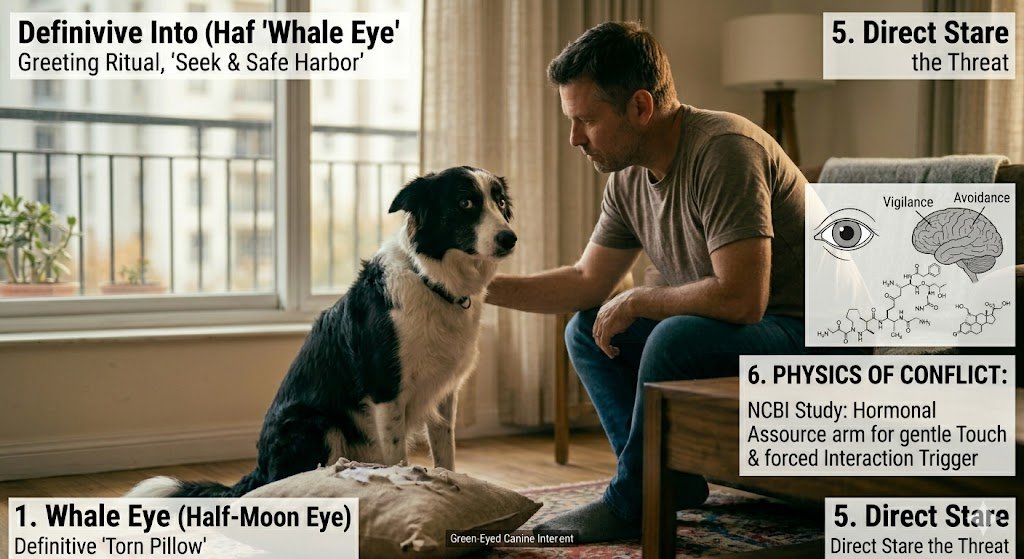
The Viral “Guilty” Look vs. The Reality of Fear (what is whale eye in dogs )
We’ve all seen the videos: a dog sits next to a shredded cushion or a half-eaten sandwich, looking sideways with the whites of their eyes bulging while their owner laughs in the background about a “guilty pup.” In our human-centric world, we label this as shame or remorse. However, in the veterinary and behavioral world, this is a critical red flag known as Whale Eye.
Whale Eye (also called Half-Moon Eye) is not a sign of a guilty conscience. Instead, it is a high-level Distance-Increasing Signal. It is your dog’s way of shouting—without making a sound—that they feel overwhelmed, threatened, or cornered. Understanding this “silent language” is the difference between a funny photo and a dangerous bite.
What is Whale Eye? (NLP Snapshot): Whale Eye occurs when a dog tenses their facial muscles and fixates their gaze on a perceived threat while simultaneously trying to turn their head away. This stretches the eyelid and exposes the white sclera of the eye in a crescent shape. It indicates that the dog has reached their Emotional Threshold and is urgently asking for space or for the current interaction to stop.
The Anatomy of the Whale Eye
To spot Whale Eye correctly, you have to look past the “cuteness” and analyze the physical mechanics of the canine face.
The Sclera Signal
In a relaxed, happy dog, the sclera (the white part of the eyeball) is almost entirely hidden by the eyelids. You should only see the colored iris and the pupil. When a dog enters a state of high anxiety, their entire body tenses, including the small muscles around the ocular socket.
The Physics of Conflict
The “white” shows because the dog is experiencing an internal conflict of interest:
- Avoidance: Their head is turning away from the source of stress (a hugging child, a camera lens, or a hovering owner) to signal they don’t want a confrontation.
- Vigilance: Their eyes remain locked on the “threat” because they are too afraid to take their eyes off it.
Secondary Markers of Stress
Whale Eye rarely travels alone. To confirm your dog is stressed and not just looking at a treat from an odd angle, check for these “Stiffness Markers”:
- Closed Mouth: A relaxed dog often has a slightly open mouth or a “long” tongue. A stressed dog will “seal” their lips tight.
- Frozen Stance: The dog’s body will feel rigid, almost like a statue.
- Brow Tension: You may see “furrowed” skin above the eyes, indicating a high level of mental strain.
Context is King: When is it Whale Eye?
Not every glimpse of white in a dog’s eye is a cause for alarm. To be a “Dog Vet Expert,” you must distinguish between a behavioral signal and a physical trait. Context and breed anatomy are the keys to accurate decoding.
The “Resource Guarder”
The most common and dangerous time to see Whale Eye is when a dog is “guarding.” If a dog is leaning over a bone, a toy, or even a specific spot on the couch, and they show the whites of their eyes as you approach, they are giving a Final Warning. They are saying, “This is mine, and I am prepared to defend it.”
The “Forced Interaction”
Many “cute” photos of children hugging dogs or owners kissing their pets feature a glaring Whale Eye. Because dogs don’t naturally hug, being physically restrained triggers a claustrophobic response. They can’t move away, so they use their eyes to express their discomfort.
Breed Exceptions: The “Natural” White
Some breeds have naturally loose skin or rounder, more protruding eyes that show the sclera even when they are perfectly happy.
- The “Bully” Breeds: Pugs, Boxers, and Bulldogs.
- Spaniels: Cocker Spaniels often have “droopy” lower lids that expose the white.
- The Movement Test: If the dog’s body is wiggly, their tail is wagging loosely, and their mouth is open, a little bit of visible white is likely just a result of their anatomy or they are simply tracking a moving toy.
The “Guilty Dog” Myth Debunked
This is perhaps the most misunderstood aspect of canine behavior. When you come home to a mess and your dog slinks away with a heavy Whale Eye, you aren’t looking at a “guilty” dog—you are looking at an Appeasing dog.
Guilt vs. Fear
Scientific studies have shown that dogs do not possess the complex social concept of “moral guilt.” They do, however, possess a master-level ability to read human body language.
- The Trigger: Your dog sees your stiff posture, hears your sharp tone, or smells the “anger pheromones” you are emitting.
- The Response: They offer Appeasement Gestures (Whale Eye, tucked tail, lip licking) to de-escalate your anger.
The Appeasement Loop
The “Guilty Look” is actually a dog’s way of saying, “I can see you are upset, and I am trying to show you that I am not a threat so you will stop being scary.” They would give this same look if you had knocked over the vase, simply because your energy is high and confrontational.
Insight for Gurgaon Owners: In high-stress, busy households, dogs may display “Guilty Looks” more often simply because they are constantly trying to manage the “vibe” of a fast-paced environment. It’s a sign that the dog needs more Safe Harbor time, not a scolding.
The “Three-Second Rule” for Photo Safety
In the age of Instagram and TikTok, we often prioritize the “perfect shot” over our pet’s comfort. Unfortunately, many viral “funny” dog videos are actually documenting a dog on the verge of a bite. To keep your household safe, you should adopt the Three-Second Rule.
The Social Media Danger
When you hold a phone up to a dog’s face, you are engaging in a “Direct Stare”—a dominant move in the canine world. If your dog responds with Whale Eye, they have reached their Emotional Threshold.
- The Warning Phase: Whale Eye is the final verbal-free warning.
- The Escalation: If the camera (the “threat”) stays in their face, the dog may feel they have no choice but to escalate to a growl, a snap, or a defensive bite.
[Infographic: The Ladder of Aggression – showing Whale Eye near the top as a critical warning]
The Photo Audit
Before hitting “post,” look at your photo. If you see the “Half-Moon” white of the eye, do not ignore it. That photo isn’t documenting a “silly face”; it’s documenting a moment where your dog didn’t feel safe. Use it as a learning tool rather than a social media post.
What to Do When You See Whale Eye
If you spot Whale Eye happening in real-time, your priority must shift immediately from whatever you were doing to De-escalation.
1. Stop the Interaction
Immediately cease the action that triggered the look. If you were hugging them, let go. If you were filming, put the phone down. If a child is near the dog, calmly and quietly move the child away.
2. Provide an Exit Route
A dog showing Whale Eye often feels cornered. Do not move toward them to “comfort” them with more pets—this can feel like a secondary attack to a stressed dog. Instead, take two steps back and turn your body sideways. This “softens” your profile and shows the dog that the “conflict” is over.
3. Create a “Safe Harbor”
Encourage your dog to go to their bed or a quiet room where they won’t be disturbed. In the busy urban environments of Gurgaon, giving a dog a “Zero-Pressure Zone” is the best way to let their cortisol levels drop back to normal.
Dr. Emily’s Rule: “Never ignore a Whale Eye. It is the canine equivalent of a yellow traffic light. If you keep driving forward, you risk an accident. In a clinical setting, we treat Whale Eye as a signal that the dog needs a ‘reset’ before any further handling can occur.”
Common Questions (FAQ)
Can a happy dog show Whale Eye?
It is extremely rare. While a dog might show some white of the eye during high-intensity play (over-arousal), it is usually accompanied by a “soft” face and an open, panting mouth. If the face is tense and the mouth is snapped shut, it is stress, not happiness. Always lean toward caution: if you see the “Half-Moon,” assume they need a break.
Why does my dog do this during “Zoomies”?
During a frantic “Zoomie” session, a dog’s eyes may appear wide, showing the whites. This is usually due to high adrenaline and physical exertion rather than fear. However, once the running stops, their eyes should quickly return to a “soft” state. If the Whale Eye persists after they stop moving, they may be feeling over-stimulated and anxious.
Is my dog “aggressive” if they show Whale Eye?
No. Whale Eye is a communicative signal, not an aggressive one. In fact, it’s a sign of a “good” communicator. The dog is trying their best to avoid a fight by giving you a clear warning. Aggression usually happens when these subtle warnings are ignored, forcing the dog to use their teeth to get their point across.
Dr. Emily’s Final Take
Learning to identify the “Half-Moon” is a superpower for any dog owner. It allows you to protect your dog from uncomfortable situations before they feel the need to protect themselves. In our quest for the “perfect photo” or the “cutest video,” we often forget that our dogs are constantly speaking to us in a silent, physical language.
At Dog Vet Expert, we believe the most beautiful photos aren’t the ones that look “funny” at the dog’s expense, but the ones where the dog’s eyes are soft, their ears are relaxed, and their spirit is at ease. When you respect the Whale Eye, you aren’t just preventing a bite—you are building a foundation of radical trust.
🦴 Jealousy or Protection?
Whale eye is the primary warning signal for resource guarding. But is your dog being protective, or are they experiencing canine jealousy? Understanding the difference is key to a safe home.
Read: Do Dogs Feel Jealousy? →😤 The “Huff” and the “Stare”
Just like the Whale Eye is a silent visual warning, a “huff” is a quiet vocal signal of irritation. Learn how to decode these low-arousal signs of discomfort.
Discover: Why Dogs “Huff” at You →Reference
we reference behavioral research into canine facial expressions. This study proves that “sclera eye” (Whale Eye) is a reliable indicator of negative emotional states and conflict in domestic dogs.
- Study Title: Dog facial expressions: a multi-modal study of emotional states
- Source: National Center for Biotechnology Information (NCBI) / Behavioural Processes.
- Key Finding: The research identifies that increased visibility of the sclera is a primary marker of “low-positive” or “negative” arousal. It confirms that Whale Eye is part of an avoidance-vigilance conflict where the dog is physically averting but visually tracking a threat.
- Direct Link: https://www.ncbi.nlm.nih.gov/pmc/articles/PMC7323385/