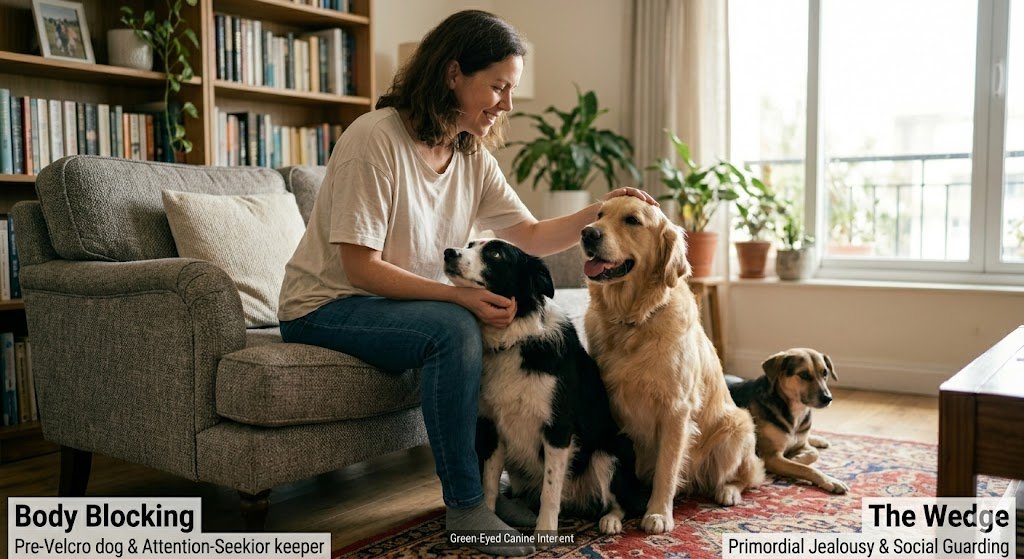
The “Green-Eyed” Canine (do dogs feel jealousy )
You’re at the park, and a friendly Golden Retriever wanders over. You lean down to give it a quick ear scratch, and suddenly, your own dog is there. They wedge themselves between your legs, paw at your hand, or let out a low, vibrating grumble.
We often joke that our dogs are “jealous,” but for decades, the scientific community dismissed this as anthropomorphism—the act of projecting human emotions onto animals. However, new research in canine cognition suggests that what we’re seeing isn’t just our imagination. It is a primitive, powerful emotional response designed to protect the most important relationship in a dog’s life.
Do Dogs Feel Jealousy? (NLP Snapshot): Yes, dogs experience a form of primordial jealousy. Unlike human envy (wanting what someone else has), canine jealousy is a socially motivated guard response. It is triggered when a “social rival” threatens the dog’s exclusive access to their primary attachment figure. This behavior is an evolutionary survival mechanism intended to secure their place in the pack and maintain their “Safe Harbor.”
The UCSD “Fake Dog” Study: The Proof in the Science
The turning point for the “jealousy debate” came from a landmark study at the University of California, San Diego (UCSD). Researchers wanted to know if dogs were truly jealous of a rival or if they were simply frustrated that their owner was distracted.
The Experiment
Owners were asked to ignore their dogs while interacting with three different objects:
- A realistic, animatronic toy dog (that barked and wagged its tail).
- A plastic jack-o’-lantern bucket.
- A pop-up book.
The Results
The reaction was overwhelming. 86% of the dogs exhibited jealous behaviors when the owner petted the “fake dog.” These behaviors included snapping at the toy, pushing the owner away, and wedging themselves between the owner and the rival.
Crucially, the dogs were significantly less concerned when the owner “petted” the bucket or read the book. This proved that the behavior wasn’t just about seeking attention; it was specifically triggered by the presence of a social rival. To the dog’s brain, the fake dog was a threat to their “VIP” status, proving that the emotional hardware for jealousy is hardwired into the canine mind.
Primordial Jealousy vs. Human Envy
To understand your dog, we have to strip away the human complexity of “envy.” In humans, envy is often about wanting what someone else has (like a bigger house or a promotion). Canine jealousy is Primordial—it is a “building block” emotion that doesn’t require complex thought about self-esteem or fairness.
The “Security File” Logic
Humans feel complex jealousy (“Does this mean my partner is leaving me?”). Dogs feel Functional Jealousy. In their minds, you are a “resource” that provides safety, food, and emotional stability.+2
- Human Envy: “I wish I had that toy.”
- Dog Jealousy: “That rival is stealing my security provider. I must break up this interaction to protect my status.”
Survival of the Bond
In a pack environment, being the “favorite” isn’t just about cuddles; it’s about survival. The dog closest to the leader gets the best food and the most protection. When you pet another dog, your dog’s brain triggers a motive to regain your attention and block the “usurper” before they lose their priority status in your “Inner Circle.”
How Dogs Show Jealousy (The “Red Flags”)
Jealousy in dogs isn’t always a dramatic growl. It often manifests as subtle “nuisance” behaviors that owners mistake for being “cute” or “clingy.”
The “Wedge” and the “Block”
The most common sign is the Physical Intervention. If you are talking to another person or petting another animal, your dog will physically push their body between you and the rival. By “wedging” themselves in, they are literally breaking the social connection and forcing you to acknowledge them instead.
Strategic Attention-Seeking
If wedging doesn’t work, a jealous dog will cycle through their “best hits” to grab your focus:
- The “Nuzzle-Intervention”: Forcefully poking your hand with their nose or pawing at your arm.
- Performing Unprompted Tricks: Suddenly sitting, shaking, or rolling over without a command—this is a “look at me, I’m a good dog” move to reclaim the spotlight.
- The “Sad” Withdrawal: Some dogs won’t fight for attention; they will sulk or leave the room entirely. This avoidance behavior is a sign of high social stress.
The Aggression Threshold
In more intense cases, jealousy turns into Resource Guarding of the Human. This includes:
- Lip curling or low growling when the other dog approaches you.
- Snapping at the air near the rival’s face.
- “Body Guarding”: Hovering over you or sitting on your feet to “claim” you as theirs.
Is it Love or Resource Guarding?
From a human perspective, we want to believe our dogs are “protecting their love” for us. However, from a veterinary and behavioral standpoint, this behavior is a specific form of Resource Guarding.
You as the “High-Value Resource”
In the canine world, a “resource” is anything that contributes to survival or well-being—food, toys, a prime sleeping spot, and social affection. Because you are the source of all good things (the “Safe Harbor”), your attention is the highest-value resource in the house. When you pet another dog, you are “spending” that resource on someone else.
Oxytocin Competition
When you interact with your dog, both of your brains release Oxytocin. This creates a biological “high” that reduces stress. When your dog sees you giving that same interaction to a rival, they experience a drop in these feel-good chemicals and a spike in Cortisol (the stress hormone). To your dog, jealousy isn’t an “attitude”—it’s a physiological drive to get their “bonding fix” back.
How to Manage the “Jealous” Dog
The goal isn’t to punish the jealousy, but to transform the dog’s mindset from “This rival is stealing my person” to “When this other dog is around, good things happen to me too.”
Equalizing the Reward
This is the most effective way to break the jealousy cycle.
- The Strategy: When you pet another dog, use your other hand to toss a treat to your dog.
- The Result: Your dog begins to associate the presence of the “rival” with receiving high-value rewards. This is called Counter-Conditioning. You are rewriting their emotional response from fear/anger to anticipation/pleasure.
The “Sit-Stay” Anchor
If your dog tries to “wedge” between you and another pet, do not pet them. If you pet a dog that is pushing in, you are rewarding the pushy behavior.
- Ask your dog to “Sit” or “Go to Place.”
- Reward them only when they are calm and waiting their turn.
- This builds Impulse Control, teaching them that they get your attention by being patient, not by being pushy.
The “Parallel Play” Technique
If you have two dogs in the house, engage them in activities that require them to focus on a task rather than on you. Using “sniff mats” or separate puzzle toys in the same room helps them coexist in a high-dopamine state without competing for your physical touch.
Safety First: If your dog’s jealousy escalates into “Resource Guarding” aggression where they bite, snap, or attack other animals when you are present, this is a dangerous behavioral threshold. This is no longer “cute” jealousy; it is a liability. Keep the dogs separated and consult a certified veterinary behaviorist immediately.
Common Questions (FAQ)
Do dogs get jealous of new babies?
Technically, yes, but it is more about a disruption of resources. For years, the dog has been the center of your “Inner Circle.” When a baby arrives, the dog’s access to your time, touch, and even their sleep schedule is suddenly restricted. They aren’t “mad” at the baby; they are stressed by the loss of their predictable “Safe Harbor.” Gradual introduction and maintaining a “special time” for the dog can help mitigate this.
Can dogs feel jealous of a phone or laptop?
Recent behavioral studies suggest they can! While your phone isn’t a “social rival” in the biological sense, dogs are masters at tracking where your visual attention goes. If you are staring at a screen for hours instead of engaging with them, they may perceive the device as a barrier to their primary resource. This often leads to “pawing” at the phone or wedging their head between you and the screen.
Is jealousy more common in specific breeds?
While any dog can feel jealous, high-drive and “velcro” breeds—such as Border Collies, Australian Shepherds, and certain Terriers—tend to show more intense guarding behaviors. These breeds are biologically wired to work closely with a human partner, making them more sensitive to any perceived “threat” to that exclusive bond.
Dr. Emily’s Final Take
Jealousy is one of the most visible proofs of the deep emotional intelligence of dogs. It’s a testament to the strength of your bond; your dog values you so much that they are willing to “guard” you against the rest of the world.
However, at Dog Vet Expert, we emphasize that a secure dog is a happy dog. While a little bit of “attention-seeking” is harmless, you want to ensure your dog feels confident enough to know that your love isn’t a finite resource that can be “stolen” by another pet. By using Consistency and Equalizing the Reward, you can transform a competitive household into a harmonious pack. Your heart is big enough for more than one dog—you just have to teach your dog how to share the “Safe Harbor.”
⚠️ Jealousy or Fear?
When a social rival pushes your dog to their emotional threshold, they often display “Whale Eye” (the whites of the eyes). Discover why this is a critical warning sign that your dog needs space.
Read: Understanding Whale Eye →🐾 The “Look at Me” Tap
Does your dog paw at you the moment you pet another animal? This is a deliberate tactile solicitation designed to reclaim your attention from a social rival.
Learn: Why Dogs Tap You With Their Paw →Reference
Study Title: Jealousy in Dogs
Authors: Christine R. Harris and Caroline Prouvost
Journal: PLOS ONE
Direct Link: https://journals.plos.org/plosone/article?id=10.1371/journal.pone.0094597