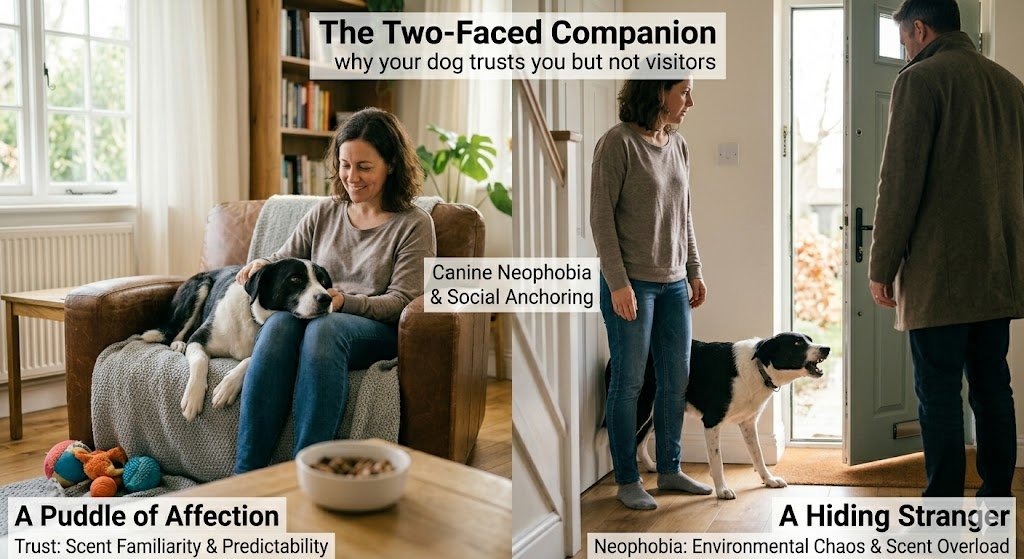
The Two-Faced Companion
It is a common source of embarrassment and confusion for dog owners: at home with just the family, your dog is a “puddle of affection”—relaxed, obedient, and constantly seeking cuddles. But the moment the doorbell rings and a visitor steps inside, that same dog transforms into a stiff, growling, or hiding stranger.
Why is it that your dog can’t see your best friend or your relative the way you do? It isn’t that your dog is “mean” or “unfriendly”; it’s that a dog’s trust is not a blanket emotion. It is highly specific and deeply rooted in their need for environmental control.
Why Your Dog Trusts You But Not Visitors (NLP Snapshot): A dog’s trust is context-dependent. Your dog trusts you because of Predictability and Scent Familiarity. You are a “known variable.” Visitors, however, represent “Environmental Chaos.” They bring unpredictable scents, unfamiliar vocal pitches, and physical movements that trigger a dog’s natural Neophobia (fear of the new) or an instinctive drive to protect the “Safe Harbor” of the home.
The “Safe Harbor” Concept
To understand why your dog is suspicious of guests, you first have to understand the role you play in their biological world. In a dog’s mind, you are the Primary Attachment Figure.
You are the Source of Safety
Because you provide food, shelter, and consistent positive reinforcement, your presence acts as a “biological anchor.” When you are alone with your dog, their cortisol (stress hormone) levels stay low because the environment is predictable. Your scent is the “all-clear” signal that tells their brain they are in a Safe Harbor.
The Intruder Alert
When a visitor enters, they “pollute” this safe environment. To a dog, a guest isn’t just a person; they are a walking collection of foreign pheromones and unpredictable energy.
- Olfactory Overload: A guest carries the scent of other environments, animals, and chemicals that your dog’s “security system” hasn’t authorized.
- The Broken Routine: Dogs thrive on patterns. A visitor breaks the pattern of the home, which moves the dog from a state of “Rest and Digest” into a state of “Hyper-Vigilance.” By entering the home, the guest has essentially “invaded” the dog’s most sacred space, forcing the dog to decide if this new variable is a friend or a threat to the pack’s stability.
Canine Neophobia: The Evolutionary Guard
To understand your dog’s suspicion, we have to look back at their ancestors. In the wild, “new” almost always meant “dangerous.” This survival instinct is known as Neophobia—a natural cautiousness or fear toward unfamiliar people, animals, or objects.
The Survival Instinct
A dog that immediately trusts a stranger is a dog that, in a wild setting, might not survive a territorial dispute. Your dog’s hesitation is actually their brain performing a high-speed Risk Assessment. They are checking the guest’s posture, scent, and intent before lowering their guard.
The Socialization Gap
Most of a dog’s “Trust Directory” is written during the critical socialization window (between 8 and 16 weeks of age).
- The “Inner Circle”: If a puppy isn’t exposed to a wide variety of people (different heights, voices, ethnicities, and outfits) during this time, their “Inner Circle” stays very small.
- The Stranger Danger: To an under-socialized dog, any human who doesn’t look or smell exactly like “their people” is categorized as a potential threat.
Why Visitors Are “Scary”
One of the biggest reasons your dog trusts you but not your guests is Human Body Language. Humans have a habit of greeting dogs in ways that, in canine language, are incredibly rude or even aggressive.
The “Looming” Effect
When a guest sees a cute dog, their first instinct is often to lean over them and pat the top of their head. To a dog, a large silhouette leaning over them is a Dominant/Threatening Gesture. You can do it because you are a “Safe Variable,” but a stranger doing it triggers a “Fight or Flight” response.
The Stare-Down
In the human world, eye contact is polite. In the dog world, prolonged direct eye contact is a challenge or a threat. Well-meaning guests often stare at the dog, waiting for them to come closer, which the dog perceives as a “stand-off.”
Unpredictable Scent Profiles
Your guest isn’t just one person; they are a walking library of scents. They carry the smell of their own pets, their car, and their environment. If your guest has a cat at home, your dog might perceive that scent as a Territorial Intrusion, making them defensive before the guest even speaks.
The “Protective” Fallacy: Resource Guarding “You”
It is a common mistake to assume a dog is being “protective” because they love you. While loyalty is real, the behavior you see when a visitor approaches is often a form of Resource Guarding. In this context, you are the resource.
You Are the Ultimate Prize
Because you provide everything—food, comfort, and emotional stability—you are the most valuable “object” in your dog’s world. When a stranger enters and tries to interact with you, your dog may feel their access to their “Safe Harbor” is being threatened.
- Body Blocking: Does your dog wedge themselves between you and your guest?
- Nudging: Do they try to push the guest’s hand away from you? This isn’t necessarily a “heroic” act; it is often an anxiety-driven attempt to maintain exclusive access to their primary security provider.
Territorial Mapping
To a dog, the home is a fixed, safe territory. They have mapped every corner and every scent. A visitor is an “unauthorized entry” into this map. If the dog doesn’t feel the guest has been “vetted” by the pack leader (you) in a way they understand, they remain in a state of High-Alert.
Steps to Bridge the Trust Gap
You cannot “force” trust, but you can create a controlled environment where a dog feels safe enough to lower their guard. The goal is to move the guest from the “Threat” category to the “Neutral/Positive” category.
The “No Touch, No Talk, No Eye Contact” Rule
The best thing a guest can do for a suspicious dog is to ignore them. By pretending the dog doesn’t exist, the guest removes the “threat” of a social confrontation. This allows the dog to sniff the guest’s shoes and hem of their pants (their “data gathering” phase) without the pressure of being touched.
Treat Tossing
Never have a guest hand-feed a fearful dog. This creates a “Conflict of Interest”: the dog wants the food but fears the hand. Instead, have the guest toss treats behind the dog.
- The Logic: This rewards the dog for being in the room but encourages them to move away from the guest to get the treat, lowering their overall pressure.
The Designated “Safe Zone”
Always provide a “Place” (a crate, a specific rug, or a separate room) where the dog knows they are 100% safe from guest interaction. If the dog feels they have an “escape hatch,” they are much less likely to feel the need to growl or snap to create space.
Safety First: If your dog shows signs of lunging, snapping, or extreme “fear-aggression” toward guests, do not attempt to “force” a meeting. This is a deep-seated behavioral issue. Consult a professional behaviorist to implement a controlled desensitization plan to ensure the safety of your visitors and your dog.
Common Questions (FAQ)
Why is my dog okay with women but not men?
This is a very common observation. It usually boils down to two factors: stature and frequency. Men tend to be taller and have broader shoulders, which can be perceived as “looming.” Furthermore, lower-frequency male voices can mimic the low-pitch growls dogs use to signal a threat. If a dog wasn’t socialized with a variety of men during puppyhood, these physical traits can trigger a defensive response.
Can a dog “sense” a bad person?
While we love the idea of a dog having a “moral compass,” science suggests they are actually sensing micro-tensions. When you are uncomfortable around a visitor, your body releases subtle pheromones and your muscles tense. Your dog, being a biological mirror, picks up on your “alert” state and assumes the visitor is the cause of the danger.
Should I let my guest give my dog a treat immediately?
Actually, no. Hand-feeding a fearful dog creates a “Motivation Conflict.” The dog wants the treat but fears the hand. This can lead to a “snap” once the treat is gone and the dog realizes how close the stranger’s hand is. It is much better to have the guest toss treats onto the floor, allowing the dog to move toward the “reward” on their own terms.
Dr. Emily’s Final Take
We often feel social pressure to have a “friendly” dog that greets everyone with a wagging tail. However, as a veterinarian, I want you to remember that respecting your dog’s “Inner Circle” is a sign of good leadership. Not every dog is a social butterfly, and that is okay. Your dog trusts you because you are predictable and safe. When you protect their boundaries from well-meaning but “pushy” visitors, you actually strengthen the bond between you. At Dog Vet Expert, we believe the goal isn’t to force your dog to love everyone—it’s to make them feel safe enough to be indifferent.
🕵️ Intuition or Instinct?
Is your dog actually sensing a “bad” person, or are they just reading your own micro-tensions? Discover the science behind how dogs evaluate the character of a visitor.
Read: Can Dogs Sense Bad People? →⭐ The Chosen One
Your dog trusts you above all others because you have passed the ultimate test. Learn the specific criteria dogs use to ‘choose’ their favorite person in a household.
Learn: How Dogs Choose Their Favorite Person →Clinical & Behavioral Authorities (Expertise)
Use these to back up the biological claims about cortisol and stress responses.
- American College of Veterinary Behaviorists (ACVB): dacvb.org – The gold standard for clinical animal behavior.
- Journal of Veterinary Behavior: journalvetbehavior.com – Perfect for citing studies on canine stress in domestic environments.