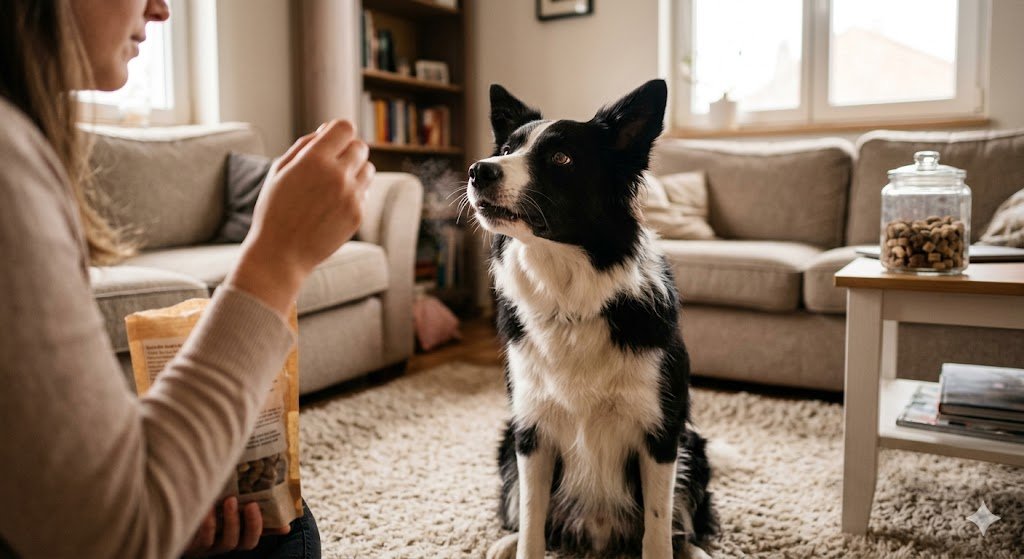
The “Punctuation” of Canine Speech
Why does my dog huff at me- You’ve just told your dog they can’t have a second treat, or perhaps you’ve informed them that the walk is over. In response, they drop their head and let out a heavy, dramatic exhale that sounds suspiciously like a teenager being told to clean their room.
While it’s easy to label this as “sass,” in the world of canine communication, it’s much more than an attitude problem. These exhales—the short, sharp huff and the long, flowing sigh—serve as the “punctuation marks” of dog language. They aren’t just air moving through a snout; they are sophisticated signals that help your dog manage their own internal emotions and communicate their social state to you.
The “Huff and Sigh” Meaning (NLP Snapshot): A dog’s huff or sigh is a vocal transition signal used to bridge the gap between two emotional states. A “huff” is an active expression of thwarted desire or mild frustration, often used when a dog is still hoping for a specific outcome. A “sigh” represents physiological decompression or emotional closure, signaling that the dog has accepted the situation and is “resetting” their nervous system.
The Anatomy of a “Huff” (Active Frustration)
If your dog lets out a “huff” when you say “No,” they are essentially giving you a piece of their mind without breaking the rules of the house. From an ethological perspective, a huff is often considered a “micro-bark.”
The Suppressed Protest
In the ancestral pack, a full bark was a high-energy alert. In a domestic setting, many dogs learn that barking at their owners is “impolite” or results in a negative correction. The huff is the compromise. It is a sharp, breathy sound that carries the rhythmic intent of a bark but without the vocal cord engagement.
The Context of “No”
When you deny a request, the huff is an expression of thwarted drive. The dog still wants the ball, the food, or the attention, and the huff is their way of acknowledging the boundary while still physically vibrating with the energy of “wanting.” It is the sound of a dog who is active, alert, and mildly exasperated.
Identifying the Body Language
A huff is rarely a solo act. When your dog huffs at you, you will typically notice:
- Forward-facing ears: Signaling that their attention is still locked on the goal.
- Intense eye contact: They are checking to see if their “protest breath” will make you reconsider.
- Tense facial muscles: Particularly around the muzzle, where the air is being forced out.
Understanding the huff is the first step in recognizing that your dog is trying to regulate their own frustration. They aren’t being “bad”—they are simply “venting.”
The Deep “Sigh” (The Great Reset)
If the huff is the sound of an argument, the sigh is the sound of a surrender. When a dog lets out a long, heavy sigh after being told “No,” they are undergoing a process known as physiological decompression. This is a critical transition in canine psychology where the dog moves from a state of “high arousal” to “low arousal.”
The Emotional Finish Line
Unlike the huff, which signals that the dog is still hoping for a change of heart, the sigh indicates that the dog has accepted the outcome. It is the “Great Reset” of their nervous system. By forcing a large volume of air out of their lungs, the dog physically relaxes their ribcage and diaphragm, which sends a signal to the brain to lower the heart rate.
Eye Position: The Key to Interpretation
To truly decode a sigh, you must look at your dog’s eyes. In ethology, the state of the eyes during an exhale tells you the “flavor” of the emotion:
- Sigh with Half-Closed Eyes: This is a sign of true contentment and trust. The dog has accepted that “playtime is over” and is now ready to nap.
- Sigh with Wide Open Eyes: This is often a sign of disappointment or “resigned boredom.” The dog has accepted the “No,” but they aren’t necessarily happy about it. They are still monitoring the room for a better opportunity.
Decoding the Sound: A Comparative Table (Why does my dog huff at me )
To help you distinguish between these two vocalizations at a glance, use this comparative guide. This helps owners move past anthropomorphism (giving dogs human traits) and into true behavioral analysis.
| Sound Feature | The “Huff” (Active) | The “Sigh” (Passive) |
|---|---|---|
| Duration | Short, sharp, and burst-like. | Long, slow, and flowing. |
| Goal | To protest or request a change. | To settle or end an interaction. |
| Nervous System | Sympathetic (Fight/Flight/Fidget). | Parasympathetic (Rest/Digest). |
| Muzzle Shape | Often “pursed” or tense. | Completely relaxed/floppy. |
| The Meaning | “I’m still waiting for that treat!” | “Fine, I guess I’ll just sleep then.” |
Export to Sheets
The “Huff-Whimper” Hybrid
Occasionally, you may hear a huff that bleeds into a tiny whimper. This is a high-intensity signal of conflict. The dog is struggling between their desire to obey your “No” and their intense drive to get what they want. If you hear this, it is often a sign that your dog needs a “redirection” game (like a snuffle mat) to help them transition into a calmer state.
Why Humans Misinterpret the “Drama”
It is incredibly common for owners to describe their dog as “sassy” or “dramatic” when they huff or sigh. This is a classic example of anthropomorphism—attributing human personality traits like defiance or sarcasm to our pets. While it certainly feels like your dog is giving you “attitude,” the truth is much more positive.
A Sign of Emotional Regulation
When your dog huffs or sighs in response to a “No,” they are actually practicing emotional regulation. Instead of escalating into barking, jumping, or destructive behavior to get what they want, they are using their breath to process their feelings. It is the canine equivalent of a human taking a “stress breath” before moving on with their day.
The Bond Indicator
In the world of ethology, a dog that huffs or sighs at you is showing a high level of social trust. It means they feel safe enough in your presence to express their internal state without fear of a harsh correction. This “dialogue” is a sign of a high-functioning social bond; your dog knows you are the pack leader, but they also know they have a “voice” in the household.
Behavior vs. Health: When it’s Not Communication
As a dog parent, it is vital to distinguish between a “psychological” huff and a “physiological” breathing issue. While most huffs are behavioral, certain respiratory sounds can mimic communication but actually require medical attention.
Respiratory Alerts
If the exhaling sound is frequent, occurs without a social trigger (like you saying “No”), or sounds “wet” or “labored,” it may not be a sigh.
- Reverse Sneezing: A common, non-emergency sound that can be mistaken for a frustrated huff.
- Brachycephalic Challenges: Breeds with flat faces (like Pugs or French Bulldogs) often make huffing sounds simply because of their airway structure.
Safety First: If your dog’s huffing is accompanied by coughing, wheezing, or a blueish tint to the gums, please consult a local professional veterinarian immediately, as this may indicate a respiratory or cardiac issue rather than a behavioral signal.
The Difference in Effort
A behavioral sigh is effortless. The dog’s body slumps and the air flows out naturally. If you notice your dog’s chest or stomach muscles working hard to push the air out (abdominal breathing), this is a medical red flag, not a “sassy” sigh. Always observe the context: if they sigh because you stopped petting them, it’s likely psychological. If they sigh while resting and seem to struggle, call the vet.
Common Questions (FAQ)
Why does my dog huff at me when I’m on the phone?
This is a classic “demand signal.” Your dog perceives that your attention—a high-value resource—has shifted away from them and toward a plastic device. The huff is a low-stakes way of saying, “I’m still here, and I’m bored.” It is an attempt to initiate an interaction without the “rudeness” of a bark.
Do dogs sigh when they are sad?
Dogs don’t experience “sadness” with the same narrative complexity as humans (they don’t dwell on the past or worry about the future). However, they do experience disappointment. A sigh after a “No” is a physiological relief of that disappointment. They aren’t depressed; they are simply processing the fact that their immediate goal wasn’t met.
Why does my dog huff right before we go for a walk?
This is known as anticipatory excitement. In this context, the huff isn’t about frustration; it’s about “contained energy.” Your dog is so excited that they are literally bursting with air, and the huff is a way to vent some of that pressure so they can stay (relatively) calm while you put on their leash.
My dog sighs and then stares at me. What does that mean?
If a sigh is followed by an intense stare, your dog is in a “negotiation phase.” They have physically reset their body, but they are still mentally checking to see if your “No” is final. If you remain consistent, they will eventually look away or go to sleep.
Dr. Emily’s Final Take
From a veterinary and behavioral standpoint, learning to “hear” the difference between a huff and a sigh is like gaining a secret window into your dog’s emotional health. These vocalizations are proof of your dog’s cognitive complexity—they show that your pet is capable of processing disappointment and choosing a peaceful “exhale” over a disruptive “outburst.”
When you acknowledge these sounds as communication rather than “sass,” you strengthen the trust between you. By giving your dog the space to “vent” their frustration, you are fostering a more confident, emotionally stable companion. At Dog Vet Expert, we encourage you to listen closely; sometimes, the most important things your dog has to say are said without a single bark.
🐾 The Proximity Seeker
Does your dog follow a frustrated ‘huff’ with a gentle paw tap? Both are tactical ways dogs ask for attention without breaking the ‘no barking’ rules of the house. Learn the science behind the tap.
Read: Why Dogs Tap You With Their Paw →🦷 The Social Nibble
Huffing is a ‘breath’ protest, but mouthing is a ‘tactile’ protest. Discover why dogs use a soft, toothless hold to communicate frustration or a deep-seated need for connection.
Learn: Why Dogs Mouth Your Hand →Reference
Reference the American College of Veterinary Behaviorists for further reading on canine vocal signals.