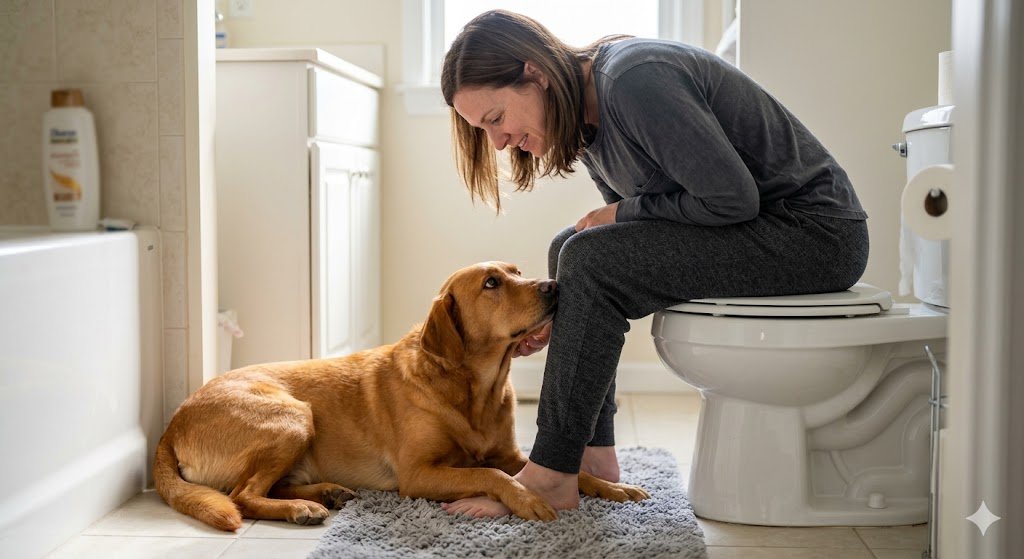
The Bathroom Bodyguard (Why does my dog follow me to the bathroom )
It is a universal experience for dog owners: you retreat to the bathroom for a few moments of privacy, only to find a wet nose nudging the door open or a pair of paws sliding under the gap. If you manage to close the door fully, you might hear a worried whine or the steady “thump” of a body leaning against the wood. If you leave it ajar, your dog likely sits with their back to you, staring intensely at the hallway.
While we joke about having a “stage-five clinger,” this behavior isn’t actually about a lack of boundaries. In the canine world, your bathroom time isn’t a private break—it’s a high-stakes security event.
The “Bathroom Sentry” Explained: Dogs guard the bathroom door due to Social Vulnerability Theory. In a pack structure, animals are at their most defenseless against predators while relieving themselves. By following you into the bathroom or standing watch at the door, your dog is acting as a sentinel, protecting a “pack member” during what they instinctively perceive as a moment of extreme physical risk.
The “Toilet Vulnerability” Instinct
To understand why your dog feels the need to be your bodyguard, we have to look at the survival mechanics of wild canids. Whether it’s a wolf in the tundra or a fox in the woods, the act of “going to the bathroom” is a dangerous necessity.
Ancestral Safety and the “Crouch”
In the wild, a dog in a squatting or “crouch” position is physically compromised. They cannot easily fight back, their field of vision is often lowered, and they cannot immediate bolt at full speed. This makes them an easy target for ambush predators. To counter this risk, pack members often take turns acting as lookouts for one another.
The Sentinel Role
When you enter the bathroom, your dog’s ancient hardwiring kicks in. They see you entering a small, enclosed space and preparing to be “vulnerable.” Their instinctual response is to provide 360-degree security.
- Facing the Door: Notice that many dogs don’t actually look at you; they look away from you toward the entrance. They are monitoring the “line of approach” to ensure no “predators” (or the vacuum cleaner) can surprise you.
- Physical Contact: If they lean against your legs, they are providing tactile reassurance, letting you know the “sentry” is on duty so you can finish your business in peace.
The “Den” Logic
In a domestic home, the bathroom is often perceived as a small, intimate “sub-den.” Because you are stationary, the dog views this as a prime opportunity for social grooming and bonding. They aren’t just protecting you; they are reinforcing the pack bond through shared presence in a safe, enclosed space.
The “Velcro Dog” vs. The Guardian
It is important to distinguish whether your dog is following you out of a sense of duty or a sense of panic. While the behaviors look similar, the underlying psychological state is very different. Understanding this distinction helps you determine if your dog is a “loyal protector” or a “worried dependent.”
Attachment Theory: Protection or Anxiety?
- The Guardian (Sentinel): A dog acting as a protector is usually calm. They might lie across the doorway or sit facing the hall. Their ears are alert, but their body isn’t trembling. They are there because they want to watch your back.
- The Velcro Dog (Anxiety): If your dog is scratching frantically at the door, whining, or showing signs of distress the moment the latch clicks, this is likely Separation Anxiety. In this case, the closed door represents a loss of their “Security Base,” triggering a fear response rather than a protective one.
The “Closed Door” Barrier
To a dog, a closed door is a sensory “blackout.” They cannot see the threat, and more importantly, they cannot see you. If they can’t verify your safety, their instinctual alarm bells go off. By keeping the door ajar, you “close the loop” on their vulnerability theory, allowing them to fulfill their role as a lookout without the stress of being separated from the pack.
Sensory Overload: Why the Bathroom?
Beyond the survival instinct, the bathroom is a uniquely fascinating place for a dog’s primary sense: their nose. While we see a room for hygiene, they see a high-density information center.
The Scent Profile and Pack Bonding
Bathrooms are concentrated scent hubs. Steam from a shower or the humidity of the room carries your unique pheromones and scent molecules more effectively than dry air. For a dog, being in the bathroom with you is an intimate “Scent-Sharing” experience. By sitting in your “aroma” while you are stationary, they are reinforcing their chemical bond with you.
The “Captured” Audience
Your dog is a master of opportunity. They know that when you are in the bathroom, you aren’t moving, you aren’t on your laptop (usually), and you aren’t distracted by chores. You are a “captured audience.” Many dogs take advantage of this “low-activity” zone to demand “check-in” pets or to perform “allogrooming” (social licking), knowing they have your undivided attention.
Plumbing and Curiosity
The sound of running water, the gurgle of pipes, and the flushing of a toilet are all significant acoustic events. For some dogs, the bathroom is a place of curiosity where “magic water” appears and disappears. They may “guard” the door simply because they want to monitor the source of these strange, loud noises to ensure they aren’t a threat to the den.
Breed-Specific Sentries
While all dogs have a pack instinct, some breeds are biologically “pre-wired” to take their bathroom duty more seriously than others. If you own a dog from a working or herding lineage, you aren’t just looking at a pet—you’re looking at a professional security guard.
The “Velcro” Herders
Breeds like German Shepherds, Border Collies, and Australian Shepherds were bred to keep a close eye on their “flock.” To these dogs, you are the sheep that keeps wandering into a small, dangerous room. They follow you to ensure the “herd” stays together and no one gets lost in the plumbing.
The Livestock Guardians
Breeds such as Great Pyrenees or Mastiffs have a “perimeter” mindset. They don’t necessarily need to be touching you; instead, they will often lie down exactly halfway between you and the nearest exit. They are marking a boundary, signaling to the rest of the house that the “inner sanctum” is currently occupied and protected.
Setting Boundaries Without Breaking Trust
It is a compliment that your dog wants to protect you, but it can become a logistical nightmare—especially if you have a small bathroom or a dog that scratches at the door. You can honor their instinct while reclaiming your personal space.
Create a “Guard Post”
Instead of letting your dog crowd your feet, give them a “job” that keeps them out of the splash zone. Place a small mat or rug just outside the bathroom door and train the “Place” command. This allows the dog to fulfill their sentinel duty by “guarding the entrance” without being physically under your sink.
Desensitization Exercises
If your dog panics when the door shuts, they need to learn that the bathroom isn’t a “portal to another dimension.” Spend time walking in, closing the door for three seconds, and walking back out with a treat. Slowly increase the time until the dog realizes that your “vulnerability” in the bathroom always ends with your safe return.
Strategic Distraction
If you need a completely “dog-free” shower, provide a high-value distraction before you enter the bathroom. A frozen lick mat or a puzzle toy in another room can engage their “foraging brain,” which is often powerful enough to override their “sentinel brain” for 15–20 minutes.
Safety First: If your dog becomes aggressive, growling or snapping at other family members who approach the bathroom door while you are inside, this has moved from “protection” to “Resource Guarding.” This requires professional intervention from a veterinary behaviorist to ensure your “bodyguard” doesn’t become a liability.
Common Questions (FAQ)
Why does my dog stare at me while I’m on the toilet?
In the dog world, prolonged eye contact can be a challenge, but in this specific context, it is a “lock-on” for safety. Your dog is looking at you to read your facial expressions and body language for signs of distress. If you look relaxed, they feel relaxed. It is their way of saying, “I’m here, I’m watching, and you’re safe.”
Do they think I’m in danger from the water or shower?
Often, yes. The loud, rushing sound of a shower can be intimidating to a dog’s sensitive hearing. Since many dogs find bath time stressful, they may assume you are also in a “threatening” situation. Their presence at the door is an act of solidarity—they are staying close in case you need to be “rescued” from the rain-room.
Why do they always try to bring a toy into the bathroom?
This is a classic “appeasement” or “distraction” behavior. If they perceive you are in a vulnerable state, they might bring a toy to offer you comfort or to “distract” any potential predators with a high-value item. It’s the canine equivalent of bringing a magazine to a friend in a waiting room.
Why does my dog wait outside the door even if they can’t see me?
This is the “Den Guarding” instinct. Even without visual contact, your dog knows you are behind that door. By lying across the threshold, they become a physical barrier. Any intruder would have to step over (or through) them to get to you.
Dr. Emily’s Final Take
While we might crave a few minutes of total solitude, your dog’s bathroom “duty” is one of the most selfless expressions of the domestic bond. In their mind, they are putting themselves in the line of fire to protect their most important pack member. They aren’t trying to be “creepy” or “clingy”—they are being a guardian.
Understanding the Vulnerability Theory allows us to see this quirk not as a nuisance, but as a deep-seated gesture of love and loyalty. At Dog Vet Expert, we encourage owners to view these moments as a testament to the security your dog feels in your pack. As long as the behavior remains calm and non-aggressive, let your “bathroom bodyguard” do their job—it’s a small price to pay for a lifetime of protection.
🕵️ The Bathroom Bodyguard
Does your dog track your every move in the bathroom? This intense observation is the same curiosity that leads them to watch you in the shower. Discover the sentinel psychology behind why dogs stare when you’re most vulnerable.
Read: Why Dogs Stare in the Shower →🤝 Proximity and the “Lean”
Following you is about protection; leaning on you is about connection. Learn why your dog uses their body weight to provide tactile reassurance the moment you finally sit down.
Learn: Why Your Dog Leans on You →Reference
Applied Animal Behaviour Science for research on sentinel behavior in group-living carnivores.