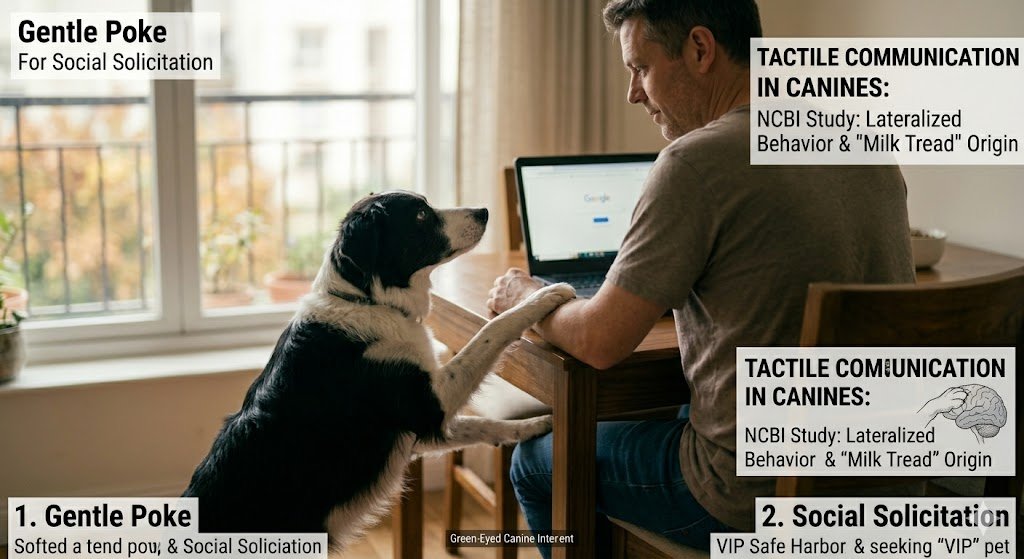
The Gentle Poke: More Than Just a Greeting (why does my dog tap me with his paw)
You’re sitting on the sofa or working at your desk, and suddenly, you feel a rhythmic, insistent poke on your arm. You look down, and there’s a paw. It isn’t a scratch, and it isn’t a playful swipe; it is a calculated, deliberate touch.
While it’s easy to dismiss this as your dog simply being “cute,” the canine paw is actually a sophisticated communication tool. In the world of animal behavior, this is known as a Tactile Communication Signal. Because dogs lack the vocal complexity of humans, they rely on physical contact to bridge the gap and ensure they are being “heard.”
Why Your Dog “Taps” You (NLP Snapshot): When a dog taps you with their paw, they are engaging in Social Solicitation. Rooted in puppyhood nursing behaviors, the tap is a multi-functional tool used for Resource Requesting(food/walks), Affiliation (seeking a bond), or Anxiety Signaling. It is the canine equivalent of a human tapping someone on the shoulder to say, “Excuse me, I need your attention right now.”
The Biological Origin: The “Milk Tread”
To understand why your dog uses their paws to get what they want, we have to look back at their very first days of life. This behavior is not just learned; it is deeply evolutionary.
The Neonatal Reflex
Newborn puppies are born with a reflex known as “kneading” or the “Milk Tread.” While nursing, puppies instinctively push their paws against their mother’s mammary glands to stimulate milk flow. In this stage of life, “Pawing = Survival.” It is the first time a dog learns that physical pressure results in a positive reward (food and comfort).
The Transition to Learned Strategy
As dogs mature and integrate into human households, this instinct undergoes a process called Operant Conditioning.
- The Action: The dog accidentally (or instinctively) paws at a human.
- The Reaction: The human smiles, says “Aww,” and pets the dog or gives them a treat.
- The Result: The dog’s brain creates a “Success Loop.” They realize that while barking might get them scolded, the “Gentle Tap” is a social superpower that almost always results in a positive outcome.
Over time, this survival reflex evolves into a Learned Communication Strategy. Your dog isn’t just “touching” you; they are utilizing a biological legacy to manage their relationship with you, their primary provider.
The “Paw Language” Dictionary (Deciphering the Intent)
Not all taps are created equal. To become a “Dog Language” expert, you need to look at the intensity, frequency, and accompanying body language. Your dog is likely using one of these four distinct “paw dialects”:
The “I’m Bored” Tap (Social Solicitation)
This is usually a short, repetitive poke. You’ll notice the dog has relaxed ears and might offer a “whale eye” (showing the whites of their eyes) while waiting for your reaction. They are simply checking to see if you are available for a play session.
The “Resource” Tap (The Demand)
This is a heavy, insistent paw placed firmly on your knee or arm. It often happens when you are eating, or when it is nearing “walkie” time. This is a Demand Signal. The dog is asserting a need for a specific resource (food or the outdoors).
The “Apology” Tap (The Pacifier)
If you have just scolded your dog or if they sense tension, they may offer a slow, soft pawing gesture. In canine behavior, this is a Pacifying Signal. They are trying to “lower the temperature” of the room and restore social harmony between the two of you.
The “Anxiety” Tap (The Grounding Request)
This tap is often frantic and accompanied by panting, pacing, or trembling. In this context, the dog is seeking Physical Grounding. Much like a human child reaching for a hand during a storm, the dog is using physical contact with you to lower their own cortisol levels.
The “Left vs. Right” Paw Theory: Brain Lateralization
Did you know that your dog might be “left-pawed” or “right-pawed”? Emerging research in Canine Neurosciencesuggests that the paw your dog chooses to tap you with can reveal their emotional state.
The Science of the Hemispheres
Like humans, a dog’s brain is divided into two hemispheres that process different types of information:
- Left Hemisphere (Controls the Right Paw): Generally associated with approach behaviors, calm logic, and positive emotions.
- Right Hemisphere (Controls the Left Paw): Often linked to the “withdrawal” response, intense emotions, and processing perceived threats or high-stress situations.
What the Tap Tells You
While not every dog follows this rule perfectly, some studies suggest that a dog using their left paw to tap you might be experiencing a more intense emotional “high” or “low” (such as fear or extreme excitement). A right-paw tap is often seen as a more calculated, routine request for a known reward.
Tracking which paw your dog uses most frequently can give you a “window” into their dominant temperament—helping you understand if they are a “thinker” (Right-Pawed) or a “feeler” (Left-Pawed).
When “Tapping” Becomes “Demanding”: The Power Shift
While a paw on the arm is often endearing, it can quickly evolve into a behavioral issue if the boundaries aren’t clear. If you pet, feed, or play with your dog every single time they tap you, you are participating in a Reinforcement Loop.
Accidental Training
By reacting immediately, you are teaching your dog that they are the “Director” of the household’s activities. Over time, this “Gentle Tap” can escalate into Demand Barking or more forceful scratching if they don’t get an instant result. In their mind, they have successfully trained you to respond to their touch.
The “Ignore to Reward” Solution
To keep your “VIP” status intact, you must be the one to initiate the interaction.
- The Wait: When your dog taps you, wait 5–10 seconds until they stop.
- The Command: Ask them for a “Sit” or “Down.”
- The Reward: Once they have complied with your request, give them the attention they wanted. This subtle shift ensures that the dog feels heard, but understands that you are the one in control of the resources.
Is it a Medical Issue? (The Vet Check)
As a dog owner, you must distinguish between a social tap and a physical symptom. Sometimes, what looks like a request for a scratch is actually a sign of discomfort.
The “Itch” Factor
If your dog is pawing at you and then immediately licking their own paws or rubbing their face against the carpet, they might be dealing with Pododermatitis (inflammation of the paw skin) or environmental allergies. Gurgaon’s seasonal dust and pollen can often cause “itchy feet” that lead to obsessive pawing.
Joint Pain and Arthritis
If an older dog suddenly starts pawing at you and then favoring that limb, it could be a sign of Osteoarthritis or a soft tissue injury. The “tap” in this context is a request for help or an attempt to shift their weight to a more comfortable position.
Dr. Emily’s Rule: “If the tapping is accompanied by redness between the toes, a ‘corn chips’ smell from the paws (indicating yeast), or a sudden change in how they bear weight, it’s time to move past the behaviorist and see a veterinarian. We need to rule out pain before we address the personality.”
Common Questions (FAQ)
Why does my dog paw at the air?
This is often called a “Displacement Behavior.” If your dog wants to tap you but realizes they shouldn’t (or can’t reach you), they may paw at the air instead. It’s a sign of internal conflict or excitement. Think of it as the canine version of a human fidgeting or tapping their pen during a meeting.
Why does my dog “hold” my arm with their paw?
This is the “Claiming” Gesture. By hooking their paw around your arm and holding on, your dog is creating a physical “lock” to ensure you don’t walk away. It is a very high-level sign of attachment and a desire for constant proximity. It is most common in “Velcro” breeds like Vizslas or Labradors.
Does pawing mean my dog is trying to be “Alpha”?
No. The “Dominance Theory” has been largely debunked by modern veterinary science. Pawing is almost always a Social Solicitation or a request for a resource. Your dog isn’t trying to “rule” you; they are trying to “talk” to you. If the pawing is too forceful, it’s a lack of manners, not a bid for the throne.
Dr. Emily’s Final Take
A tap from a paw is one of the most intimate ways a dog communicates. It requires them to invade your personal space and initiate physical contact—a move that requires immense trust.
At Dog Vet Expert, we see the “Canine Tap” as a bridge between two different species. While we have words, they have touch. If your dog is tapping you, they are inviting you into their world. Listen to what they are saying, respect their medical health, and set healthy boundaries. When you respond to a “tap” with a calm, directed command, you aren’t just petting a dog; you are refining a lifelong conversation.
🦷 From Tapping to Mouthing
When a paw tap isn’t enough, some dogs escalate to “mouthing” your hand. Learn why this gentle use of the mouth is actually a sophisticated form of social solicitation.
Read: Why Dogs Mouth Your Hand →😤 The “Huff” and the “Tap”
Pawing and “huffing” are two sides of the same coin: quiet, non-aggressive requests for affection. Discover how to decode these low-arousal signals before they turn into barking.
Learn: Why Dogs “Huff” at You →Reference
“Research published in NCBI regarding lateralized behavior suggests that a dog’s choice of paw is not random; it is often a reflection of which side of the brain is processing their current emotional state.”