Category: Psychology

  • The Psychology of “Dog People” vs. “Cat People” in 2026: What Your Pet Choice Says About Your Personality

    The Psychology of “Dog People” vs. “Cat People” in 2026: What Your Pet Choice Says About Your Personality

    The Great Pet Divide (dog people vs cat people psychology)

    In 2026, our pets aren’t just companions; they are sophisticated extensions of our lifestyle and identity. As our homes in cities like Gurugram become more tech-integrated and our work lives more fluid, the choice between a barking Border Collie and a purring Persian reveals more than just a preference for fur length. It highlights a fundamental psychological blueprint.

    For decades, we’ve relied on simple clichés to define these groups. However, modern behavioral science suggests that the “Dog vs. Cat” divide is rooted in how we process social energy and handle independence. Whether you are looking for a partner in activity or a silent observer for your home office, your pet is a mirror of your internal world.

    The Great Divide (NLP Snapshot): Modern psychology utilizes the “Big Five” personality traits to differentiate the tribes. Dog People typically score higher in Extroversion and Conscientiousness, reflecting a drive for social synchronization and structured routine. Cat People score higher in Openness and Neuroticism, showing a preference for autonomy, non-conformity, and intellectual depth.

    The Dog Person: The Social Synchronizer

    The psychology of a “Dog Person” is built on the foundation of Co-Regulation. Because dogs are obligate social animals, they require—and provide—constant feedback. This creates a specific personality profile often found in the active hubs of Sector 99 and beyond.

    Extroversion and Community

    Dog people are statistically more likely to be extroverted. A dog acts as a “social lubricant,” forcing the owner to engage with the physical world. If you find yourself chatting with strangers at the park or joining local pet groups, you are leaning into the high-extroversion trait that defines this group.

    The Need for Feedback

    Unlike cats, dogs provide immediate, visible emotional feedback. A dog person often has a psychological need for this external validation. The “social sync” that happens when a dog wags its tail or follows you into the kitchen helps the owner regulate their own stress levels through shared activity.

    High Conscientiousness

    Owning a dog in 2026 requires intense organization. Between tracking walks, managing high-tech feeding schedules, and coordinating vet visits, dog owners often score higher in Conscientiousness. This trait correlates with being self-disciplined, dutiful, and achievement-oriented in their professional lives.

    The Cat Person: The Independent Intellectual

    While dog people thrive on feedback, the psychology of a “Cat Person” is rooted in Autonomy and Observation. In the post-pandemic era, this personality type has found its stride, as cats are the perfect companions for those who value internal focus over external noise.

    High “Openness” and Non-Conformity

    Statistically, cat people score significantly higher in Openness to Experience. This means they are more likely to be curious, unconventional, and appreciative of abstract concepts. While a dog person might enjoy a group fitness class, a cat person is more likely to spend their evening with a complex book, a niche hobby, or an experimental film.

    Autonomy Over Obedience

    A cat person doesn’t want a “servant” or a “follower”; they want an equal. The psychology here is one of earned affection. Cat owners often find deep satisfaction in the fact that their pet is an independent spirit who chooses to spend time with them, rather than being biologically hard-wired to do so. This often mirrors the owner’s own professional and social life, where they value independence and self-sufficiency.

    The Cognitive Lean

    Research has consistently shown that cat owners often score slightly higher on intelligence tests and abstract reasoning. This isn’t because cats make you smarter, but because the solitary, contemplative lifestyle that attracts cat owners is highly compatible with academic and intellectual pursuits.

    The 2026 Shift: The “Digital Nomad” Influence

    The year 2026 has brought a new variable into the mix: the Lifestyle Conflict. Many people who are “Dog People” by nature are finding themselves living “Cat Lifestyles” due to the demands of the digital economy and urban living in places like Gurgaon.

    Lifestyle over Personality

    For many young professionals, the desire for a high-energy dog is sidelined by 12-hour work cycles and apartment living. This has led to the rise of the “Reluctant Cat Owner”—someone whose heart is with a Labrador, but whose calendar only has room for a British Shorthair.

    The Rise of “EvenUS” Living

    In 2026, couples are increasingly making pet decisions based on Labor Logistics. We see this in the data: the choice between a dog and a cat is now a negotiation of household labor.

    • The Dog Debt: Who gets up for the 6 AM walk before the first Zoom call?
    • The Cat Compromise: Who manages the litter box? Pet ownership is shifting from a purely emotional choice to a tactical one, where the “psychology” of the owner must adapt to the “logistics” of the partnership.

    Neuroticism vs. Emotional Stability

    The “Big Five” trait of Neuroticism—which in psychological terms refers to emotional sensitivity and the tendency to experience stress—often acts as the primary divider between dog and cat tribes.

    The Stress Buffer Style

    Dog people and cat people tend to “recharge” their emotional batteries in polar opposite ways.

    • The Active Buffer (Dogs): Dog owners typically use their pets as a distraction from internal stress. By engaging in the physical world (walking, playing fetch), they force their brains to shift from “rumination” to “action.” This group leans toward emotional stability through outward movement.
    • The Meditative Buffer (Cats): Cat owners are statistically higher in Neuroticism, meaning they are more sensitive to their environments. They use their pets as a “calm anchor.” The act of sitting still with a purring cat provides a meditative, low-energy environment that helps a sensitive nervous system recover from the sensory overload of a city like Gurgaon.

    The Sensitivity Paradox

    Cat people aren’t “grumpy”; they are often more emotionally attuned. Their choice of a cat reflects a need for a companion that respects boundaries and doesn’t demand high-octane social energy when the owner is already at their emotional limit.

    Shared Traits: Where the Tribes Meet

    Despite the long-standing debate, 2026 data shows that the “Pet Parent” identity is becoming more unified than ever. When we look beneath the personality traits, the biological responses are nearly identical.

    The Oxytocin Bond

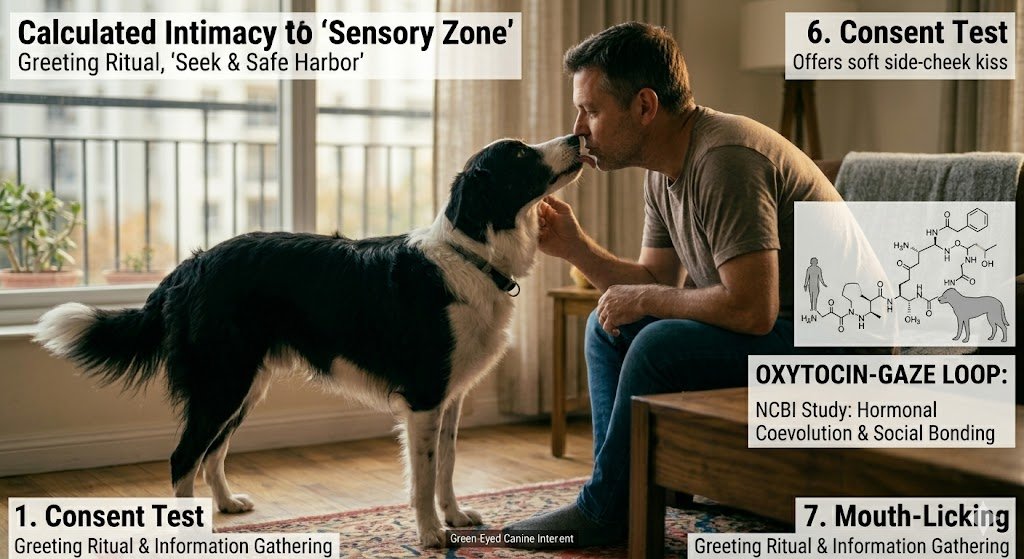
    Whether you are looking into the eyes of a Golden Retriever or scratching a Tabby behind the ears, the chemical result is the same: a massive release of Oxytocin (the “cuddle hormone”). This surge lowers cortisol and strengthens the human-animal bond, proving that the brain doesn’t differentiate between species when it comes to love.

    Higher Empathy Levels

    Both dog and cat people score significantly higher in Empathetic Concern than non-pet owners. The act of caring for a living being that cannot speak—monitoring their health, feeding them, and interpreting their needs—builds a specific type of emotional intelligence. In a world of increasing AI and automation, this “human-pet” connection is one of the last bastions of raw, unfiltered empathy.

    Common Questions (FAQ)

    Can a “Cat Person” become a “Dog Person”?

    Absolutely. Personality is not static. We often see “Neuroplasticity” in pet ownership—when a cat person moves from a small apartment to a house with a yard, their Openness to a new lifestyle often shifts their preference. However, the core psychological need (independence vs. feedback) usually remains, leading them to choose “cat-like” dog breeds (like Basenjis or Greyhounds).

    Is it true that “opposites attract” in pet parenting?

    In many 2026 households, we see “mixed-pet” couples. This can be a major psychological strength; the Dog Person brings the social energy and structure, while the Cat Person brings the calm and emotional depth. Using tools like EvenUS helps these couples balance the very different labor requirements of each species.

    What about “Both” people?

    People who own both cats and dogs usually score the highest across all positive personality markers. They are the “Psychological All-Rounders”—possessing the flexibility to engage in high-energy social play and the sensitivity to enjoy quiet, independent companionship.

    Dr. Emily’s Final Take

    Your choice of pet isn’t a box that defines you; it’s a mirror reflecting what you need at this specific stage of your life. Whether you crave the rhythmic, disciplined life of a dog owner or the quiet, intellectual autonomy of a cat parent, you are making a choice that supports your mental health.

    At Dog Vet Expert, we’ve seen that the most successful pet-human relationships aren’t based on a “perfect” match, but on an owner’s self-awareness. When you understand your own personality traits—whether you’re an extroverted “Synchronizer” or an independent “Observer”—you can provide the best possible care for the animal that shares your home. In 2026, pet ownership is the ultimate act of self-care.

    Reference

    we reference the foundational study on how the “Big Five” traits manifest in pet owners.

    • Study Title: Personalities of Self-Identified “Dog People” and “Cat People”
    • Source: Anthrozoös / University of Texas at Austin.
    • Key Finding: This research established the statistically significant link between dog ownership and higher levels of extroversion/agreeableness, versus cat ownership and higher levels of openness/neuroticism.
    • Direct Link: https://www.tandfonline.com/doi/abs/10.2752/175303710X12750451258850

    🐕 Expert Insight: The Favorite Person Theory

    Once you understand the dog vs. cat personality types, the next step is understanding the selection process: why dogs pick one specific person as their favorite.

    Read: Why Dogs Pick a “Favorite” Person →

    🧠 The Emotional Mirror Effect

    Dog owners often notice something even deeper—their dog actually mirrors their emotions. Discover the biological science behind this unique canine behavior.

    Discover: Why Dogs Mirror Our Moods →
  • Why Does My Dog Stare at Me In The Shower: Protection, Curiosity, or Concern?

    Why Does My Dog Stare at Me In The Shower: Protection, Curiosity, or Concern?

    The Bathroom Bodyguard (why does my dog stare at me in the shower)

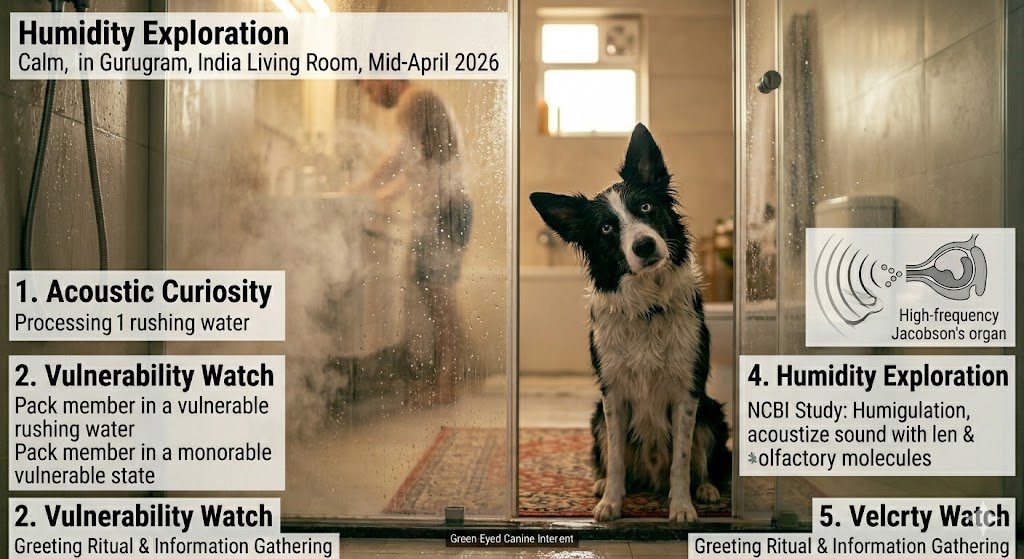
    You step into the shower for ten minutes of peace, only to find your dog sitting on the bathmat, staring at you through the glass or peeking behind the curtain with intense focus. Why does the simple act of running water turn your dog into a full-time private investigator?

    To us, a shower is a routine chore; to a dog, it is a high-stakes event. Because dogs are pack animals, they view most activities through the lens of safety and social hierarchy. When you enter a small, enclosed room and surround yourself with a roar of white noise, your dog’s natural instincts are triggered.

    The “Shower Stare” (NLP Snapshot): Dogs stare at you in the shower because of Vulnerability Monitoring and Acoustic Curiosity. They view you as a pack member who has entered a “vulnerable” state. By staying close and maintaining eye contact, they are performing their role as a “bodyguard,” ensuring that no threats approach while your own senses (sight and hearing) are compromised by the water and steam.

    The “Vulnerability” Watch

    In the wild, animals are at their most vulnerable when they are distracted or their senses are masked. This is why dogs often look at you when they are eliminating—they are checking to see if you have their back while they are preoccupied.

    The Protector Instinct

    Your dog considers you the leader of their pack. When you disappear behind a curtain and the sound of splashing water drowns out the noise of the house, your dog perceives that you are “blind” to potential danger.

    • Standing Guard: By sitting on the mat and staring, they are fulfilling an ancestral duty to stand watch.
    • The “Safe Harbor”: They want to be the first thing you see when you emerge, confirming that the territory is still secure.

    In a high-energy urban environment like Gurgaon, where outside noises (construction, horns, neighbors) are constant, your dog may feel even more pressure to “guard” the bathroom door, as the shower makes it impossible for you to monitor the “intruder alerts” they hear outside.

    Acoustic and Olfactory Confusion

    While we find the sound of a shower relaxing, to a dog, it is a chaotic wall of high-frequency white noise. Their ears, which can hear frequencies up to 65,000 Hz, pick up the hiss of the pipes and the splatter of droplets as a loud, complex auditory event.

    The “Wash-Away” Effect

    Dogs experience the world primarily through scent. You have a unique “olfactory thumbprint”—a mix of natural pheromones and oils that tells your dog exactly who you are. When you step into the shower, you are effectively “erasing” yourself.

    • Scent Masking: The soaps, shampoos, and conditioners you use are often overwhelming to a dog’s sensitive nose.
    • The Identity Crisis: They stare because they are trying to reconcile the visual of you with the unfamiliar smell of lavender, mint, or citrus that is now radiating from the stall. They are essentially waiting for “their human” to return.

    Humidity and “Flavor” Exploration

    Have you ever noticed your dog sniffing the air intensely or even “licking” the steam in a foggy bathroom? This is because humidity acts as a powerful scent carrier.

    Tasting the Air

    The warm steam in your bathroom traps scent molecules and holds them in the air at a much higher concentration than dry air.

    • The Jacobson’s Organ: Your dog may be staring with a slightly open mouth, using their vomeronasal organ (Jacobson’s organ) to “process” the chemicals in the steam.
    • Decoding the Soap: They are analyzing the new “flavors” you are applying to your skin. To them, the bathroom becomes a high-definition laboratory of smells, and they don’t want to miss a single data point.

    By staring, they are focusing their brain’s processing power on the sensory input they are receiving. They aren’t just looking; they are conducting a full-scale olfactory investigation.

    Resource Guarding (The “Door” Effect)

    If your dog is what trainers call a “Velcro Dog,” they view you as their most valuable resource. In their mind, any closed door is a physical barrier between them and their source of security, food, and affection.

    FOMO (Fear Of Missing Out)

    Dogs don’t understand the concept of “privacy.” To them, a bathroom door is simply a wall that has temporarily swallowed their favorite person.

    • The Boundary Stare: They stare at the curtain or the glass because they are monitoring the “exit.” They want to ensure they are the very first thing you interact with the moment you become available again.
    • The “Wait-and-See” Strategy: By maintaining a constant watch, they are making sure you don’t magically disappear through a secondary exit (which, to a dog, is a very real concern when they can’t see the whole room).

    When the Staring is a “Cry for Help”

    While most shower staring is protective or curious, it can sometimes cross the line into clinical anxiety. As a pet parent in a busy city like Gurgaon, where apartment living means you are never truly “far” from your dog, separation anxiety can manifest in the bathroom.

    Indicators of Anxiety:

    • The Distress Loop: If the staring is accompanied by high-pitched whining, frantic scratching at the shower door, or pacing, your dog isn’t “guarding” you—they are panicking because they can’t reach you.
    • Water Phobia Projection: If your dog has a negative association with baths, they may be staring because they are genuinely concerned for you. They think the running water is a trap or a punishment and are waiting to see if you need rescuing from the “scary” water.

    Dr. Emily’s Rule: “If your dog sits calmly and watches, it’s a sign of a healthy bond. However, if they are panting or unable to settle until the water stops, they are suffering from a lack of confidence. Try giving them a ‘high-value’ long-lasting treat (like a frozen Kong) just outside the bathroom door. This builds a positive association with your shower time and teaches them that ‘distance’ from you can be a rewarding experience.”

    Common Questions (FAQ)

    Why do they try to lick the water off my legs?

    There are three main reasons for this “post-shower grooming”:

    1. Salt and Minerals: Even after a shower, your skin may have traces of salt that dogs find tasty.
    2. The Grooming Instinct: In a pack, licking is a bonding activity. Your dog may think you are “wet and messy” and is trying to help you dry off and get your fur (skin) back in order.
    3. Identity Restoration: By licking you, they are replacing the soap smell with their own scent, “re-marking” you as part of their family.

    Do they think I’m drowning?

    Dogs don’t have a concept of “showering,” but they do understand submersion. If you are behind a glass door with water spraying everywhere, some empathetic dogs interpret the situation as a struggle. If your dog is staring and let’s out a “help” bark, they might genuinely think you are being attacked by the “hissing” water.

    Why do some dogs bark at the shower?

    This is usually a Reactive Response to the sound of the pipes. The high-pitched whistle or deep rumble of water moving through the plumbing can be irritating or even painful to a dog’s sensitive ears, causing them to “scold” the shower for making such a racket.

    Dr. Emily’s Final Take

    Being stared at in the shower is actually a huge compliment. It means your dog is deeply bonded to you and considers your safety their primary job. Whether they are monitoring your vulnerability or just trying to figure out why you want to smell like a “lemon grove” instead of a human, the behavior is a sign of intense focus and loyalty.

    At Dog Vet Expert, we see this as a sign of a healthy, protective relationship. Unless your dog is showing signs of extreme anxiety, there is no harm in letting them stand guard. After all, having a dedicated “Bathroom Bodyguard” is just one of the many perks of being a dog parent.

    🚻 The “Velcro Dog” Mystery

    If your dog is a dedicated shower watcher, they likely follow you into the bathroom every single time. Is it loyalty or just a lack of boundaries?

    Learn: Why Your Dog Follows You to the Bathroom →

    🐕 The Power of the Lean

    The “Shower Stare” and “The Lean” are both driven by the same ancient pack instinct: a need for safety and comfort through physical proximity.

    Read: Why Do Dogs Lean on You? →

    Reference

    we look at the evolutionary psychology of “vigilance” in domestic canines.

    • Study Title: Social monitoring and vigilance in domestic dogs
    • Source: Animal Cognition.
    • Key Finding: This study confirms that dogs frequently monitor their primary human caretakers during periods of perceived “low defense,” acting as sentinels even in the absence of a direct threat.
    • Direct Link: https://link.springer.com/article/10.1007/s10071-017-1110-3
  • Why Do Dogs Get Zoomies After Pooping: Why Dogs Run Like Crazy After a Bathroom Break

    Why Do Dogs Get Zoomies After Pooping: Why Dogs Run Like Crazy After a Bathroom Break

    The Victory Lap (why do dogs get zoomies after pooping )

    Your dog finishes their business, takes a quick sniff, and then—whoosh—they are a blur of fur, sprinting across the yard as if they’ve just won an Olympic gold medal. This isn’t just a random burst of energy; it is a near-universal canine ritual. While it looks hilarious to us, the “Post-Poop Zoomies” are driven by a fascinating mix of ancient survival tactics and internal biology.

    In the veterinary world, these bursts are technically called Frenetic Random Activity Periods (FRAPs). They represent a sudden discharge of built-up energy or a response to a sharp change in the dog’s internal physical state. When it happens specifically after a bathroom break, it’s a sign that your dog is feeling a unique combination of metabolic relief and psychological “high.”

    The “Poop-Zoom” (NLP Snapshot): The Post-Poop Zoomie is triggered by Vagus Nerve stimulation and the release of Endorphins. It serves two purposes: it provides a rush of physical “Poo-phoria” and fulfills an ancestral Survival Instinct to move away from a scent trail that could attract predators. To your dog, that frantic sprint is the ultimate “I feel amazing” celebration.

    The Vagus Nerve & “Poo-phoria”

    The most scientific explanation for the zoomies involves the Vagus Nerve, the longest and most complex of the cranial nerves, which runs from the brain all the way down to the abdomen.

    The Biology of Relief

    As a dog passes a large stool, the distension in the lower colon can stimulate the Vagus Nerve. This stimulation creates a distinct physiological loop:

    1. The Drop: Initially, Vagus stimulation can cause a slight drop in heart rate and blood pressure.
    2. The Rush: Once the stool is passed and the pressure is released, the body responds with a sudden surge of Endorphins and Adrenaline.

    “Poo-phoria”

    This chemical cocktail creates a sensation often nicknamed “Poo-phoria.” For a few seconds, your dog feels a rush of intense well-being and physical “lightness.” Because dogs don’t have words to express this feeling, they use the only language they know: high-speed, tail-tucked running. It’s not just that they are “done”; it’s that the act itself has triggered a natural biological high.

    The Ancestral Escape: Masking the Trail

    While your backyard in Gurgaon is a safe haven, your dog’s DNA is still hard-wired for survival in the wild. Ancestrally, waste is more than just a biological byproduct—it is a High-Scent GPS Marker.

    Predator Avoidance

    In the wild, a pile of fresh waste is a clear signal to predators that an animal is nearby and potentially vulnerable. To mitigate this risk, wolves and wild canids developed a “deposit and depart” strategy.

    • The Escape: Once the business is finished, the dog immediately puts significant distance between themselves and the waste site.
    • The Sprint: The Zoomies allow the dog to relocate quickly, making it harder for a stalking predator to track their exact current location based on the fresh scent.

    Even though your dog’s biggest “predator” might be the neighbor’s cat or a passing car, that ancient instinct to “evacuate and escape” is triggered the moment they feel that Vagus Nerve rush.

    Territorial Marking: The “Back-Kick” Connection

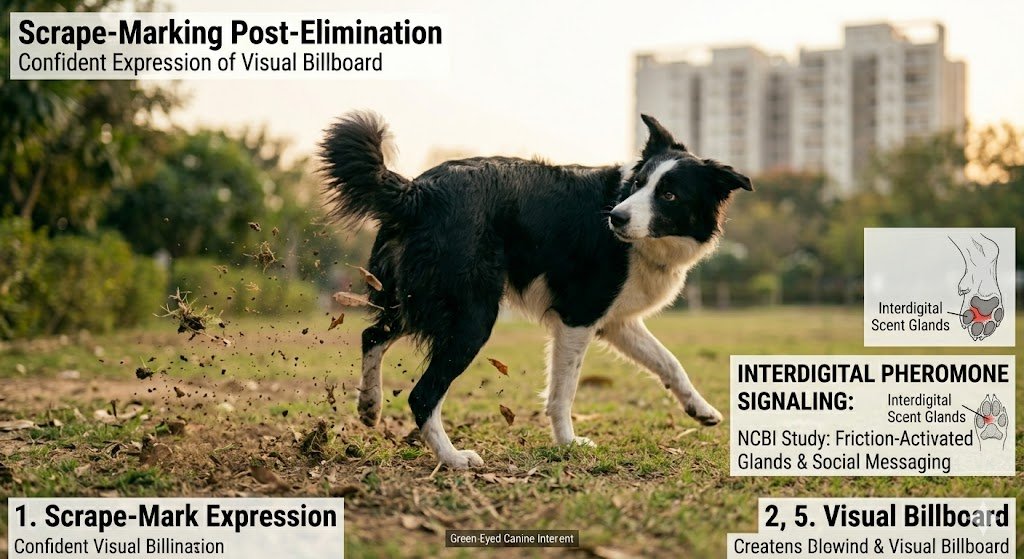
    You’ve likely noticed that the Post-Poop Zoomies are often preceded by “scuffing”—that frantic back-kicking of grass or dirt. This isn’t about burying the waste; it’s about maximizing the message.

    Scent Glands in the Paws

    Dogs have specialized sebaceous and sweat glands located between their paw pads. These glands secrete a unique pheromonal signature.

    • Double Marking: By kicking and then sprinting, the dog is spreading their scent over a larger radius.
    • Visual and Olfactory: The scuff marks provide a visual cue, while the “Zoomie” helps distribute the pheromones across the perimeter.

    To your dog, the Post-Poop Zoomie is the ultimate territorial “Update Status.” They’ve left their most potent marker, and now they are using their physical speed to broadcast their presence and claim to the surrounding area.

    The “Feeling Light” Theory

    Beyond the complex biology of nerves and ancient survival, there is a very simple, physical explanation: it just feels good to be empty. Carrying waste causes a degree of abdominal pressure and physical “heaviness” that can make a dog feel sluggish or even slightly vulnerable.

    Physical Liberation

    Once the “mental load” of finding the perfect spot is over and the physical weight is gone, dogs experience a literal burst of physical lightness.

    • The “Relief” Reflex: This sudden ease of movement often translates into playfulness.
    • Pent-up Energy: Many dogs hold their energy while “hunting” for the right patch of grass. Once the job is done, that tension is released all at once.

    It is the ultimate “I feel great!” moment. If you’ve ever felt a spring in your step after a long day of travel finally ends with a hot shower, you’ve experienced a human version of the Post-Poop Zoomies.

    When Zoomies Aren’t a Celebration: The Red Flags

    As a pet parent, it is important to distinguish between a “Victory Lap” and a “Panic Run.” If the Zoomies look frantic, rigid, or “itchy” rather than joyful, your dog might be trying to outrun discomfort rather than celebrating relief.

    Signs of Irritation:

    • The “Tuck and Run”: If they are running with their tail clamped tightly between their legs and looking back at their rear end with wide eyes, they might be experiencing stinging or a “dangling” piece of debris.
    • Scooting: If the run is interrupted by sitting down and dragging their rear across the grass, it’s a classic sign of Anal Gland fullness or irritation.
    • Compulsive Circling: If the Zoomie is very tight and they seem unable to stop, it could indicate constipation or gastrointestinal cramping.

    Dr. Emily’s Rule: “A healthy zoomie is characterized by a ‘play bow,’ a loose body, and a happy expression. If your dog looks distressed or keeps obsessively checking their hindquarters during the run, it’s not a celebratory FRAP—it’s a sign of localized irritation that might require a veterinary check-up.”

    Common Questions (FAQ)

    Do cats get the “Post-Poop Zoomies” too?

    Yes! Cat owners often call this the “Midnight Crazies,” but it frequently happens right after a litter box session. Cats have the same Vagus Nerve anatomy as dogs, meaning they experience that identical rush of endorphins and metabolic relief. In the wild, cats are both predators and prey, so the instinct to sprint away from a scented “marker” is just as strong in felines.

    Why do they look so “proud” after a Zoomie?

    While we shouldn’t anthropomorphize too much, the Zoomie is a social signal. By running back to you after their sprint, your dog is checking in to share their “success.” In a pack environment, completing a vulnerable task like elimination and returning safely to the group is a moment of high social synchronization.

    Should I stop them from running indoors?

    If your dog has the Zoomies on a slippery tile or hardwood floor (common in Gurgaon apartments), it can lead to ACL tears or pulled muscles. You don’t need to stop the energy, but try to redirect them to a carpeted area or a rug where they have better traction for those high-speed turns.

    Dr. Emily’s Final Take

    The “Post-Poop Zoomie” is one of the purest expressions of a dog’s well-being. It is a sign that their digestive system is functioning correctly, their nerves are firing as they should, and—most importantly—they feel safe enough in their environment to let loose.

    At Dog Vet Expert, we believe these moments are the “Self-Care” of the canine world. So, the next time your dog turns into a furry rocket ship after their bathroom break, don’t worry about the logic. Just enjoy the show—it’s a clear indicator that you have a happy, healthy, and high-spirited companion.

    🐾 The Post-Poop “Back-Kick”

    That frantic grass-kicking isn’t just about burying waste—it’s a sophisticated scent-marking ritual that works hand-in-hand with the zoomies.

    Read: Why Dogs Kick After They Poop →

    🚻 The Bathroom Bodyguard

    If your dog celebrates their own bathroom breaks with a sprint, they likely monitor yours too. It’s the same protective pack instinct at play.

    Discover: Why Dogs Follow You to the Bathroom →

    Reference

    we reference the physiological connection between the gastrointestinal tract and the autonomic nervous system.

    • Study Title: Vagal regulation of visceral functions and emotional behavior
    • Source: Frontiers in Neuroscience.
    • Key Finding: This research details how stimulation of the Vagus Nerve—often triggered by visceral events like elimination—directly influences emotional arousal and energy surges in mammals.
    • Direct Link: https://www.frontiersin.org/articles/10.3389/fnins.2018.00049/full
  • Dog Panting But Not Hot: Stress vs. Excitement

    Dog Panting But Not Hot: Stress vs. Excitement

    More Than Just an Air Conditioner (dog panting but not hot )

    It’s a rainy, 22°C evening in Gurgaon, your AC is humming, and your dog is perfectly dry—yet they are sitting on the rug panting like they just finished a 5km run. For most owners, a panting dog means one thing: “My dog is hot.” While it’s true that dogs pant to evaporate moisture from their tongue and lungs to cool down, this is only half the story.

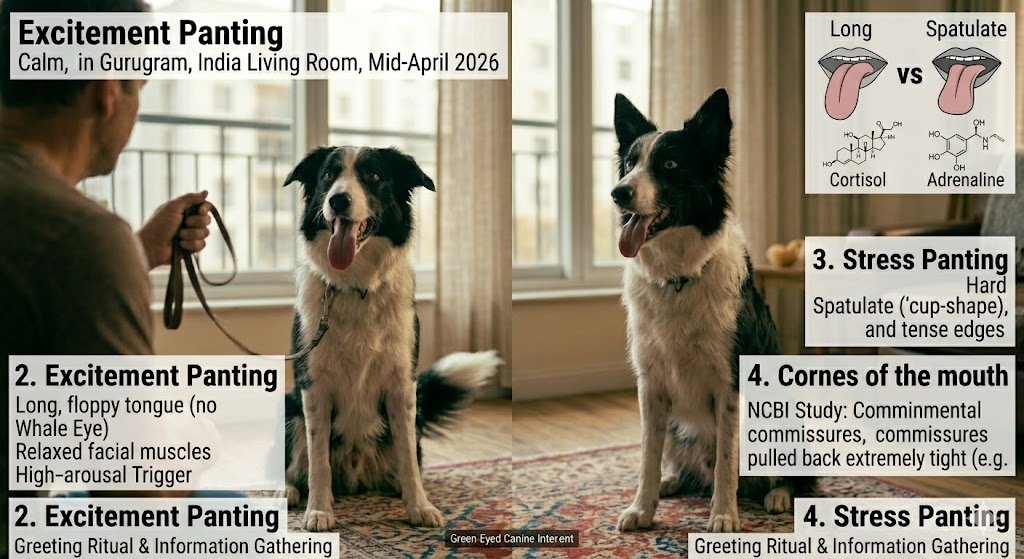
    When a dog pants in a cool environment, they are engaging in Behavioral Panting. This isn’t about body temperature; it’s about a surge of internal chemicals like Cortisol (the stress hormone) or Adrenaline (the excitement hormone). By analyzing the tension of the tongue and the set of the jaw, you can determine if your dog is having a “happy high” or if they are silently struggling with anxiety.

    The “Cool” Pant (NLP Snapshot): If the room is cool but the tongue is out, your dog is communicating an Emotional State. Behavioral panting is the canine body’s way of processing intense arousal. To decode it, you must look for the “Tension markers”: a relaxed, “long” tongue usually signals joy, while a rigid, “cupped” tongue signals a desperate need for space or comfort.

    The “Excitement” Pant: High-Arousal Joy

    We’ve all seen the “Happy Pant”—the frantic breathing that occurs when you pick up the leash or come home after a long work day. This is a form of high-arousal joy. Even though the dog isn’t physically hot yet, their heart rate has spiked in anticipation, and their body is prepping for action.

    The Visual Cues of Joy:

    • The “Long” Tongue: In a happy pant, the tongue is typically very floppy. It often hangs out of the front or even the side of the mouth, looking “long” and relaxed.
    • Soft Facial Features: The eyes remain round and soft. You won’t see the tension of the brow or the “Whale Eye” (whites of the eyes).
    • The “Wiggle” Factor: This panting is almost always accompanied by a loose, curvy body. The tail might be wagging so hard that the dog’s entire rear end moves, and their ears are likely in a neutral or slightly forward position.

    In this state, the panting is simply the “exhaust” of a highly fueled emotional engine. It’s the sound of a dog that is ready to play, eat, or greet their favorite person.

    The “Stress” Pant: The Silent Cry for Help

    The most dangerous thing an owner can do is mistake a stressed dog for a “happy” one. Unlike the relaxed breathing of excitement, a Stress Pant is a physiological reaction to the “Fight or Flight” system. Even in a chilled, air-conditioned room, a dog’s internal chemistry can make them feel like they are overheating.

    The Visual Cues of Stress:

    • The “Spatulate” Tongue: This is the most critical marker. Instead of being floppy and long, the tongue becomes rigid and wide at the end, looking almost like a spatula. The edges may curl up, forming a “cup” shape.
    • Tense Commissures: Look at the corners of the mouth (the commissures). In a stressed dog, these are pulled back extremely tight, creating a “long lip” appearance that looks strained rather than relaxed.
    • Rapid-Fire Rhythm: Stress panting is often much faster and shallower than heat-related panting. It sounds frantic because it is frantic.

    When you see this, your dog isn’t “happy to be here.” Whether it’s a crowded market in Gurgaon or a loud thunderstorm, the spatulate tongue is a signal that your dog has reached their Emotional Threshold and needs a “Safe Harbor” immediately.

    Decoding the “Stress Smile”

    One of the biggest hurdles in canine communication is the Stress Smile. Because dogs pull the corners of their mouths back when they are anxious, it can mimic a human grin. This leads many owners to post “funny” photos of their “smiling” dog, unaware that the animal is actually in a state of high distress.

    How to Tell the Difference:

    • The Eye Test: A real “smile” is accompanied by soft, squinty eyes. A stress smile is almost always paired with Whale Eye (showing the whites of the eyes) or a “hard,” wide-eyed stare.
    • The Brow Tension: Look at the forehead. A happy dog has a smooth brow; a stressed “smiler” will have visible furrows or tension lines above the eyes.
    • The Vertical Retraction: In a true smile, the lips are loose. In a stress smile, you may see the front teeth exposed not in a snarl, but because the lips are being pulled back so forcefully by facial tension.

    The Urban Impact

    In high-density areas like Gurgaon, dogs are constantly bombarded by “Micro-Stressors”—the hum of heavy construction, high-pitched horns, and crowded elevators. Over time, a dog can develop a Chronic Stress Pant. If your dog “smiles” every time you enter a specific busy area, they aren’t enjoying the view; they are trying to cope with the sensory overload.

    5. The “Medical” Pant: Pain and Discomfort

    Sometimes, panting has nothing to do with emotions or the Gurgaon heat—it is a physiological response to physical distress. Because dogs are experts at masking pain, panting is often one of the few outward signs that something is wrong internally.

    The Silent Symptom

    Panting can be a primary indicator of acute or chronic pain. When a dog is hurting, their heart rate increases and their breathing becomes labored as a natural response to the discomfort.

    Red Flags to Watch For:

    • Restless Panting: If your dog is panting in the middle of the night or while resting in a cool room, this is a major warning sign.
    • Accompanying Trembling: Panting paired with shivering or “shaking” (when it isn’t cold) often points to abdominal pain or back issues.
    • Rigid Abdomen: If the stomach feels hard to the touch while they are panting, it could indicate a serious gastrointestinal issue like Bloat (GDV), which is a life-threatening emergency.

    Dr. Emily’s Rule: “If your dog starts panting out of nowhere while resting, and you can’t identify an emotional trigger like a doorbell or a toy, assume it is medical until proven otherwise. Check for a stiff gait, reluctance to jump, or a ‘hunched’ back. When in doubt, a quick vet check can prevent a minor ache from becoming a major crisis.”

    How to De-escalate Behavioral Panting

    Once you’ve identified that the panting is behavioral (Stress or Excitement), your goal is to help your dog lower their Arousal Levels and return to a state of “Calm Neutral.”

    For High Excitement:

    • Scatter Feeding: Drop a handful of kibble or small treats on the floor. Sniffing is a “calming signal” that naturally lowers a dog’s heart rate and shifts their focus from the excitement trigger to the ground.
    • The “Quiet” Entry: If they pant frantically when you get home, ignore them for the first 3 minutes. Once they settle, reward the calm behavior with a gentle pet rather than a high-pitched greeting.

    For High Stress:

    • Create a “Safe Harbor”: Move your dog to a quiet, dark room or their crate. Use white noise or a fan to muffle the sounds of Gurgaon traffic or construction that might be fueling the anxiety.
    • Pheromone Support: Consider using DAP (Dog Appeasing Pheromone) diffusers or sprays. These mimic the “comfort chemicals” a mother dog releases, helping to chemically lower cortisol levels.
    • Body Pressure: For some dogs, a snug-fitting “Thundershirt” or a gentle wrap can provide a grounding sensation that stops the frantic panting loop.

    Common Questions (FAQ)

    Why does my dog pant in the car even with the AC on?

    Car panting is usually a mix of Anxiety and Anticipation. For some dogs, the car represents the “Excitement Pant” (going to the park), while for others, it’s a “Stress Pant” (fear of the vet or motion sickness). If the tongue is spatulate and they are drooling, it is likely nausea or fear. If they are looking out the window with a floppy tongue, it’s high-arousal joy.

    Can certain medications cause panting?

    Yes. If your dog has been prescribed Steroids (like Prednisone), a very common side effect is excessive panting, thirst, and hunger. This is a physiological side effect and doesn’t necessarily mean the dog is hot or stressed, but you should always report it to your vet to ensure the dosage is correct.

    Is panting a sign of heart issues?

    In older dogs, persistent panting or heavy breathing while at rest can be a symptom of Congestive Heart Failure (CHF)or Cushing’s Disease. If the panting is accompanied by a persistent cough, especially at night, seek veterinary advice immediately.

    Dr. Emily’s Final Take

    A pant is more than just a cooling mechanism; it is a window into your dog’s internal world. At Dog Vet Expert, we want you to look past the tongue and see the whole dog. By distinguishing between a “Joyful Pant” and a “Stress Pant,” you aren’t just being observant—you are being an advocate for your dog’s mental and physical health.

    In the fast-paced, often noisy environment of Gurgaon, being able to “read” your dog’s breathing allows you to step in before excitement turns into over-stimulation or stress turns into panic. Once you master this subtle dialect of the canine language, you build a foundation of radical trust that makes life better for both ends of the leash.

    🧠 The Emotional Mirror

    Dogs are incredibly in tune with our feelings. If you are stressed, your dog may start panting as a direct reflection of your own emotional state.

    Read: Why Dogs Mirror Your Mood →

    🐕 Seeking Support: The Lean

    Panting isn’t the only way dogs signal discomfort. Many dogs will also lean their physical weight against you when they are seeking a ‘Safe Harbor.’

    Learn: Why Dogs Lean on You →

    Reference

    we reference research on how respiratory rates and mouth shapes correlate with cortisol levels in domestic dogs.

    • Study Title: Physiological and behavioral responses of dogs to various stressors
    • Source: Journal of Veterinary Behavior / Elsevier.
    • Key Finding: This research highlights that panting without thermal stress is a primary indicator of “acute psychological distress.” It specifically notes that tongue shape and lip retraction are measurable markers of high-cortisol states.
    • Direct Link: https://www.journalvetbehavior.com/article/S1558-7878(14)00078-X/fulltext
  • Can Dogs See “Ghosts”? Explaining the “Staring at Nothing” Phenomenon Through Science

    Can Dogs See “Ghosts”? Explaining the “Staring at Nothing” Phenomenon Through Science

    The Eerie “Stare-Down” (can dogs see ghosts )

    It’s midnight in Gurgaon, the house is silent, and your dog is frozen, staring intensely at a dark corner of the hallway. They might growl low in their throat or let out a sharp “boof,” but when you look, you see absolutely nothing. It is easy to let your imagination run wild—is there a “visitor” from the beyond, or is your dog’s biology just superior to yours?

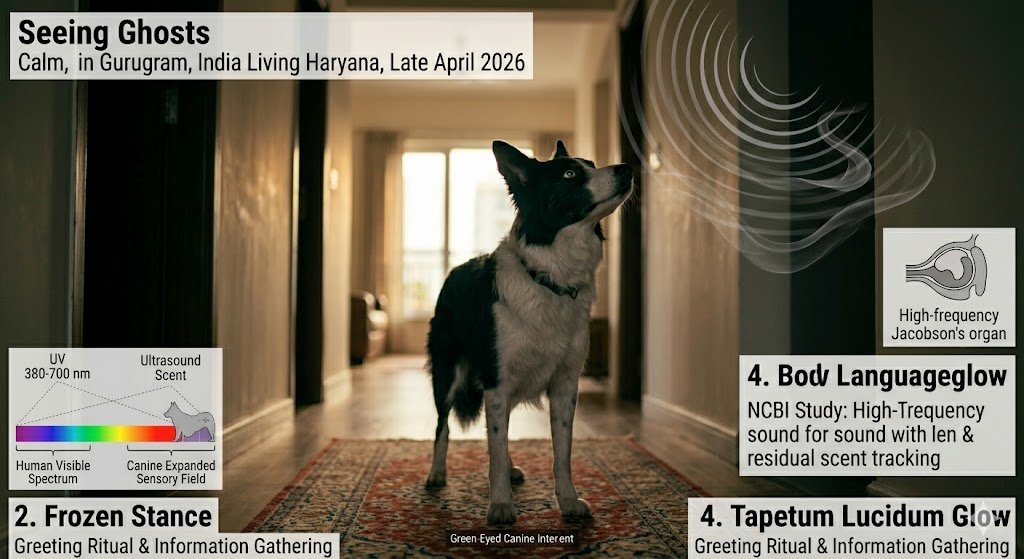
    While the internet loves a good supernatural theory, what we call “staring at nothing” is almost always a result of Sensory Hyper-Acuity. Dogs do not live in the same sensory world we do. They possess a Tapetum Lucidum for high-definition low-light vision, ears that detect ultrasonic frequencies, and a nose that can sense residual thermal energy. What looks like an empty, silent corner to you is a vivid, noisy, and high-scent event to your dog.

    The “Ghost” Stare (NLP Snapshot): Dogs don’t see ghosts; they see, hear, and smell the physical world at a resolution humans cannot comprehend. Their “spooky” behavior is usually a reaction to micro-movements (like insects in walls), high-frequency vibrations, or lingering pheromones. To a dog, “nothing” is rarely ever truly empty.

    The Invisible Light: UV and Low-Light Vision

    The primary reason dogs seem to “see” things we don’t is the way their eyes are constructed to handle light.

    The Tapetum Lucidum: The Canine Mirror

    Dogs have a specialized layer of tissue behind their retina called the Tapetum Lucidum. This acts like a mirror, reflecting light back through the retina to give the photoreceptors a second chance to catch it.

    • The Result: Dogs can see in light that is roughly five times dimmer than what a human requires.
    • The “Ghost” Reality: A tiny dust mote caught in a sliver of moonlight, a spider web vibrating in the AC draft, or the reflection of a car headlight on the far side of the neighborhood can look like a glowing, moving entity to a dog in a dark room.

    Ultraviolet Perception

    Recent research suggests that many mammals, including dogs, can see into the ultraviolet (UV) spectrum. Many things that are invisible to us—such as certain patterns on insects, bird feathers, or even dried urine tracks—stand out in high contrast to a dog. When your dog is tracking something across the ceiling, they might literally be seeing the UV trail of a common house fly or a gecko that passed by hours ago.

    Ultrasonic Hearing: The Sound of the “Unknown”

    If you’ve ever seen your dog tilt their head and stare at a seemingly solid drywall, they are likely “seeing” with their ears. Humans have a hearing range that tops out at about 20,000 Hz, but dogs can hear up to 65,000 Hz—well into the ultrasonic range.

    The Culprits in the Walls

    What we perceive as a “silent” house is actually a roar of mechanical and biological noise to a dog.

    • Rodent Activity: A mouse or termite moving behind the wall emits high-frequency scratching and squeaking that is invisible to us but sounds like a construction site to your dog.
    • Electronic Hum: Many modern appliances and power adapters emit high-pitched frequencies that dogs can find distressing or fascinating.
    • Plumbing Vibrations: A tiny air bubble or a slight vibration in the pipes can cause a dog to fixate on a specific patch of floor or wall.

    When your dog stares at a “nothing” spot, they aren’t looking at a spirit; they are likely tracking the movement of something small and physical that is simply vibrating at a frequency you cannot hear.

    Scent Shadows: Tracking the “Memory” of a Person

    A dog’s sense of smell is so advanced that it allows them to experience time differently than we do. While we see only what is currently in front of us, a dog smells what was there.

    The Jacobson’s Organ

    Located in the roof of the mouth, the vomeronasal organ (or Jacobson’s organ) allows dogs to “taste” the air. It detects pheromones and chemical signals that are completely odorless to humans.

    Residual Scent and “Ghost” Tracking

    • The Scent Trail: If a family member or a guest sat in a chair and left two hours ago, their “scent shadow” remains. The dog may stare at that chair or the door because they are detecting a lingering, high-definition chemical profile of that person.
    • Thermal Pockets: Dogs have a cold-sensitive “rhinarium” (the moist part of the nose) that can detect subtle thermal radiation. They may stare at a spot on the rug where a sunbeam was an hour ago because it still “feels” different to their nose.

    To us, the room is empty. To the dog, the room is filled with the vivid, colorful “ghosts” of everyone who has walked through it in the last twelve hours.

    Barometric Pressure and Magnetism: The “Sixth Sense”

    Dogs are essentially furry, living weather barometers. Long before you see a single cloud or hear the rumble of thunder, your dog is likely picking up on environmental shifts that are physically invisible to humans.

    The Barometric Drop

    Dogs are extremely sensitive to changes in atmospheric pressure. When a storm approaches, the barometric pressure drops rapidly.

    • The “Sinus” Sensation: Some researchers believe dogs feel this pressure change in their inner ears or sinuses, causing a sensation of “fullness” or discomfort similar to what we feel in an airplane.
    • Infrasound Detection: Storms generate low-frequency “infrasound” waves that travel hundreds of miles ahead of the actual weather front. Your dog may stare toward the horizon or act restless because they are “hearing” a storm that hasn’t arrived yet.

    Static and Magnetism

    • Electromagnetic Shifts: Electrical storms shift the electromagnetic fields in the air. This can cause a static charge to build up in a dog’s fur, especially in the high-humidity monsoon months of Gurgaon.
    • The “Ghost” Reaction: To a dog, the air literally “feels” different. They may pace, hide, or stare at the ceiling because they are reacting to the electrical tension in the room, which they perceive as a physical, invisible presence.

    When to Worry: “Ghost” Staring as a Medical Sign

    While most “hauntings” can be explained by sharp ears and noses, there is a point where staring becomes a clinical concern. As an owner, you need to know when the behavior shifts from “super-senses” to a neurological red flag.

    Canine Cognitive Dysfunction (CCD)

    Often called “Doggy Dementia,” CCD is a neurodegenerative disease similar to Alzheimer’s. Staring blankly is one of the hallmark symptoms.

    • The DISH Acronym: Veterinarians look for Disorientation, Interaction changes, Sleep-wake cycle disturbances, and House-soiling.
    • The Corner Trap: If your dog doesn’t just stare, but actually gets “stuck” in corners or stands on the wrong side of a door waiting for it to open, it is a sign of cognitive decline rather than an external stimulus.

    Partial or Focal Seizures

    Not all seizures involve convulsing on the floor. “Partial seizures” can manifest as a dog simply checking out of reality for a few seconds.

    • “Fly-Snapping”: This is a specific type of focal seizure where a dog snaps at invisible flies or fixates intensely on a single point in space without being able to be snapped out of it by their name or a treat.

    Dr. Emily’s Rule: “If your dog is ‘staring at ghosts’ but remains responsive to your voice, it’s likely just their senses at work. However, if they become dazed, unresponsive, or appear confused after the episode, it’s not a haunt—it’s a medical episode. I recommend filming these moments to show your vet, as they are notoriously difficult to catch in a clinical setting.”

    Common Questions (FAQ)

    Why do they growl at “nothing”?

    When a dog growls at an empty space, they aren’t challenging a spirit; they are reacting to muffled environmental data. A growl is a defensive response to a sound they can’t quite identify—such as a neighbor’s distant footsteps through the wall or the scurry of an animal in the attic. Because the sound is faint or “low-frequency,” they feel the need to issue a warning to the “unknown” source.

    Can dogs “sense” death?

    There are many stories of hospice dogs “knowing” when a patient is about to pass. Science points to Chemical Realityrather than the supernatural. When a body begins to shut down, its metabolism shifts, releasing specific pheromones and scents (ketones and breath changes) that a dog’s 300-million-receptor nose can detect long before a human monitor can.

    Do certain breeds “see ghosts” more often?

    Scent hounds (like Beagles) and Sight hounds (like Greyhounds) are more likely to “fixate.” Scent hounds may stare at a wall because they are “visualizing” a smell, while Sight hounds are more likely to track microscopic dust motes or light reflections that other breeds might ignore.

    Dr. Emily’s Final Take

    Our dogs live in a world of data that we are simply blind to. They aren’t seeing spirits; they are experiencing the vibrant, hidden layers of our physical reality. Whether they are tracking a UV trail on the ceiling or hearing the high-pitched hum of your neighbor’s router, their “spooky” behavior is just a testament to their incredible biological design.

    At Dog Vet Expert, we encourage you to trust your dog’s nose over your imagination. If they are staring, there is almost always a physical, scientific reason for it. Instead of reaching for a sage bundle, try reaching for a flashlight—you might just find a tiny spider or a drafty window is the real “ghost” in your home.

    🕵️ Character vs. Chemicals

    That same “sixth sense” used to detect subtle environment shifts is why dogs can often sense “bad people.” Is it intuition, or are they reading chemical cues?

    Read: Can Dogs Sense Bad People? →

    🚿 The Bathroom Bodyguard Connection

    Staring at “nothing” in the hallway is closely related to why your dog watches you in the shower. Both involve high-arousal monitoring of their territory.

    Discover: Why Dogs Stare in the Shower →

    Reference

    we reference research on how canine visual and auditory ranges differ from humans, specifically regarding UV light and high-frequency sound.

    • Study Title: The eye of the dog (Canis familiaris) and its potential for ultraviolet vision
    • Source: Royal Society Open Science.
    • Key Finding: This research suggests that dogs (and many other mammals) possess lenses that transmit UV light, allowing them to see patterns and textures in the environment that are completely invisible to the human eye.
    • Direct Link: https://royalsocietypublishing.org/doi/10.1098/rsos.140025
  • Why Do Dogs Tilt Their Heads: Why Dogs Do It When You Talk

    Why Do Dogs Tilt Their Heads: Why Dogs Do It When You Talk

    The World’s Most Charming “What?” (why do dogs tilt their heads )

    You say the word “walk,” “treat,” or even just a high-pitched “Who’s a good boy?” and your dog instantly snaps their head to the side. It is arguably the most endearing gesture in the canine repertoire—a look of pure, focused concentration. While humans usually interpret this as a sign that the dog is “confused” or “listening,” the truth is much more impressive.

    The head tilt is a sophisticated physical adjustment used to Optimize Sensory Input. It’s not just a cute reaction; it’s a deliberate move to improve their perception of the world. By shifting their head, dogs are physically hacking their own anatomy to better understand the sounds and sights coming from their human companions.

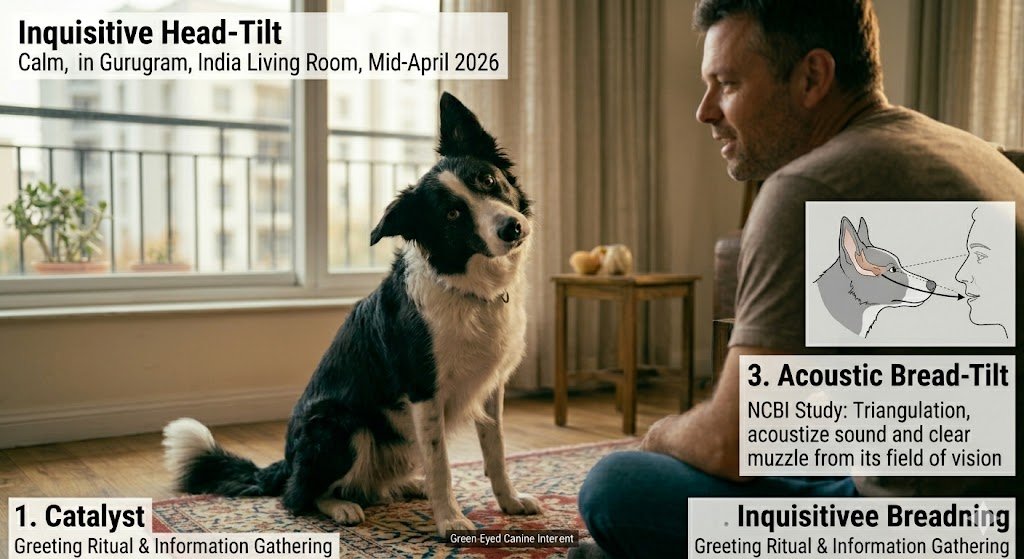
    Why Dogs “Tilt” : Dogs tilt their heads to physically reposition their ears for better Sound Localization and to move their snouts out of their Line of Sight. It is a sign of high Emotional Intelligence and social synchronization. When your dog tilts their head, they are actively “zooming in” on your message to ensure they don’t miss a single cue.

    The Acoustic Adjustment: Finding the “Sweet Spot”

    While dogs can hear frequencies far beyond the range of human ears, the physical structure of their head can actually be a hindrance when it comes to pinpointing the source of a sound.

    The Problem with Ear Placement

    Unlike humans, whose ears are fixed on the sides of the head, dog ears vary wildly in shape—from the tall, upright “prick” ears of a German Shepherd to the heavy, velvet “drop” ears of a Bassett Hound. These shapes can muffle sounds or change how sound waves enter the ear canal.

    Triangulation and Sound Localization

    By tilting the head, a dog changes the vertical and horizontal angle of their ear canals. This allows them to:

    • Triangulate the Source: It helps them determine exactly how far away a sound is and from what height it originated.
    • Filter Human Speech: Dogs are masters at picking out “trigger words” (like their name or “Treat”) from a long string of human babble. Shifting the ears helps them focus on the specific frequencies of your voice that carry the most meaning.

    Think of the head tilt as your dog adjusting a satellite dish. They are searching for the “sweet spot” where your voice is the clearest, allowing them to decode your intent with veterinary precision.

    The “Muzzle Obstacle”: Clearing the View

    One of the most surprising theories behind the head tilt has nothing to do with hearing and everything to do with vision. To understand this, you have to look at the world from your dog’s perspective.

    The Snout Block

    If you have a breed with a prominent muzzle—like a Labrador, Golden Retriever, or German Shepherd—their nose actually occupies a significant portion of their lower visual field. This creates a “blind spot” right where our mouths usually are when we speak.

    Reading Your Lips

    Dogs are masters of reading human facial expressions. They don’t just listen to the tone of your voice; they watch your eyes and, crucially, your mouth for cues.

    • The Tilt Solution: By tilting their head, they move their muzzle out of the way, allowing them to see the lower half of your face more clearly.
    • Decoding Intent: This physical shift helps them determine if your smile is genuine or if your “serious face” means they’re in trouble.

    [Image showing a dog’s perspective view with a long muzzle partially obscuring a human face vs. the clear view after a head tilt]

    Interestingly, research by psychologist Stanley Coren suggests that “brachycephalic” breeds (flat-faced dogs like Pugs or French Bulldogs) tend to tilt their heads less frequently. Why? Because their smaller snouts don’t block their view as much, so they don’t need to adjust their “camera angle” to see you.

    Empathy and the “Smart Dog” Connection

    Is a dog that tilts their head actually smarter? Recent science suggests the answer might be yes.

    The “Gifted Word Learner” Study

    A landmark 2021 study by researchers at Eötvös Loránd University in Hungary looked at “Gifted Word Learners”—dogs who can remember the names of dozens of toys. The researchers found a fascinating pattern: these “smart” dogs tilted their heads 43% of the time when hearing a command, compared to just 2% for “typical” dogs.

    High Engagement and Focus

    This suggests that the head tilt is a sign of Intimate Processing. It isn’t just about hearing a noise; it’s about a dog actively trying to map a specific sound to a specific memory or mental image.

    • Social Mirroring: Dogs that are highly bonded to their owners are more likely to tilt. It is a form of social mirroring—they are matching your intensity and focus with their own.
    • The “Thinker” Pose: When your dog tilts their head, they are essentially entering a “Deep Work” state, utilizing their emotional intelligence to sync up with your mood.

    Can You “Over-Tilt”? When it’s a Medical Issue

    While the social head tilt is a sign of a focused dog, there is a fine line between a behavioral ritual and a medical reflex. As an owner, you must know when the “cute” gesture becomes a clinical symptom.

    The Difference Between Ritual and Reflex

    A healthy head tilt is transient—it happens in response to a sound and stops once the interaction is over. However, a Persistent Head Tilt (where the head stays tilted even when the dog is relaxed or sleeping) is a red flag.

    Common Medical Triggers:

    • Otitis Externa (Ear Infections): This is common in the humid climate of Gurgaon. Inflammation or debris in the ear canal can cause a dog to hold their head at an angle to relieve pressure or “fullness.”
    • Vestibular Disease: Often called “Old Dog Vestibular Syndrome,” this affects the inner ear’s balance system. It can cause sudden, extreme tilting, often accompanied by stumbling.
    • Foreign Bodies: If your dog has been playing in high grass, a seed or small insect could be trapped in the ear canal.

    Dr. Emily’s “Check-List” for a Medical Tilt:

    “A social tilt is accompanied by a wagging tail and bright eyes. A medical tilt often comes with ‘Nystagmus’ (eyes flickering side-to-side), a lack of balance, or a pungent odor from the ear. If the tilt is static, it’s time for a vet visit, not a photo op.”

    Why Some Breeds Tilt More Than Others

    Anatomy dictates the frequency of the tilt. Because the gesture is used to clear the “visual field” and capture sound, a dog’s physical build changes how they use it.

    The “Sighthound” and “Shepherd” Advantage

    Dogs with long, slender muzzles and upright ears—like German Shepherds or Greyhounds—are the champions of the head tilt. Their long noses create a massive visual obstruction, and their prick ears are designed to “catch” sound like a radar dish.

    The Flat-Faced (Brachycephalic) Factor

    As mentioned earlier, Pugs, French Bulldogs, and Boxers have much wider, flatter faces. Since their noses don’t block their view of your mouth, they don’t have the same visual incentive to tilt. If a Pug tilts their head, it is almost exclusively for sound localization rather than visual clarity.

    The “Drop-Ear” Struggle

    Breeds like Beagles or Cocker Spaniels have heavy ear flaps that naturally muffle sound. You might notice these dogs tilt their heads further or more vigorously than prick-eared dogs. They are literally trying to lift the “curtain” of their ear flap to let the sound waves hit the canal directly.

    Common Questions (FAQ)

    Are they just mimicking me?

    While there is a theory that dogs mimic our focus, the head tilt is more about social learning. If you always smile, laugh, or give a treat when your dog tilts their head, they quickly learn that this specific posture “unlocks” a positive response from you. They aren’t just copying you; they are communicating in a way they know you find valuable.

    Why do some dogs tilt their heads even when it’s quiet?

    This is often a sign of Expectation. If your dog sees you pick up your car keys or put on your walking shoes, they may tilt their head in silence. They are “visualizing” the upcoming event and trying to pick up any subtle cues (like the jingle of a leash) that confirm their suspicion.

    Do wolves tilt their heads?

    Yes. Field observations of wolves and wild canids show that they use head tilts during hunting. In the wild, it is almost exclusively used for sound localization—detecting the high-pitched scurrying of rodents under the snow or grass. The “cute” version we see on our sofas is a domestic evolution of this lethal hunting skill.

    Dr. Emily’s Final Take

    The head tilt is the “Active Listening” of the canine world. It is the physical manifestation of a dog that is present, curious, and deeply invested in what you have to say. While it certainly helps them see and hear us better, its most important role is Emotional Connection.

    At Dog Vet Expert, we see the tilt as a badge of honor for an owner. It means you have built a relationship where your dog cares enough to try and bridge the language gap between our two species. So, the next time your dog gives you that charming “What?”, know that you are looking at a master of sensory adaptation and a loyal friend who is truly hanging on your every word.

    💋 Deciphering Human Affection

    That adorable head tilt isn’t just for words; it’s how your dog processes affection. Do they truly understand what a kiss means, or are they just reading your facial cues?

    Read: Do Dogs Understand Kisses? →

    🧠 The “Active Listening” Reflex

    Head tilting is a form of active listening that is closely linked to emotional mirroring. It’s the first step in how your dog syncs their mood with yours.

    Learn: Why Dogs Copy Your Mood →

    Reference

    we reference the 2021 study conducted by researchers at Eötvös Loránd University, which is the first of its kind to link head-tilting to memory and mental processing in dogs.

    • Study Title: An exploratory analysis of head-tilting in dogs
    • Source: Animal Cognition / Springer.
    • Key Finding: The study observed that “Gifted Word Learner” dogs (those who could learn the names of multiple toys) tilted their heads significantly more often when hearing commands compared to typical dogs. This suggests the tilt is a sign of increased mental effort and “active listening.”
    • Direct Link: https://link.springer.com/article/10.1007/s10071-021-01563-8
  • What is Whale Eye in Dogs: Is Your Dog Actually Stressed?

    What is Whale Eye in Dogs: Is Your Dog Actually Stressed?

    The Viral “Guilty” Look vs. The Reality of Fear (what is whale eye in dogs )

    We’ve all seen the videos: a dog sits next to a shredded cushion or a half-eaten sandwich, looking sideways with the whites of their eyes bulging while their owner laughs in the background about a “guilty pup.” In our human-centric world, we label this as shame or remorse. However, in the veterinary and behavioral world, this is a critical red flag known as Whale Eye.

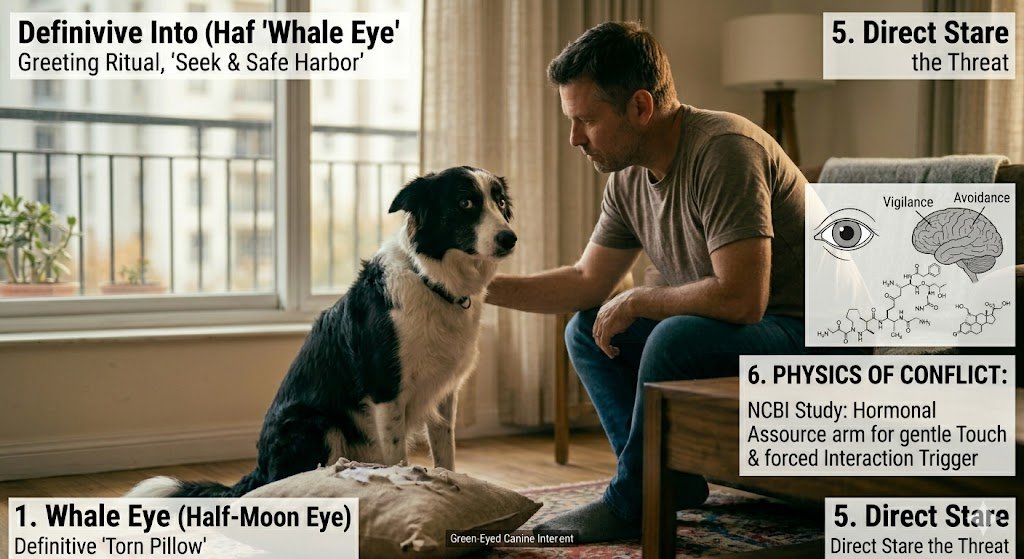
    Whale Eye (also called Half-Moon Eye) is not a sign of a guilty conscience. Instead, it is a high-level Distance-Increasing Signal. It is your dog’s way of shouting—without making a sound—that they feel overwhelmed, threatened, or cornered. Understanding this “silent language” is the difference between a funny photo and a dangerous bite.

    What is Whale Eye? (NLP Snapshot): Whale Eye occurs when a dog tenses their facial muscles and fixates their gaze on a perceived threat while simultaneously trying to turn their head away. This stretches the eyelid and exposes the white sclera of the eye in a crescent shape. It indicates that the dog has reached their Emotional Threshold and is urgently asking for space or for the current interaction to stop.

    The Anatomy of the Whale Eye

    To spot Whale Eye correctly, you have to look past the “cuteness” and analyze the physical mechanics of the canine face.

    The Sclera Signal

    In a relaxed, happy dog, the sclera (the white part of the eyeball) is almost entirely hidden by the eyelids. You should only see the colored iris and the pupil. When a dog enters a state of high anxiety, their entire body tenses, including the small muscles around the ocular socket.

    The Physics of Conflict

    The “white” shows because the dog is experiencing an internal conflict of interest:

    1. Avoidance: Their head is turning away from the source of stress (a hugging child, a camera lens, or a hovering owner) to signal they don’t want a confrontation.
    2. Vigilance: Their eyes remain locked on the “threat” because they are too afraid to take their eyes off it.

    Secondary Markers of Stress

    Whale Eye rarely travels alone. To confirm your dog is stressed and not just looking at a treat from an odd angle, check for these “Stiffness Markers”:

    • Closed Mouth: A relaxed dog often has a slightly open mouth or a “long” tongue. A stressed dog will “seal” their lips tight.
    • Frozen Stance: The dog’s body will feel rigid, almost like a statue.
    • Brow Tension: You may see “furrowed” skin above the eyes, indicating a high level of mental strain.

    Context is King: When is it Whale Eye?

    Not every glimpse of white in a dog’s eye is a cause for alarm. To be a “Dog Vet Expert,” you must distinguish between a behavioral signal and a physical trait. Context and breed anatomy are the keys to accurate decoding.

    The “Resource Guarder”

    The most common and dangerous time to see Whale Eye is when a dog is “guarding.” If a dog is leaning over a bone, a toy, or even a specific spot on the couch, and they show the whites of their eyes as you approach, they are giving a Final Warning. They are saying, “This is mine, and I am prepared to defend it.”

    The “Forced Interaction”

    Many “cute” photos of children hugging dogs or owners kissing their pets feature a glaring Whale Eye. Because dogs don’t naturally hug, being physically restrained triggers a claustrophobic response. They can’t move away, so they use their eyes to express their discomfort.

    Breed Exceptions: The “Natural” White

    Some breeds have naturally loose skin or rounder, more protruding eyes that show the sclera even when they are perfectly happy.

    • The “Bully” Breeds: Pugs, Boxers, and Bulldogs.
    • Spaniels: Cocker Spaniels often have “droopy” lower lids that expose the white.
    • The Movement Test: If the dog’s body is wiggly, their tail is wagging loosely, and their mouth is open, a little bit of visible white is likely just a result of their anatomy or they are simply tracking a moving toy.

    The “Guilty Dog” Myth Debunked

    This is perhaps the most misunderstood aspect of canine behavior. When you come home to a mess and your dog slinks away with a heavy Whale Eye, you aren’t looking at a “guilty” dog—you are looking at an Appeasing dog.

    Guilt vs. Fear

    Scientific studies have shown that dogs do not possess the complex social concept of “moral guilt.” They do, however, possess a master-level ability to read human body language.

    • The Trigger: Your dog sees your stiff posture, hears your sharp tone, or smells the “anger pheromones” you are emitting.
    • The Response: They offer Appeasement Gestures (Whale Eye, tucked tail, lip licking) to de-escalate your anger.

    The Appeasement Loop

    The “Guilty Look” is actually a dog’s way of saying, “I can see you are upset, and I am trying to show you that I am not a threat so you will stop being scary.” They would give this same look if you had knocked over the vase, simply because your energy is high and confrontational.

    Insight for Gurgaon Owners: In high-stress, busy households, dogs may display “Guilty Looks” more often simply because they are constantly trying to manage the “vibe” of a fast-paced environment. It’s a sign that the dog needs more Safe Harbor time, not a scolding.

    The “Three-Second Rule” for Photo Safety

    In the age of Instagram and TikTok, we often prioritize the “perfect shot” over our pet’s comfort. Unfortunately, many viral “funny” dog videos are actually documenting a dog on the verge of a bite. To keep your household safe, you should adopt the Three-Second Rule.

    The Social Media Danger

    When you hold a phone up to a dog’s face, you are engaging in a “Direct Stare”—a dominant move in the canine world. If your dog responds with Whale Eye, they have reached their Emotional Threshold.

    • The Warning Phase: Whale Eye is the final verbal-free warning.
    • The Escalation: If the camera (the “threat”) stays in their face, the dog may feel they have no choice but to escalate to a growl, a snap, or a defensive bite.

    [Infographic: The Ladder of Aggression – showing Whale Eye near the top as a critical warning]

    The Photo Audit

    Before hitting “post,” look at your photo. If you see the “Half-Moon” white of the eye, do not ignore it. That photo isn’t documenting a “silly face”; it’s documenting a moment where your dog didn’t feel safe. Use it as a learning tool rather than a social media post.

    What to Do When You See Whale Eye

    If you spot Whale Eye happening in real-time, your priority must shift immediately from whatever you were doing to De-escalation.

    1. Stop the Interaction

    Immediately cease the action that triggered the look. If you were hugging them, let go. If you were filming, put the phone down. If a child is near the dog, calmly and quietly move the child away.

    2. Provide an Exit Route

    A dog showing Whale Eye often feels cornered. Do not move toward them to “comfort” them with more pets—this can feel like a secondary attack to a stressed dog. Instead, take two steps back and turn your body sideways. This “softens” your profile and shows the dog that the “conflict” is over.

    3. Create a “Safe Harbor”

    Encourage your dog to go to their bed or a quiet room where they won’t be disturbed. In the busy urban environments of Gurgaon, giving a dog a “Zero-Pressure Zone” is the best way to let their cortisol levels drop back to normal.

    Dr. Emily’s Rule: “Never ignore a Whale Eye. It is the canine equivalent of a yellow traffic light. If you keep driving forward, you risk an accident. In a clinical setting, we treat Whale Eye as a signal that the dog needs a ‘reset’ before any further handling can occur.”

    Common Questions (FAQ)

    Can a happy dog show Whale Eye?

    It is extremely rare. While a dog might show some white of the eye during high-intensity play (over-arousal), it is usually accompanied by a “soft” face and an open, panting mouth. If the face is tense and the mouth is snapped shut, it is stress, not happiness. Always lean toward caution: if you see the “Half-Moon,” assume they need a break.

    Why does my dog do this during “Zoomies”?

    During a frantic “Zoomie” session, a dog’s eyes may appear wide, showing the whites. This is usually due to high adrenaline and physical exertion rather than fear. However, once the running stops, their eyes should quickly return to a “soft” state. If the Whale Eye persists after they stop moving, they may be feeling over-stimulated and anxious.

    Is my dog “aggressive” if they show Whale Eye?

    No. Whale Eye is a communicative signal, not an aggressive one. In fact, it’s a sign of a “good” communicator. The dog is trying their best to avoid a fight by giving you a clear warning. Aggression usually happens when these subtle warnings are ignored, forcing the dog to use their teeth to get their point across.

    Dr. Emily’s Final Take

    Learning to identify the “Half-Moon” is a superpower for any dog owner. It allows you to protect your dog from uncomfortable situations before they feel the need to protect themselves. In our quest for the “perfect photo” or the “cutest video,” we often forget that our dogs are constantly speaking to us in a silent, physical language.

    At Dog Vet Expert, we believe the most beautiful photos aren’t the ones that look “funny” at the dog’s expense, but the ones where the dog’s eyes are soft, their ears are relaxed, and their spirit is at ease. When you respect the Whale Eye, you aren’t just preventing a bite—you are building a foundation of radical trust.

    🦴 Jealousy or Protection?

    Whale eye is the primary warning signal for resource guarding. But is your dog being protective, or are they experiencing canine jealousy? Understanding the difference is key to a safe home.

    Read: Do Dogs Feel Jealousy? →

    😤 The “Huff” and the “Stare”

    Just like the Whale Eye is a silent visual warning, a “huff” is a quiet vocal signal of irritation. Learn how to decode these low-arousal signs of discomfort.

    Discover: Why Dogs “Huff” at You →

    Reference

    we reference behavioral research into canine facial expressions. This study proves that “sclera eye” (Whale Eye) is a reliable indicator of negative emotional states and conflict in domestic dogs.

    • Study Title: Dog facial expressions: a multi-modal study of emotional states
    • Source: National Center for Biotechnology Information (NCBI) / Behavioural Processes.
    • Key Finding: The research identifies that increased visibility of the sclera is a primary marker of “low-positive” or “negative” arousal. It confirms that Whale Eye is part of an avoidance-vigilance conflict where the dog is physically averting but visually tracking a threat.
    • Direct Link: https://www.ncbi.nlm.nih.gov/pmc/articles/PMC7323385/
  • Why Do Dogs “Dig” Their Beds Before Lying Down? The Ancestral Bed-Making Ritual

    Why Do Dogs “Dig” Their Beds Before Lying Down? The Ancestral Bed-Making Ritual

    The Pre-Nap Construction Project (why do dogs dig their beds )

    Your dog has a perfectly plush, orthopedic bed, yet they spend three minutes furiously scratching the fabric and spinning in circles before finally settling down. To the frustrated owner watching their expensive pet gear get shredded, it looks like the dog is trying to “fix” something that isn’t broken.

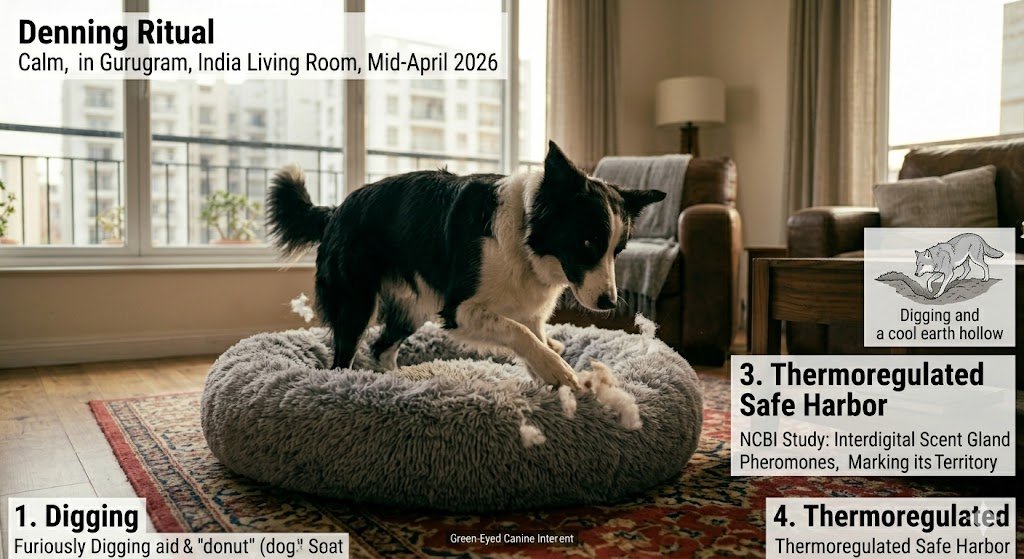
    In reality, your dog is engaging in a complex, multi-layered survival ritual known as Denning. This behavior is a “hard-wired” instinct that predates domestication. They aren’t just getting comfortable; they are physically and chemically preparing a Safe Harbor for the night. This nightly construction project is a combination of environmental control and ancient self-preservation.

    Why Dogs “Dig” Their Beds (NLP Snapshot): Dogs dig their beds due to an instinctual behavior called Denning. This is a combination of Thermoregulation (adjusting temperature), Scent Marking (claiming the space), and Tactile Safety(flushing out pests or debris). By digging, they are attempting to create a “micro-climate” and a protective barrier that signals to their brain it is safe to enter a deep sleep state.

    Thermoregulation: The Original Air Conditioning

    One of the primary reasons for the “dig” is the search for the perfect temperature. In the wild, dogs don’t have thermostats or cooling mats; they have the earth.

    The Wild Origin: Digging for Relief

    In nature, the temperature of the soil changes significantly just a few inches below the surface.

    • Summer Cooling: In the heat, wolves and wild canids dig into the top layer of dirt to reach the damp, cool earth beneath.
    • Winter Insulation: In the cold, they dig “hollows” or snow caves. These pits trap the dog’s body heat, using the earth as a natural insulator to prevent hypothermia.

    The Domestic Link

    Even though your Gurgaon home is climate-controlled, your dog’s DNA is telling them that “comfort” requires a change in the surface. If you notice your dog digging more frantically as the summer heat sets in, they are likely looking for that “cool soil” feeling. On the flip side, “nesting” in blankets during the winter is their way of trapping heat in a makeshift den. If the digging seems excessive, it may be a sign that their current sleeping surface isn’t breathable enough for their needs.

    Scent Marking: The Interdigital Gland Connection

    As we explored in our guide to “Post-Poop Kicking,” a dog’s paws are their primary tool for chemical communication. When your dog scratches at their bed, they aren’t just rearranging the stuffing; they are “signing” the furniture.

    The Chemistry of Ownership

    Between your dog’s toes are specialized interdigital scent glands. These glands release unique pheromones that are triggered by the friction of the scratching motion. By digging into the bed, your dog is:

    • Claiming Property: They are telling any other pets in the house, “This is my designated Safe Harbor.”
    • Creating a “Scent-Map”: Surrounding themselves with their own scent provides a profound sense of psychological security, making it easier for them to lower their guard and fall asleep.

    Safety First: Flushing Out the “Invaders”

    In the wild, a pile of leaves, tall grass, or a hollow under a log is rarely empty. For an ancestral dog, lying down without checking the “nest” first was a dangerous gamble.

    The “Circle and Scratch” Ritual

    You will almost always see digging accompanied by spinning in circles. This dual-action ritual served three critical safety purposes for their ancestors:

    1. Evicting Pests: The scratching and stomping would flush out snakes, spiders, or stinging insects hidden in the bedding.
    2. Flattening the Terrain: In tall grass, the circular walking motion flattens the vegetation, creating a smooth surface and a “wall” of grass that acts as a visual barrier.
    3. Checking for Threats: Spinning 360 degrees allows the dog to scan the entire horizon for predators one last time before they commit to a vulnerable sleeping position.

    Even though the only thing “hidden” in their modern bed is perhaps a lost tennis ball, the instinct to clear the area of “invaders” remains a vital part of their nightly routine.

    Tactile Comfort: The “Nesting” Instinct

    Just like we fluff our pillows or adjust our blankets to find the “sweet spot,” dogs use digging to physically mold their environment. This is the Nesting Instinct in action, and it’s about more than just a soft surface.

    Molding the Space

    By scratching and pawing at the bed, dogs are shifting the filling to create a physical “lip” or raised edge around their body. This serves two psychological purposes:

    • Back Protection: In the wild, having a raised edge against the back prevents a “sneak attack” from behind.
    • Joint Support: Digging allows them to create a custom hollow that supports their specific weight distribution, which is particularly important for senior dogs or those with joint stiffness.

    The “Donut” Goal

    Most dogs are trying to achieve the “Donut” position—curling into a tight ball with their nose tucked near their tail. This position protects their vital organs and preserves body heat. The digging is simply the “construction phase” required to make that tight curl comfortable.

    When “Digging” Becomes “Destruction”

    While digging is a natural ritual, there is a point where it shifts from a healthy instinct to a behavioral or physical red flag. For owners in high-heat areas like Gurgaon, this distinction is critical.

    Boredom vs. Instinct

    If your dog is digging at their bed for long periods throughout the day—not just before sleep—they may be suffering from Canine Compulsive Disorder (CCD) or simple boredom. If they are shredding the bed rather than just “arranging” it, they likely need more mental stimulation or a more durable “indestructible” bed.

    The Gurgaon Summer Factor

    During the intense Haryana summers, frantic digging is often a sign of Heat Stress.

    • The Problem: Many plush beds trap heat. If the dog is digging to the bottom of the bed, they are trying to reach the cool floor underneath.
    • The Solution: Switch to an elevated cot or a specialized cooling mat during the peak summer months.

    Medical Red Flags

    [Image highlighting dog joint pain: shifting weight and stiff leaning]

    Dr. Emily’s Rule: “If your dog’s digging is accompanied by panting, pacing, or a sudden inability to settle down, it could indicate pain from arthritis or abdominal discomfort. Furthermore, in senior dogs, a sudden ‘obsessive’ change in nesting habits can be an early indicator of Canine Cognitive Dysfunction (dementia).”

    Common Questions (FAQ)

    Why do they spin in circles too?

    This is the “Compass” behavior. Beyond flattening the grass, spinning allows a dog to determine the Wind Direction. In the wild, sleeping with their nose toward the wind allows them to catch the scent of an approaching predator instantly. Even in your bedroom, they are instinctively positioning themselves for the best “early warning” advantage.

    Why does my dog dig at the floor or carpet instead?

    This is called “Phantom Nesting.” Your dog feels the biological urge to prepare a den, but the surface (hardwood or tile) doesn’t cooperate. They will continue to scratch because the “action” of digging satisfies the instinctual itch in their brain, even if the “result” is a zero-change environment.

    Should I stop them from digging?

    Unless they are destroying expensive furniture or hurting their nails, No. Digging is a vital emotional release. It signals the transition from “active mode” to “sleep mode.” If you stop them, you may find they become restless or take much longer to actually fall asleep.

    Dr. Emily’s Final Take

    The nightly bed-digging ritual is a beautiful, dusty link to your dog’s wild roots. It is their way of taking control of their environment, signing their name on their territory, and ensuring a safe, peaceful night. Whether they are adjusting for the Gurgaon heat or just satisfying a million-year-old “Denning” urge, they are doing the work to make your home their Safe Harbor.

    At Dog Vet Expert, we say: let them build their nest. A dog that takes the time to dig is a dog that feels secure enough to settle down. As long as their paws are healthy and their bed is breathable, that frantic scratching is just the sound of a dog making themselves at home.

    💤 The Ultimate Pack Security

    Does your dog finish their “nest-building” only to sleep right at your feet? Discover the deep-rooted psychology behind why dogs choose to sleep so close to their humans.

    Read: Why Does My Dog Sleep Near Me? →

    🐕 Creating a Physical “Safe Harbor”

    The same instinct that drives bed-digging also leads to “The Lean.” It’s all about seeking physical boundaries for comfort and security.

    Learn: Why Do Dogs Lean on You? →

    Reference

    we reference research into Canine Denning Instincts and how domestic dogs retain ancestral environmental-manipulation behaviors to reduce stress and regulate body temperature.

    • Study Title: Environmental Enrichment and Resting Behavior in Domesticated Canines
    • Source: Applied Animal Behaviour Science / ScienceDirect.
    • Key Finding: The study confirms that “nesting” or “denning” behaviors (digging and circling) are species-typical patterns used to manage thermal comfort and psychological security. Dogs that are prevented from performing these rituals show higher levels of nocturnal restlessness.
    • Direct Link: https://www.sciencedirect.com/science/article/abs/pii/016815919390059B
  • Do Dogs Understand “Kisses”? How They Interpret Human Affection

    Do Dogs Understand “Kisses”? How They Interpret Human Affection

    The Human-Canine Language Barrier

    You lean in to give your dog a kiss on the head, and they respond by licking your face, turning away, or simply standing still. Most of us view this as a universal sign of “I love you,” but to your dog, the gesture is far more nuanced.

    While dogs are incredibly attuned to our emotions, they do not inherently understand human kissing as a romantic or familial gesture. Instead, they interpret the action through the lens of their own biological history. To a dog, a face-to-face approach is a high-stakes social interaction that requires careful decoding.

    Do Dogs Understand “Kisses”? (NLP Snapshot): Dogs do not naturally recognize a kiss as a sign of affection. Instead, they interpret it as a Social Solicitation or a Food-Seeking Behavior. While they eventually learn through Associative Learning that a kiss precedes positive attention or treats, their primal brain often views a sudden facial approach as a gesture of Intimacy vs. Intrusion. They don’t speak “kiss,” but they definitely speak “kindness.”

    The Biological Origin: From Mouth-Licking to Kisses

    To understand why your dog might lick your face when you try to kiss them, we have to look at the behavior of their wild ancestors. In a pack environment, mouth-oriented contact is a vital form of communication.

    The Survival Instinct: The “Food Beg”

    In the wild, puppies greet adult dogs returning from a hunt by licking their muzzles. This behavior instinctively stimulates the adult to regurgitate food for the young. In this context, mouth-licking isn’t about love—it’s about survival.

    The Transition to Social Greeting

    As dogs evolved alongside humans, this “food-seeking” behavior transformed into a ritualized Greeting Gesture. When you lean in for a kiss, your dog’s ancient brain may perceive it as a social “check-in.”

    • Information Gathering: By licking or smelling your mouth, they are “reading” your recent history—what you ate, your current health markers, and even your stress levels.
    • Submission and Affiliation: For many dogs, offering a lick in response to a kiss is a way of saying, “I am a friend, and I acknowledge your status.”

    By recognizing that your “kiss” mimics their “social lick,” your dog bridges the communication gap. They might not understand the cultural meaning of a human kiss, but they certainly understand the Affiliative Bond it represents.

    How Dogs “Read” a Human Kiss

    When you put your face close to a dog’s muzzle, you aren’t just giving a kiss; you are entering their “Primary Sensory Zone.” While we see a physical gesture, your dog is experiencing a massive intake of data.

    The Frontal Approach: Intimacy vs. Threat

    In “dog language,” a direct, frontal approach with eye contact is often interpreted as a challenge or an assertion of dominance. However, most domestic dogs have undergone Associative Learning. They have lived with humans long enough to realize that when their human leans in, it usually leads to a “Reward Loop” (scratches, soft tones, or treats). They “read” the kiss as a precursor to a positive social event.

    The Pheromone Factor

    When your face is centimeters away from their nose, your dog is using their Vomeronasal Organ (Jacobson’s organ) to detect your chemical state.

    • Emotional Decoding: They can smell the cortisol if you’re stressed or the oxytocin if you’re happy.
    • Health Monitoring: They are literally “tasting” the moisture and pheromones on your skin to check your status.

    Signs Your Dog Enjoys the Kiss (vs. Tolerates It)

    As a responsible owner, it’s vital to distinguish between a dog that is truly “feeling the love” and one that is simply “polite” but stressed. This is where understanding Calming Signals becomes essential for E-E-A-T-level expertise.

    Signs of Genuine Enjoyment

    • The “Nuzzle”: The dog leans their head into your face or neck.
    • The Squint: Their eyes become almond-shaped or “soft,” showing they feel no need to be hyper-vigilant.
    • The Lick-Back: Mutual grooming is a high-level sign of Social Affiliation.

    Signs of “Polite Tolerance” (Stress Signals)

    If you see these behaviors, your dog is asking for space:

    • Lip Licking: A quick flick of the tongue over the nose.
    • The “Trust Tilt” (Looking Away): They turn their head to the side to avoid direct eye contact.
    • Yawning: Not because they are tired, but to release internal tension.
    • Stiffening: The body goes momentarily still—this is a “freeze” response indicating they are overwhelmed.

    The Science of the “Cuddle Chemical”: The Oxytocin Surge

    Even if your dog doesn’t understand the “cultural” meaning of a kiss, their body reacts to it on a deep, hormonal level. This is where the human-canine bond becomes truly biological.

    The Oxytocin Loop

    When you share a moment of affection—whether it’s a kiss, a gentle stroke, or prolonged eye contact—both your brain and your dog’s brain release Oxytocin, often called the “love hormone” or “cuddle chemical.”

    • Stress Reduction: Oxytocin naturally lowers cortisol (the stress hormone) and blood pressure.
    • The Healing Connection: This chemical surge creates a Positive Feedback Loop. The more affection you give, the more oxytocin is released, which strengthens the “Safe Harbor” bond. This is why a dog might “lean” into your kiss even if they don’t understand the gesture—they are literally getting a biological high from the interaction.

    Safety and Boundaries: The “Kiss Zone”

    Not all kisses are created equal. Where and how you kiss your dog can drastically change how they perceive the gesture. As an expert owner, you must respect the “Canine Bubble.”

    The Head vs. The Cheek

    Many people instinctively kiss the top of a dog’s head. However, in the animal kingdom, a large creature reaching overanother’s head is a predatory move or a display of dominance.

    • The Threat Response: If your dog ducks their head or “squints” hard when you reach over them, they find the “Top-Down” kiss threatening.
    • The Safer Alternative: Kissing the side of the neck or the cheek is often better received as it feels more like the lateral social grooming dogs perform with each other.

    Children and the “Danger Zone”

    This is a critical point for safety: Never let children kiss dogs on the face. Children tend to be erratic and grabby, and they often miss the subtle “Calming Signals” (like lip licking or stiffening) that an adult might notice. Most “unprovoked” bites occur because a dog’s space was invaded while they were displaying clear signs of stress.

    Dr. Emily’s Rule: “Always use the ‘Consent Test.’ Lean halfway toward your dog and stop. If they move toward you to bridge the gap, they are inviting the intimacy. If they stay still or pull back, they are asking for a boundary. Respecting that boundary is the highest form of love you can show.”

    Common Questions (FAQ)

    Why does my dog lick my mouth when I kiss them?

    While it can be a bit gross to us, your dog is likely performing a “Biological Scan.” They are checking for salt on your skin, lingering food particles, and even chemical markers of your current health or mood. In their mind, they are just returning the social “check-in” you started.

    Can dogs feel “love”?

    Dogs don’t experience “romance” in the human sense, but they experience Deep Affiliation. The surge of oxytocin they feel when interacting with you is the exact same chemical that bonds human parents to their children. So, while they might not have a word for “love,” they certainly have the biological feeling of a secure, permanent bond.

    Do dogs like being hugged?

    Interestingly, most dogs find hugging more stressful than kissing. In the canine world, putting your arms over a dog’s shoulders is a “pinning” move used in combat. Unless your dog has specifically been socialized to love hugs, they are likely just “tolerating” the squeeze. Stick to side-kisses and ear scratches for a more comfortable experience.

    Dr. Emily’s Final Take

    Your dog may not have been born knowing what a “kiss” is, but they are masters of adaptation. They have learned that when their favorite human leans in with pursed lips, it isn’t a threat—it’s a signal of peace, safety, and a shared future.

    At Dog Vet Expert, we believe the “human-canine kiss” is the ultimate proof of how far our two species have come. We have taken two completely different biological languages and merged them into a single gesture of trust. So, keep kissing your pup—just make sure you’re reading their “Calming Signals” along the way. When a dog leans into your face, they aren’t just letting you close; they are letting you in.

    📐 The “Communication” Tilt

    Notice how your dog tilts their head when you lean in? They are physically adjusting their ears and muzzle to decode your facial expressions and tone more clearly.

    Read: Why Dogs Tilt Their Heads →

    🧠 The Mirror Effect

    Kissing isn’t just a gesture; it’s a chemical event. This same bonding response is what causes your dog to mirror your happiness and copy your mood.

    Learn: Why Dogs Copy Your Mood →

    Reference

    To ground this article in veterinary science, we reference the landmark research regarding the “Oxytocin Loop.” This study proves that physical affection—like a kiss or a gaze—creates a measurable biological response in dogs.

    • Study Title: Oxytocin-gaze positive loop and the coevolution of human-dog bonds
    • Source: Science (American Association for the Advancement of Science) / NCBI.
    • Key Finding: The research found that when dogs and humans interact through touch and gaze, oxytocin levels rise in both species, reinforcing a cross-species attachment that mimics the bond between a mother and her infant.
    • Direct Link: https://www.ncbi.nlm.nih.gov/pmc/articles/PMC4402621/
  • Why Do Dogs kick After They Poop? The Science of Scrape-Marking

    Why Do Dogs kick After They Poop? The Science of Scrape-Marking

    Why Do Dogs kick After They Poop: It’s Not About Cleanliness

    Your dog finishes their business and suddenly transforms into a bull in a ring—furiously kicking up grass, dirt, and sod behind them. It looks like a frantic attempt to “clean up,” much like a cat in a litter box. However, in the world of canine behavior, this is known as Scrape-Marking, and it has absolutely nothing to do with hygiene.

    While we might think they are trying to hide the mess, your dog is actually doing the exact opposite. They are creating a high-visibility, high-scent “billboard” to broadcast their presence to every other animal in the neighborhood.

    Why Your Dog “Kicks” After Pooping (NLP Snapshot): Kicking after pooping is a form of Dual-Sensory Communication. Dogs utilize Interdigital Scent Glands located between their toes to deposit unique pheromones onto the ground. By kicking, they are performing a “Scrape-Mark” that acts as both a visual and olfactory signpost. This behavior claims territory, advertises social status, and leaves a “biological ID card” that lasts much longer than the waste itself.

    The Secret Scent Glands: Interdigital Pheromones

    The most fascinating part of the “burnout” isn’t what you see, but what your dog is “writing” on the ground. Most owners don’t realize that a dog’s paws are one of their most powerful tools for chemical communication.

    The Interdigital Glands

    Located between the pads of your dog’s feet are specialized Sebaceous Glands (often called interdigital glands). These glands secrete a complex cocktail of pheromones that are unique to your individual dog.

    The Physics of the Kick

    The act of kicking serves a specific biological purpose: Friction and Pressure.

    • Friction: The aggressive scraping action against the grass or soil opens the pores of the interdigital glands.
    • Deposition: The pressure forces the pheromones out and grinds them into the earth.

    While the feces provides some data (like diet and health), the pheromones from the feet provide the “Who” and “When.” These chemical signals are more stable and persistent, meaning even after the waste is gone or washed away, the “Scent Billboard” created by the kicking remains active for days, signaling to the pack that this territory is spoken for.

    The “Visual Billboard” Effect

    It is a common mistake to think dogs only care about smell. In reality, the physical “scrapes” left in the dirt or grass are just as important as the pheromones. Think of this as the canine version of Bold Text on a sign—it makes the message impossible to miss from a distance.

    The Multi-Sensory Signal

    When your dog kicks up a “burnout” in the grass, they are creating a Visual Marker. Even before another dog gets close enough to catch the scent, they can see the disturbed earth from 20 feet away.

    • The Sight: The physical lines in the dirt act as an “arrow,” pointing directly to the source of the scent.
    • The Smell: Once the visual cue draws a rival dog in, the olfactory data (the pheromones) provides the detailed report.

    [Image showing a dog looking at a fresh scrape in the grass from a distance]

    By combining a physical sight with a chemical smell, your dog ensures their “biological ID card” is read by as many neighbors as possible. This is why dogs often seek out a flat, open patch of grass to perform their kick—they want the most visible stage for their performance.

    Is it a Sign of Dominance or Anxiety?

    Many owners worry that their dog’s post-poop kicking is a sign of aggression or “Alpha” behavior. However, modern veterinary science suggests a much more nuanced view.

    The “Confidence” Signal

    In most cases, scrape-marking is a sign of a Confident, Secure Dog. By claiming the space, they are telling the world, “I am here, I am healthy, and I am comfortable in this territory.” It is a passive way to manage social boundaries without ever having to engage in a physical fight.

    The “Anxiety” Over-Marking

    Sometimes, you’ll notice a dog kicking more frantically than usual. If a new dog has moved into the neighborhood or if there is tension at the local park, a dog might engage in Hyper-Scraping. This isn’t necessarily dominance; it’s a self-soothing behavior. By spreading their own scent more aggressively, the dog is literally “surrounding themselves with themselves” to feel safer in an uncertain environment.

    The Gender & Breed Factor

    • It’s Not Just Males: Both male and female dogs possess interdigital glands and engage in scrape-marking.
    • Breed Variance: You might notice that “Guardian” breeds or Terriers are more prone to vigorous kicking than others. This is often linked to their historical roles in defending territory or “flushing out” rivals.

    The Evolutionary Link: Ancestral “Border Patrol”

    To understand why your modern-day pet is tearing up your lawn, we have to look back at their ancestors. In the wild, wolves use Scrape-Marking as a sophisticated form of “Passive Defense.”

    The Wolf’s Boundary Line

    For a wolf pack, territorial disputes are dangerous and energy-consuming. Instead of fighting every intruder, wolves leave “signposts” at the borders of their territory. By kicking the ground after eliminating, a wolf creates a permanent visual and chemical boundary.

    Why the “Kick” Survived Evolution

    This behavior survived thousands of years of domestication because it is a highly efficient survival tactic. It allows a dog to:

    1. Avoid Confrontation: It warns other dogs to stay away before a face-to-face meeting occurs.
    2. Define a “Safe Harbor”: It reinforces the boundaries of where the dog feels secure. When your dog kicks in the park, they aren’t just being a “rebel”—they are practicing an ancient ritual of Canine Border Patrol.

    When the Kick Becomes a Problem: Lawn Care & Safety

    As much as we respect the instinct, the “Post-Poop Burnout” can be tough on your environment—and your dog’s paws. For pet owners in urban areas like Gurgaon, where green space is a luxury, managing the kick is key.

    Protecting Your “Gurgaon Green”

    If your dog is destroying your garden or the community park’s grass, you don’t have to stop the behavior entirely. Instead, redirect it:

    • The “Soft Landing”: Encourage your dog to eliminate on mulched areas or sand patches where kicking won’t cause permanent damage.
    • The Reward Shift: If you want to stop the kicking in a specific area, offer a high-value treat immediately after they finish pooping. This interrupts the “Kick Loop” and focuses their attention on you instead of the ground.

    Paw Safety on Hard Surfaces

    In the summer months in India, the pavement and gravel can reach blistering temperatures.

    • Abrasions: Vigorously kicking on hot asphalt or rough gravel can lead to pad tears or split nails.
    • Heat Risk: The friction of the kick combined with the heat of the road is a recipe for burns.

    Dr. Emily’s Rule: “Always check your dog’s pads for redness or thinning skin after a ‘spirited’ kicking session on hard surfaces. If your dog starts ‘phantom kicking’ (going through the motions in the air) or refuses to walk after a kick, they may have sustained a micro-tear or a ligament strain in the hind legs.”

    Common Questions (FAQ)

    Why doesn’t my other dog kick?

    Just like humans have different personalities, dogs have different “social comfort” levels. If you have a multi-dog household and only one is a “kicker,” it usually means that the kicker is the more confident or territorial of the group. Non-kickers aren’t necessarily “submissive”; they might just feel their physical presence and the waste itself provide enough of a message.

    Do cats kick for the same reason?

    No. This is a classic case of Convergent Evolution but with opposite intents. Cats typically dig and kick to bury their waste to avoid attracting predators or rivals. Dogs kick to broadcast their location. While the action looks similar, the cat is whispering, while the dog is shouting.

    Should I stop my dog from kicking?

    Unless they are in danger of hurting their paws on hot Gurgaon asphalt or destroying a protected flower bed, it’s best to let them be. This is a deeply satisfying, instinctual behavior. Suppressing it can lead to frustration or a lack of confidence in their environment. It’s their version of “checking in” on social media—don’t delete their post!

    Dr. Emily’s Final Take

    At Dog Vet Expert, we often tell owners: “Let the dog be a dog.” The post-poop kick is a glorious reminder that even the most pampered apartment-dwelling pup carries the DNA of a wild ancestor. It’s a multi-sensory masterpiece of communication that uses sight, smell, and physical effort to define their world.

    As long as their pads are healthy and your lawn can handle the occasional “burnout,” let them kick. It keeps their mind sharp, their territory secure, and their “biological billboard” updated. After all, a dog that kicks is a dog that feels they truly belong to the space they inhabit.

    🚀 From Kicking to Zooming

    That aggressive back-kick is often just the “warm-up” for a full-blown victory lap. Discover the biological ‘Poo-phoria’ that turns a bathroom break into a high-speed chase.

    Read: The Science of Post-Poop Zoomies →

    🚻 The Personal Bodyguard

    If your dog claims territory after their own business, they likely feel the need to protect you during yours. It’s the same protective pack instinct that drives the post-poop kick.

    Learn: Why Dogs Follow You to the Bathroom →

    Reference

    Study Title: Interdigital Gland and Social Signaling in Canines

    Source: National Center for Biotechnology Information (NCBI) / Journal of Anatomy.

    Key Finding: This research identifies the specific sebaceous and apocrine glands between a dog’s toes that are activated by pressure and friction (the “kick”), confirming that the behavior is for olfactory marking rather than sanitation.

    Direct Link: https://www.ncbi.nlm.nih.gov/pmc/articles/PMC3520308/