The “Soft Mouth” Mystery (Why does my dog mouth my hand )
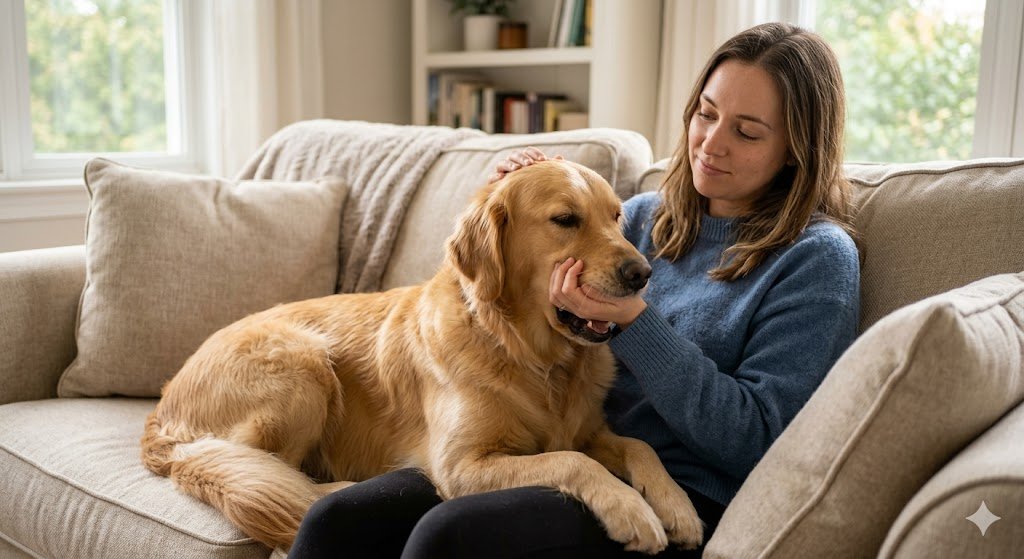
You’re sitting on the couch, quietly petting your dog, when suddenly they lean in and gently take your hand or wrist into their mouth. Your heart might skip a beat—after all, in the human world, teeth on skin usually means trouble. But your dog isn’t growling, their body is relaxed, and the pressure is so light it’s almost non-existent. They are just… holding you.
This behavior, often referred to as “mouthing” or the “Social Nibble,” is one of the most misunderstood forms of canine communication. While it involves teeth, it is the polar opposite of a bite. It is a nuanced, tactile gesture that dates back thousands of years to the very origins of the wolf-human bond.
The “Social Nibble” Explained (NLP Snapshot): Dog mouthing is a form of tactile communication used to signal trust, affection, and social security. Rooted in allogrooming (social grooming) and early puppyhood development, a “soft mouth” indicates that a dog has mastered bite inhibition and is using their mouth as a sensory tool to maintain a physical connection with a trusted member of their “pack.”
From Littermates to You: The Origin of the Nibble
To understand why your dog mouths your hand today, we have to look at their first few weeks of life. The mouth is a dog’s primary way of interacting with the world, acting much like a human’s hands and fingers.
Bite Inhibition 101
In the litter, puppies play-fight constantly. If a puppy bites a sibling too hard, the sibling yelps and stops playing. This “feedback loop” teaches the puppy Bite Inhibition—the ability to control the strength of their jaw. When your adult dog mouths your hand gently, they are demonstrating this lifelong skill. They are choosing to use “Level 0” pressure, which is a significant sign of cognitive control and respect for your physical boundaries.
The Allogrooming Instinct
In wild canine groups, members engage in allogrooming. They use their small front incisors to gently nibble at each other’s fur to remove parasites and debris. This behavior, often called “cobbing” or “flea-biting,” isn’t just about hygiene; it’s a social glue that lowers the heart rate of both dogs involved. When your dog nibbles your thumb or the edge of your hand, they are attempting to “groom” you, treating you as an intimate family member.
Sensory Exploration
Puppies also mouth objects to learn about their texture, taste, and density. Even as adults, some dogs remain “orally fixated.” Mouthing your hand allows them to gather sensory data about where you’ve been, what you’ve touched, and even your current chemical state through your skin. It is their way of “feeling” your presence in the most literal sense possible.
Decoding the “Social Nibble” vs. A Warning Nip
For many owners, the feel of teeth on skin triggers an immediate “danger” response. However, a social nibble and a warning nip are at opposite ends of the behavioral spectrum. Understanding the subtle cues of canine ethology allows you to distinguish between a sign of love and a sign of stress.
The “Slack Jaw” vs. The “Rigid Snap”
In a true social mouth, the jaw muscles are loose. Your dog isn’t “clamping” down; they are simply resting their teeth against you. In contrast, a warning nip is preceded by a stiffening of the jaw and a “muzzle puckering” where the lips are drawn forward.
Eye Contact: Soft vs. Hard
- Social Eyes: When your dog is mouthing you affectionately, their eyes will appear “soft,” often squinting or blinking slowly. This indicates they are in a parasympathetic (relaxed) state.
- The “Whale Eye”: If a dog is about to nip out of fear or defense, you will see the whites of their eyes (whale eye) and a fixed, hard stare.
The “Retriever Drive”
If you own a Golden Retriever, Labrador, or Cocker Spaniel, mouthing is often a genetic “hold.” These breeds were developed to carry delicate game in their mouths without damaging it (a “soft mouth”). To them, holding your wrist or hand is the highest form of carry—it’s as if they are holding onto their most prized possession.
Why Your Hand? The Scent-Taste Connection
Have you ever wondered why dogs specifically target your hands for the social nibble? It isn’t just because they are the easiest part of your body to reach; your hands are a chemical library for your dog.
The Pheromone Exchange
Human hands contain a high concentration of sweat glands and sebaceous glands. By mouthing your hand, dogs use their Jacobson’s Organ (the vomeronasal organ located in the roof of the mouth) to “taste-smell” your pheromones. This allows them to detect your stress levels, your health, and even where you have been earlier in the day. It is an intimate sensory “check-in.”
The “Salt” Factor and Sensory Input
Beyond the deep psychological connection, there is a simple sensory pleasure. Human skin often has a thin layer of salt from perspiration. While it sounds unappealing to us, this salty flavor provides an interesting sensory experience for a dog. Combined with the tactile sensation of your skin, the act of mouthing provides a complex “sensory bouquet” that keeps them engaged and grounded.
Grounding and Self-Soothing
For many high-energy dogs, mouthing serves as a self-soothing mechanism. Much like a human might squeeze a stress ball, a dog will mouth a trusted person’s hand to release endorphins. If your dog mouths you the moment you come home from work, they are likely using you as a “grounding tool” to lower their own excitement levels and find their emotional center.
The Science of the “Calm Down” Mouth
For many dogs, particularly those with high “oral drive,” having something in their mouth isn’t just a choice—it’s a biological necessity for relaxation. This is why you often see a dog run to grab a toy the moment you walk through the door; if a toy isn’t available, your hand becomes the substitute.
Sensory Input and Endorphins
When a dog mouths gently, it triggers the release of endorphins and dopamine in their brain. This is a rhythmic, self-soothing behavior similar to how a human might use a “fidget spinner” or a chewable sensory tool. The pressure on their gums provides a specific type of tactile feedback that helps regulate their nervous system.
Drive Redirection
In states of high arousal—such as when you return home after a long day—a dog’s energy can become overwhelming. They want to jump, bark, and zoom, but they know they must stay calm. By mouthing your hand, they redirect that physical energy into a controlled, quiet action. It acts as an “emotional ground wire,” bleeding off excess excitement so they don’t escalate into disruptive behaviors.
When Mouthing Becomes a Problem
While the “social nibble” is a beautiful sign of trust, it is important for owners to monitor the intensity of the behavior. Because dogs communicate through their mouths, a shift in pressure can signal a shift in their emotional state.
The Excitement Escalation
If a dog gets “over-aroused” during play, their bite inhibition can slip. What started as a soft hold can turn into a painful pinch. This isn’t usually aggression; it’s a loss of emotional control. As an owner, your job is to “pause” the interaction the moment the pressure increases, teaching the dog that the “social” part of the nibble ends when the pain begins.
The Red Flags of Redirection
If your dog is mouthing you while pacing, whining, or looking frantically for an exit, the behavior has shifted from “affection” to “anxiety-driven displacement.” In these cases, the dog is using you as a pacifier because they are overwhelmed by their environment.
Safety First: If your dog’s mouthing is accompanied by a stiff body, growling, or if they are applying painful pressure, please consult a local professional behaviorist or veterinarian immediately. This may be a sign of redirected aggression or a lack of bite inhibition that requires expert intervention.
Common Questions (FAQ)
Why does my dog nibble my clothes instead of my skin?
This is often considered a “polite” version of the social nibble. Some dogs learn that humans are sensitive to teeth on skin, so they redirect their grooming instinct toward your sleeves or pant legs. It carries the same sentimental value as mouthing your hand—they are trying to “clean” and bond with you through fabric.
Is it okay to let my dog mouth my hand?
As long as the pressure is non-existent and the dog is relaxed, it is a healthy form of bonding. However, you should always be able to ask your dog to “leave it” or “out.” If the dog refuses to let go or gets “hooky” with their teeth, you should set a boundary to ensure you remain the one in control of the interaction.
Why do Golden Retrievers mouth more than other breeds?
Retrievers have been selectively bred for centuries to have a “Soft Mouth”—the ability to carry a bird for miles without leaving a single mark on it. This genetic predisposition makes them naturally “mouth-oriented.” For a Retriever, the mouth is their primary tool for showing affection and offering “gifts.”
My dog nibbles me with just their front teeth. Is that a bite?
No, this is specifically called “Cobbing” or “Flea-biting.” It is a grooming behavior. In a dog pack, this is a sign of high-level friendship. They are essentially telling you, “You are part of my inner circle, and I’m taking care of you.”
Dr. Emily’s Final Take
From a clinical and behavioral perspective, mouthing is one of the most intimate gestures a dog can offer. When a dog puts your hand in their mouth, they are placing their most powerful weapon against your skin and choosing to use zero force. It is a profound demonstration of Bite Inhibition and emotional maturity.
If your dog is a “social nibbler,” don’t fear the teeth. Instead, observe the context. If the eyes are soft and the tail is a slow, rhythmic wag, you are witnessing a deep, ancestral form of love. At Dog Vet Expert, we believe that understanding these tactile signals is the key to moving past the “owner” mindset and into a true, lifelong partnership with your dog.
🐾 Tactile Demands
Does your dog follow a social nibble with a rhythmic paw tap? Both are ‘proximity seekers’ used to initiate play. Learn the psychology behind why your dog uses their paws to grab your attention.
Read: Why Dogs Tap You With Their Paw →🌬️ Beyond the Teeth: The Huff
Mouthing is a tactile signal, but a ‘huff’ is the auditory equivalent. Discover how dogs use soft exhales to communicate excitement or impatience without ever letting out a bark.
Learn: Why Dogs Huff at You →Reference
IAABC (International Association of Animal Behavior Consultants) regarding bite inhibition and social play.