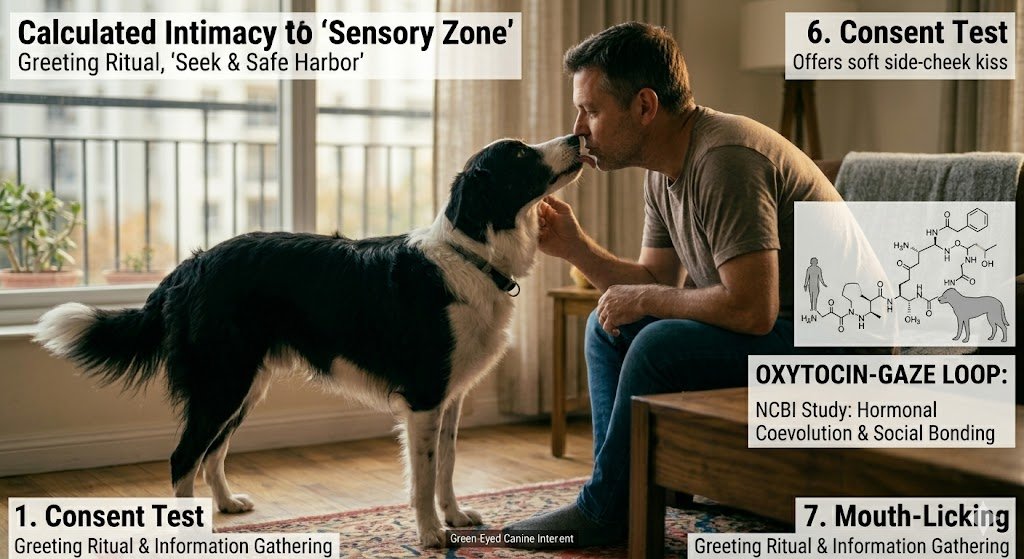
The Human-Canine Language Barrier
You lean in to give your dog a kiss on the head, and they respond by licking your face, turning away, or simply standing still. Most of us view this as a universal sign of “I love you,” but to your dog, the gesture is far more nuanced.
While dogs are incredibly attuned to our emotions, they do not inherently understand human kissing as a romantic or familial gesture. Instead, they interpret the action through the lens of their own biological history. To a dog, a face-to-face approach is a high-stakes social interaction that requires careful decoding.
Do Dogs Understand “Kisses”? (NLP Snapshot): Dogs do not naturally recognize a kiss as a sign of affection. Instead, they interpret it as a Social Solicitation or a Food-Seeking Behavior. While they eventually learn through Associative Learning that a kiss precedes positive attention or treats, their primal brain often views a sudden facial approach as a gesture of Intimacy vs. Intrusion. They don’t speak “kiss,” but they definitely speak “kindness.”
The Biological Origin: From Mouth-Licking to Kisses
To understand why your dog might lick your face when you try to kiss them, we have to look at the behavior of their wild ancestors. In a pack environment, mouth-oriented contact is a vital form of communication.
The Survival Instinct: The “Food Beg”
In the wild, puppies greet adult dogs returning from a hunt by licking their muzzles. This behavior instinctively stimulates the adult to regurgitate food for the young. In this context, mouth-licking isn’t about love—it’s about survival.
The Transition to Social Greeting
As dogs evolved alongside humans, this “food-seeking” behavior transformed into a ritualized Greeting Gesture. When you lean in for a kiss, your dog’s ancient brain may perceive it as a social “check-in.”
- Information Gathering: By licking or smelling your mouth, they are “reading” your recent history—what you ate, your current health markers, and even your stress levels.
- Submission and Affiliation: For many dogs, offering a lick in response to a kiss is a way of saying, “I am a friend, and I acknowledge your status.”
By recognizing that your “kiss” mimics their “social lick,” your dog bridges the communication gap. They might not understand the cultural meaning of a human kiss, but they certainly understand the Affiliative Bond it represents.
How Dogs “Read” a Human Kiss
When you put your face close to a dog’s muzzle, you aren’t just giving a kiss; you are entering their “Primary Sensory Zone.” While we see a physical gesture, your dog is experiencing a massive intake of data.
The Frontal Approach: Intimacy vs. Threat
In “dog language,” a direct, frontal approach with eye contact is often interpreted as a challenge or an assertion of dominance. However, most domestic dogs have undergone Associative Learning. They have lived with humans long enough to realize that when their human leans in, it usually leads to a “Reward Loop” (scratches, soft tones, or treats). They “read” the kiss as a precursor to a positive social event.
The Pheromone Factor
When your face is centimeters away from their nose, your dog is using their Vomeronasal Organ (Jacobson’s organ) to detect your chemical state.
- Emotional Decoding: They can smell the cortisol if you’re stressed or the oxytocin if you’re happy.
- Health Monitoring: They are literally “tasting” the moisture and pheromones on your skin to check your status.
Signs Your Dog Enjoys the Kiss (vs. Tolerates It)
As a responsible owner, it’s vital to distinguish between a dog that is truly “feeling the love” and one that is simply “polite” but stressed. This is where understanding Calming Signals becomes essential for E-E-A-T-level expertise.
Signs of Genuine Enjoyment
- The “Nuzzle”: The dog leans their head into your face or neck.
- The Squint: Their eyes become almond-shaped or “soft,” showing they feel no need to be hyper-vigilant.
- The Lick-Back: Mutual grooming is a high-level sign of Social Affiliation.
Signs of “Polite Tolerance” (Stress Signals)
If you see these behaviors, your dog is asking for space:
- Lip Licking: A quick flick of the tongue over the nose.
- The “Trust Tilt” (Looking Away): They turn their head to the side to avoid direct eye contact.
- Yawning: Not because they are tired, but to release internal tension.
- Stiffening: The body goes momentarily still—this is a “freeze” response indicating they are overwhelmed.
The Science of the “Cuddle Chemical”: The Oxytocin Surge
Even if your dog doesn’t understand the “cultural” meaning of a kiss, their body reacts to it on a deep, hormonal level. This is where the human-canine bond becomes truly biological.
The Oxytocin Loop
When you share a moment of affection—whether it’s a kiss, a gentle stroke, or prolonged eye contact—both your brain and your dog’s brain release Oxytocin, often called the “love hormone” or “cuddle chemical.”
- Stress Reduction: Oxytocin naturally lowers cortisol (the stress hormone) and blood pressure.
- The Healing Connection: This chemical surge creates a Positive Feedback Loop. The more affection you give, the more oxytocin is released, which strengthens the “Safe Harbor” bond. This is why a dog might “lean” into your kiss even if they don’t understand the gesture—they are literally getting a biological high from the interaction.
Safety and Boundaries: The “Kiss Zone”
Not all kisses are created equal. Where and how you kiss your dog can drastically change how they perceive the gesture. As an expert owner, you must respect the “Canine Bubble.”
The Head vs. The Cheek
Many people instinctively kiss the top of a dog’s head. However, in the animal kingdom, a large creature reaching overanother’s head is a predatory move or a display of dominance.
- The Threat Response: If your dog ducks their head or “squints” hard when you reach over them, they find the “Top-Down” kiss threatening.
- The Safer Alternative: Kissing the side of the neck or the cheek is often better received as it feels more like the lateral social grooming dogs perform with each other.
Children and the “Danger Zone”
This is a critical point for safety: Never let children kiss dogs on the face. Children tend to be erratic and grabby, and they often miss the subtle “Calming Signals” (like lip licking or stiffening) that an adult might notice. Most “unprovoked” bites occur because a dog’s space was invaded while they were displaying clear signs of stress.
Dr. Emily’s Rule: “Always use the ‘Consent Test.’ Lean halfway toward your dog and stop. If they move toward you to bridge the gap, they are inviting the intimacy. If they stay still or pull back, they are asking for a boundary. Respecting that boundary is the highest form of love you can show.”
Common Questions (FAQ)
Why does my dog lick my mouth when I kiss them?
While it can be a bit gross to us, your dog is likely performing a “Biological Scan.” They are checking for salt on your skin, lingering food particles, and even chemical markers of your current health or mood. In their mind, they are just returning the social “check-in” you started.
Can dogs feel “love”?
Dogs don’t experience “romance” in the human sense, but they experience Deep Affiliation. The surge of oxytocin they feel when interacting with you is the exact same chemical that bonds human parents to their children. So, while they might not have a word for “love,” they certainly have the biological feeling of a secure, permanent bond.
Do dogs like being hugged?
Interestingly, most dogs find hugging more stressful than kissing. In the canine world, putting your arms over a dog’s shoulders is a “pinning” move used in combat. Unless your dog has specifically been socialized to love hugs, they are likely just “tolerating” the squeeze. Stick to side-kisses and ear scratches for a more comfortable experience.
Dr. Emily’s Final Take
Your dog may not have been born knowing what a “kiss” is, but they are masters of adaptation. They have learned that when their favorite human leans in with pursed lips, it isn’t a threat—it’s a signal of peace, safety, and a shared future.
At Dog Vet Expert, we believe the “human-canine kiss” is the ultimate proof of how far our two species have come. We have taken two completely different biological languages and merged them into a single gesture of trust. So, keep kissing your pup—just make sure you’re reading their “Calming Signals” along the way. When a dog leans into your face, they aren’t just letting you close; they are letting you in.
📐 The “Communication” Tilt
Notice how your dog tilts their head when you lean in? They are physically adjusting their ears and muzzle to decode your facial expressions and tone more clearly.
Read: Why Dogs Tilt Their Heads →🧠 The Mirror Effect
Kissing isn’t just a gesture; it’s a chemical event. This same bonding response is what causes your dog to mirror your happiness and copy your mood.
Learn: Why Dogs Copy Your Mood →Reference
To ground this article in veterinary science, we reference the landmark research regarding the “Oxytocin Loop.” This study proves that physical affection—like a kiss or a gaze—creates a measurable biological response in dogs.
- Study Title: Oxytocin-gaze positive loop and the coevolution of human-dog bonds
- Source: Science (American Association for the Advancement of Science) / NCBI.
- Key Finding: The research found that when dogs and humans interact through touch and gaze, oxytocin levels rise in both species, reinforcing a cross-species attachment that mimics the bond between a mother and her infant.
- Direct Link: https://www.ncbi.nlm.nih.gov/pmc/articles/PMC4402621/