More Than Just an Air Conditioner (dog panting but not hot )
It’s a rainy, 22°C evening in Gurgaon, your AC is humming, and your dog is perfectly dry—yet they are sitting on the rug panting like they just finished a 5km run. For most owners, a panting dog means one thing: “My dog is hot.” While it’s true that dogs pant to evaporate moisture from their tongue and lungs to cool down, this is only half the story.
When a dog pants in a cool environment, they are engaging in Behavioral Panting. This isn’t about body temperature; it’s about a surge of internal chemicals like Cortisol (the stress hormone) or Adrenaline (the excitement hormone). By analyzing the tension of the tongue and the set of the jaw, you can determine if your dog is having a “happy high” or if they are silently struggling with anxiety.
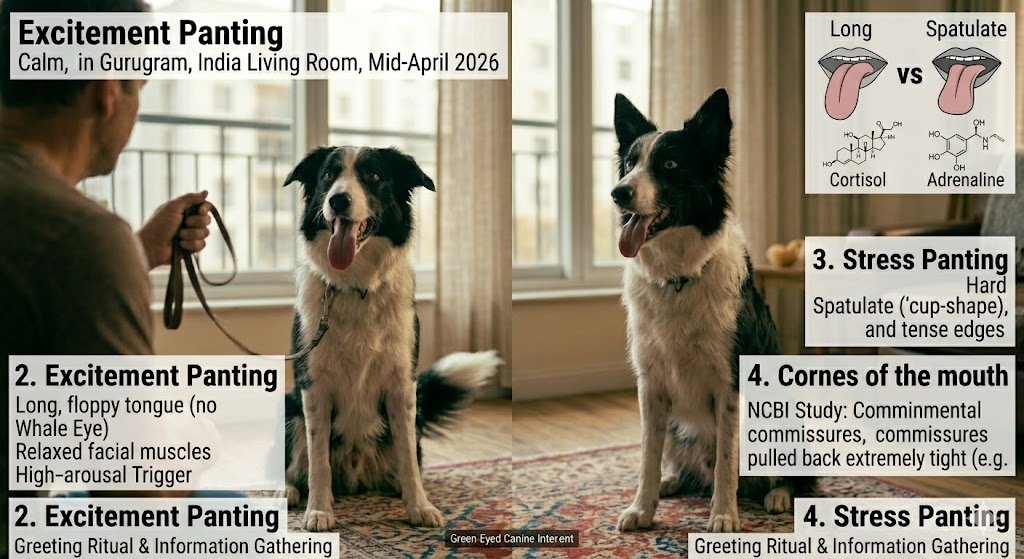
The “Cool” Pant (NLP Snapshot): If the room is cool but the tongue is out, your dog is communicating an Emotional State. Behavioral panting is the canine body’s way of processing intense arousal. To decode it, you must look for the “Tension markers”: a relaxed, “long” tongue usually signals joy, while a rigid, “cupped” tongue signals a desperate need for space or comfort.
The “Excitement” Pant: High-Arousal Joy
We’ve all seen the “Happy Pant”—the frantic breathing that occurs when you pick up the leash or come home after a long work day. This is a form of high-arousal joy. Even though the dog isn’t physically hot yet, their heart rate has spiked in anticipation, and their body is prepping for action.
The Visual Cues of Joy:
- The “Long” Tongue: In a happy pant, the tongue is typically very floppy. It often hangs out of the front or even the side of the mouth, looking “long” and relaxed.
- Soft Facial Features: The eyes remain round and soft. You won’t see the tension of the brow or the “Whale Eye” (whites of the eyes).
- The “Wiggle” Factor: This panting is almost always accompanied by a loose, curvy body. The tail might be wagging so hard that the dog’s entire rear end moves, and their ears are likely in a neutral or slightly forward position.
In this state, the panting is simply the “exhaust” of a highly fueled emotional engine. It’s the sound of a dog that is ready to play, eat, or greet their favorite person.
The “Stress” Pant: The Silent Cry for Help
The most dangerous thing an owner can do is mistake a stressed dog for a “happy” one. Unlike the relaxed breathing of excitement, a Stress Pant is a physiological reaction to the “Fight or Flight” system. Even in a chilled, air-conditioned room, a dog’s internal chemistry can make them feel like they are overheating.
The Visual Cues of Stress:
- The “Spatulate” Tongue: This is the most critical marker. Instead of being floppy and long, the tongue becomes rigid and wide at the end, looking almost like a spatula. The edges may curl up, forming a “cup” shape.
- Tense Commissures: Look at the corners of the mouth (the commissures). In a stressed dog, these are pulled back extremely tight, creating a “long lip” appearance that looks strained rather than relaxed.
- Rapid-Fire Rhythm: Stress panting is often much faster and shallower than heat-related panting. It sounds frantic because it is frantic.
When you see this, your dog isn’t “happy to be here.” Whether it’s a crowded market in Gurgaon or a loud thunderstorm, the spatulate tongue is a signal that your dog has reached their Emotional Threshold and needs a “Safe Harbor” immediately.
Decoding the “Stress Smile”
One of the biggest hurdles in canine communication is the Stress Smile. Because dogs pull the corners of their mouths back when they are anxious, it can mimic a human grin. This leads many owners to post “funny” photos of their “smiling” dog, unaware that the animal is actually in a state of high distress.
How to Tell the Difference:
- The Eye Test: A real “smile” is accompanied by soft, squinty eyes. A stress smile is almost always paired with Whale Eye (showing the whites of the eyes) or a “hard,” wide-eyed stare.
- The Brow Tension: Look at the forehead. A happy dog has a smooth brow; a stressed “smiler” will have visible furrows or tension lines above the eyes.
- The Vertical Retraction: In a true smile, the lips are loose. In a stress smile, you may see the front teeth exposed not in a snarl, but because the lips are being pulled back so forcefully by facial tension.
The Urban Impact
In high-density areas like Gurgaon, dogs are constantly bombarded by “Micro-Stressors”—the hum of heavy construction, high-pitched horns, and crowded elevators. Over time, a dog can develop a Chronic Stress Pant. If your dog “smiles” every time you enter a specific busy area, they aren’t enjoying the view; they are trying to cope with the sensory overload.
5. The “Medical” Pant: Pain and Discomfort
Sometimes, panting has nothing to do with emotions or the Gurgaon heat—it is a physiological response to physical distress. Because dogs are experts at masking pain, panting is often one of the few outward signs that something is wrong internally.
The Silent Symptom
Panting can be a primary indicator of acute or chronic pain. When a dog is hurting, their heart rate increases and their breathing becomes labored as a natural response to the discomfort.
Red Flags to Watch For:
- Restless Panting: If your dog is panting in the middle of the night or while resting in a cool room, this is a major warning sign.
- Accompanying Trembling: Panting paired with shivering or “shaking” (when it isn’t cold) often points to abdominal pain or back issues.
- Rigid Abdomen: If the stomach feels hard to the touch while they are panting, it could indicate a serious gastrointestinal issue like Bloat (GDV), which is a life-threatening emergency.
Dr. Emily’s Rule: “If your dog starts panting out of nowhere while resting, and you can’t identify an emotional trigger like a doorbell or a toy, assume it is medical until proven otherwise. Check for a stiff gait, reluctance to jump, or a ‘hunched’ back. When in doubt, a quick vet check can prevent a minor ache from becoming a major crisis.”
How to De-escalate Behavioral Panting
Once you’ve identified that the panting is behavioral (Stress or Excitement), your goal is to help your dog lower their Arousal Levels and return to a state of “Calm Neutral.”
For High Excitement:
- Scatter Feeding: Drop a handful of kibble or small treats on the floor. Sniffing is a “calming signal” that naturally lowers a dog’s heart rate and shifts their focus from the excitement trigger to the ground.
- The “Quiet” Entry: If they pant frantically when you get home, ignore them for the first 3 minutes. Once they settle, reward the calm behavior with a gentle pet rather than a high-pitched greeting.
For High Stress:
- Create a “Safe Harbor”: Move your dog to a quiet, dark room or their crate. Use white noise or a fan to muffle the sounds of Gurgaon traffic or construction that might be fueling the anxiety.
- Pheromone Support: Consider using DAP (Dog Appeasing Pheromone) diffusers or sprays. These mimic the “comfort chemicals” a mother dog releases, helping to chemically lower cortisol levels.
- Body Pressure: For some dogs, a snug-fitting “Thundershirt” or a gentle wrap can provide a grounding sensation that stops the frantic panting loop.
Common Questions (FAQ)
Why does my dog pant in the car even with the AC on?
Car panting is usually a mix of Anxiety and Anticipation. For some dogs, the car represents the “Excitement Pant” (going to the park), while for others, it’s a “Stress Pant” (fear of the vet or motion sickness). If the tongue is spatulate and they are drooling, it is likely nausea or fear. If they are looking out the window with a floppy tongue, it’s high-arousal joy.
Can certain medications cause panting?
Yes. If your dog has been prescribed Steroids (like Prednisone), a very common side effect is excessive panting, thirst, and hunger. This is a physiological side effect and doesn’t necessarily mean the dog is hot or stressed, but you should always report it to your vet to ensure the dosage is correct.
Is panting a sign of heart issues?
In older dogs, persistent panting or heavy breathing while at rest can be a symptom of Congestive Heart Failure (CHF)or Cushing’s Disease. If the panting is accompanied by a persistent cough, especially at night, seek veterinary advice immediately.
Dr. Emily’s Final Take
A pant is more than just a cooling mechanism; it is a window into your dog’s internal world. At Dog Vet Expert, we want you to look past the tongue and see the whole dog. By distinguishing between a “Joyful Pant” and a “Stress Pant,” you aren’t just being observant—you are being an advocate for your dog’s mental and physical health.
In the fast-paced, often noisy environment of Gurgaon, being able to “read” your dog’s breathing allows you to step in before excitement turns into over-stimulation or stress turns into panic. Once you master this subtle dialect of the canine language, you build a foundation of radical trust that makes life better for both ends of the leash.
🧠 The Emotional Mirror
Dogs are incredibly in tune with our feelings. If you are stressed, your dog may start panting as a direct reflection of your own emotional state.
Read: Why Dogs Mirror Your Mood →🐕 Seeking Support: The Lean
Panting isn’t the only way dogs signal discomfort. Many dogs will also lean their physical weight against you when they are seeking a ‘Safe Harbor.’
Learn: Why Dogs Lean on You →Reference
we reference research on how respiratory rates and mouth shapes correlate with cortisol levels in domestic dogs.
- Study Title: Physiological and behavioral responses of dogs to various stressors
- Source: Journal of Veterinary Behavior / Elsevier.
- Key Finding: This research highlights that panting without thermal stress is a primary indicator of “acute psychological distress.” It specifically notes that tongue shape and lip retraction are measurable markers of high-cortisol states.
- Direct Link: https://www.journalvetbehavior.com/article/S1558-7878(14)00078-X/fulltext