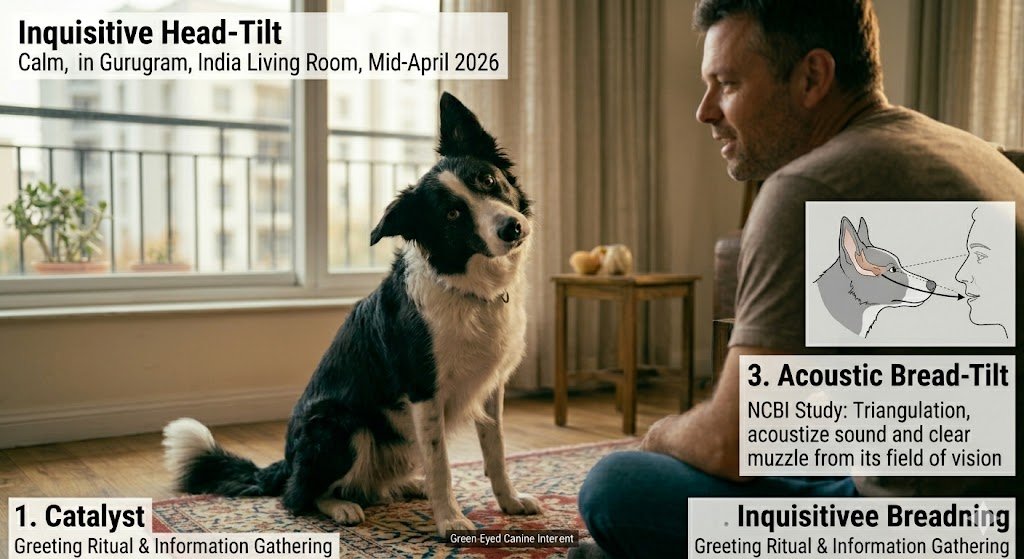
The World’s Most Charming “What?” (why do dogs tilt their heads )
You say the word “walk,” “treat,” or even just a high-pitched “Who’s a good boy?” and your dog instantly snaps their head to the side. It is arguably the most endearing gesture in the canine repertoire—a look of pure, focused concentration. While humans usually interpret this as a sign that the dog is “confused” or “listening,” the truth is much more impressive.
The head tilt is a sophisticated physical adjustment used to Optimize Sensory Input. It’s not just a cute reaction; it’s a deliberate move to improve their perception of the world. By shifting their head, dogs are physically hacking their own anatomy to better understand the sounds and sights coming from their human companions.
Why Dogs “Tilt” : Dogs tilt their heads to physically reposition their ears for better Sound Localization and to move their snouts out of their Line of Sight. It is a sign of high Emotional Intelligence and social synchronization. When your dog tilts their head, they are actively “zooming in” on your message to ensure they don’t miss a single cue.
The Acoustic Adjustment: Finding the “Sweet Spot”
While dogs can hear frequencies far beyond the range of human ears, the physical structure of their head can actually be a hindrance when it comes to pinpointing the source of a sound.
The Problem with Ear Placement
Unlike humans, whose ears are fixed on the sides of the head, dog ears vary wildly in shape—from the tall, upright “prick” ears of a German Shepherd to the heavy, velvet “drop” ears of a Bassett Hound. These shapes can muffle sounds or change how sound waves enter the ear canal.
Triangulation and Sound Localization
By tilting the head, a dog changes the vertical and horizontal angle of their ear canals. This allows them to:
- Triangulate the Source: It helps them determine exactly how far away a sound is and from what height it originated.
- Filter Human Speech: Dogs are masters at picking out “trigger words” (like their name or “Treat”) from a long string of human babble. Shifting the ears helps them focus on the specific frequencies of your voice that carry the most meaning.
Think of the head tilt as your dog adjusting a satellite dish. They are searching for the “sweet spot” where your voice is the clearest, allowing them to decode your intent with veterinary precision.
The “Muzzle Obstacle”: Clearing the View
One of the most surprising theories behind the head tilt has nothing to do with hearing and everything to do with vision. To understand this, you have to look at the world from your dog’s perspective.
The Snout Block
If you have a breed with a prominent muzzle—like a Labrador, Golden Retriever, or German Shepherd—their nose actually occupies a significant portion of their lower visual field. This creates a “blind spot” right where our mouths usually are when we speak.
Reading Your Lips
Dogs are masters of reading human facial expressions. They don’t just listen to the tone of your voice; they watch your eyes and, crucially, your mouth for cues.
- The Tilt Solution: By tilting their head, they move their muzzle out of the way, allowing them to see the lower half of your face more clearly.
- Decoding Intent: This physical shift helps them determine if your smile is genuine or if your “serious face” means they’re in trouble.
[Image showing a dog’s perspective view with a long muzzle partially obscuring a human face vs. the clear view after a head tilt]
Interestingly, research by psychologist Stanley Coren suggests that “brachycephalic” breeds (flat-faced dogs like Pugs or French Bulldogs) tend to tilt their heads less frequently. Why? Because their smaller snouts don’t block their view as much, so they don’t need to adjust their “camera angle” to see you.
Empathy and the “Smart Dog” Connection
Is a dog that tilts their head actually smarter? Recent science suggests the answer might be yes.
The “Gifted Word Learner” Study
A landmark 2021 study by researchers at Eötvös Loránd University in Hungary looked at “Gifted Word Learners”—dogs who can remember the names of dozens of toys. The researchers found a fascinating pattern: these “smart” dogs tilted their heads 43% of the time when hearing a command, compared to just 2% for “typical” dogs.
High Engagement and Focus
This suggests that the head tilt is a sign of Intimate Processing. It isn’t just about hearing a noise; it’s about a dog actively trying to map a specific sound to a specific memory or mental image.
- Social Mirroring: Dogs that are highly bonded to their owners are more likely to tilt. It is a form of social mirroring—they are matching your intensity and focus with their own.
- The “Thinker” Pose: When your dog tilts their head, they are essentially entering a “Deep Work” state, utilizing their emotional intelligence to sync up with your mood.
Can You “Over-Tilt”? When it’s a Medical Issue
While the social head tilt is a sign of a focused dog, there is a fine line between a behavioral ritual and a medical reflex. As an owner, you must know when the “cute” gesture becomes a clinical symptom.
The Difference Between Ritual and Reflex
A healthy head tilt is transient—it happens in response to a sound and stops once the interaction is over. However, a Persistent Head Tilt (where the head stays tilted even when the dog is relaxed or sleeping) is a red flag.
Common Medical Triggers:
- Otitis Externa (Ear Infections): This is common in the humid climate of Gurgaon. Inflammation or debris in the ear canal can cause a dog to hold their head at an angle to relieve pressure or “fullness.”
- Vestibular Disease: Often called “Old Dog Vestibular Syndrome,” this affects the inner ear’s balance system. It can cause sudden, extreme tilting, often accompanied by stumbling.
- Foreign Bodies: If your dog has been playing in high grass, a seed or small insect could be trapped in the ear canal.
Dr. Emily’s “Check-List” for a Medical Tilt:
“A social tilt is accompanied by a wagging tail and bright eyes. A medical tilt often comes with ‘Nystagmus’ (eyes flickering side-to-side), a lack of balance, or a pungent odor from the ear. If the tilt is static, it’s time for a vet visit, not a photo op.”
Why Some Breeds Tilt More Than Others
Anatomy dictates the frequency of the tilt. Because the gesture is used to clear the “visual field” and capture sound, a dog’s physical build changes how they use it.
The “Sighthound” and “Shepherd” Advantage
Dogs with long, slender muzzles and upright ears—like German Shepherds or Greyhounds—are the champions of the head tilt. Their long noses create a massive visual obstruction, and their prick ears are designed to “catch” sound like a radar dish.
The Flat-Faced (Brachycephalic) Factor
As mentioned earlier, Pugs, French Bulldogs, and Boxers have much wider, flatter faces. Since their noses don’t block their view of your mouth, they don’t have the same visual incentive to tilt. If a Pug tilts their head, it is almost exclusively for sound localization rather than visual clarity.
The “Drop-Ear” Struggle
Breeds like Beagles or Cocker Spaniels have heavy ear flaps that naturally muffle sound. You might notice these dogs tilt their heads further or more vigorously than prick-eared dogs. They are literally trying to lift the “curtain” of their ear flap to let the sound waves hit the canal directly.
Common Questions (FAQ)
Are they just mimicking me?
While there is a theory that dogs mimic our focus, the head tilt is more about social learning. If you always smile, laugh, or give a treat when your dog tilts their head, they quickly learn that this specific posture “unlocks” a positive response from you. They aren’t just copying you; they are communicating in a way they know you find valuable.
Why do some dogs tilt their heads even when it’s quiet?
This is often a sign of Expectation. If your dog sees you pick up your car keys or put on your walking shoes, they may tilt their head in silence. They are “visualizing” the upcoming event and trying to pick up any subtle cues (like the jingle of a leash) that confirm their suspicion.
Do wolves tilt their heads?
Yes. Field observations of wolves and wild canids show that they use head tilts during hunting. In the wild, it is almost exclusively used for sound localization—detecting the high-pitched scurrying of rodents under the snow or grass. The “cute” version we see on our sofas is a domestic evolution of this lethal hunting skill.
Dr. Emily’s Final Take
The head tilt is the “Active Listening” of the canine world. It is the physical manifestation of a dog that is present, curious, and deeply invested in what you have to say. While it certainly helps them see and hear us better, its most important role is Emotional Connection.
At Dog Vet Expert, we see the tilt as a badge of honor for an owner. It means you have built a relationship where your dog cares enough to try and bridge the language gap between our two species. So, the next time your dog gives you that charming “What?”, know that you are looking at a master of sensory adaptation and a loyal friend who is truly hanging on your every word.
💋 Deciphering Human Affection
That adorable head tilt isn’t just for words; it’s how your dog processes affection. Do they truly understand what a kiss means, or are they just reading your facial cues?
Read: Do Dogs Understand Kisses? →🧠 The “Active Listening” Reflex
Head tilting is a form of active listening that is closely linked to emotional mirroring. It’s the first step in how your dog syncs their mood with yours.
Learn: Why Dogs Copy Your Mood →Reference
we reference the 2021 study conducted by researchers at Eötvös Loránd University, which is the first of its kind to link head-tilting to memory and mental processing in dogs.
- Study Title: An exploratory analysis of head-tilting in dogs
- Source: Animal Cognition / Springer.
- Key Finding: The study observed that “Gifted Word Learner” dogs (those who could learn the names of multiple toys) tilted their heads significantly more often when hearing commands compared to typical dogs. This suggests the tilt is a sign of increased mental effort and “active listening.”
- Direct Link: https://link.springer.com/article/10.1007/s10071-021-01563-8