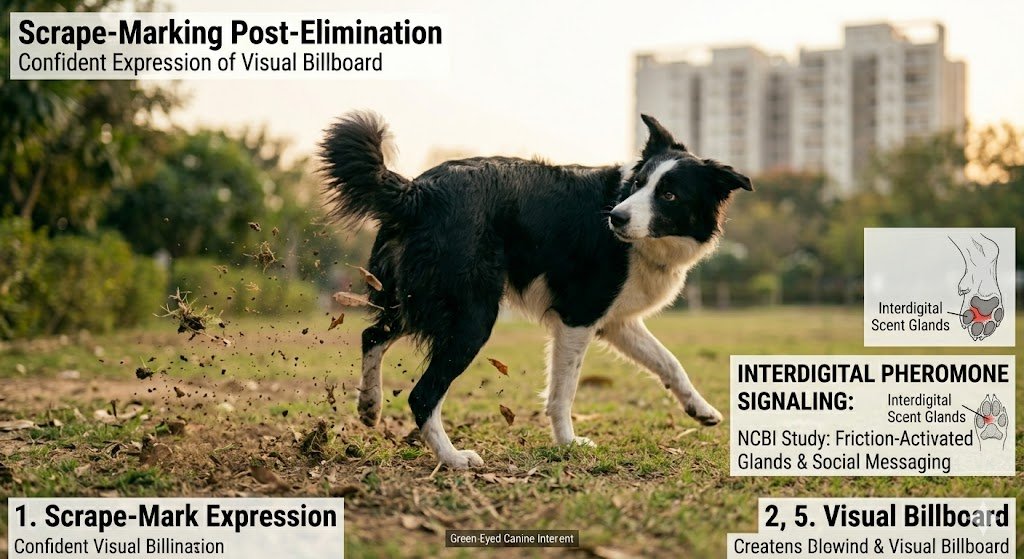
Why Do Dogs kick After They Poop: It’s Not About Cleanliness
Your dog finishes their business and suddenly transforms into a bull in a ring—furiously kicking up grass, dirt, and sod behind them. It looks like a frantic attempt to “clean up,” much like a cat in a litter box. However, in the world of canine behavior, this is known as Scrape-Marking, and it has absolutely nothing to do with hygiene.
While we might think they are trying to hide the mess, your dog is actually doing the exact opposite. They are creating a high-visibility, high-scent “billboard” to broadcast their presence to every other animal in the neighborhood.
Why Your Dog “Kicks” After Pooping (NLP Snapshot): Kicking after pooping is a form of Dual-Sensory Communication. Dogs utilize Interdigital Scent Glands located between their toes to deposit unique pheromones onto the ground. By kicking, they are performing a “Scrape-Mark” that acts as both a visual and olfactory signpost. This behavior claims territory, advertises social status, and leaves a “biological ID card” that lasts much longer than the waste itself.
The Secret Scent Glands: Interdigital Pheromones
The most fascinating part of the “burnout” isn’t what you see, but what your dog is “writing” on the ground. Most owners don’t realize that a dog’s paws are one of their most powerful tools for chemical communication.
The Interdigital Glands
Located between the pads of your dog’s feet are specialized Sebaceous Glands (often called interdigital glands). These glands secrete a complex cocktail of pheromones that are unique to your individual dog.
The Physics of the Kick
The act of kicking serves a specific biological purpose: Friction and Pressure.
- Friction: The aggressive scraping action against the grass or soil opens the pores of the interdigital glands.
- Deposition: The pressure forces the pheromones out and grinds them into the earth.
While the feces provides some data (like diet and health), the pheromones from the feet provide the “Who” and “When.” These chemical signals are more stable and persistent, meaning even after the waste is gone or washed away, the “Scent Billboard” created by the kicking remains active for days, signaling to the pack that this territory is spoken for.
The “Visual Billboard” Effect
It is a common mistake to think dogs only care about smell. In reality, the physical “scrapes” left in the dirt or grass are just as important as the pheromones. Think of this as the canine version of Bold Text on a sign—it makes the message impossible to miss from a distance.
The Multi-Sensory Signal
When your dog kicks up a “burnout” in the grass, they are creating a Visual Marker. Even before another dog gets close enough to catch the scent, they can see the disturbed earth from 20 feet away.
- The Sight: The physical lines in the dirt act as an “arrow,” pointing directly to the source of the scent.
- The Smell: Once the visual cue draws a rival dog in, the olfactory data (the pheromones) provides the detailed report.
[Image showing a dog looking at a fresh scrape in the grass from a distance]
By combining a physical sight with a chemical smell, your dog ensures their “biological ID card” is read by as many neighbors as possible. This is why dogs often seek out a flat, open patch of grass to perform their kick—they want the most visible stage for their performance.
Is it a Sign of Dominance or Anxiety?
Many owners worry that their dog’s post-poop kicking is a sign of aggression or “Alpha” behavior. However, modern veterinary science suggests a much more nuanced view.
The “Confidence” Signal
In most cases, scrape-marking is a sign of a Confident, Secure Dog. By claiming the space, they are telling the world, “I am here, I am healthy, and I am comfortable in this territory.” It is a passive way to manage social boundaries without ever having to engage in a physical fight.
The “Anxiety” Over-Marking
Sometimes, you’ll notice a dog kicking more frantically than usual. If a new dog has moved into the neighborhood or if there is tension at the local park, a dog might engage in Hyper-Scraping. This isn’t necessarily dominance; it’s a self-soothing behavior. By spreading their own scent more aggressively, the dog is literally “surrounding themselves with themselves” to feel safer in an uncertain environment.
The Gender & Breed Factor
- It’s Not Just Males: Both male and female dogs possess interdigital glands and engage in scrape-marking.
- Breed Variance: You might notice that “Guardian” breeds or Terriers are more prone to vigorous kicking than others. This is often linked to their historical roles in defending territory or “flushing out” rivals.
The Evolutionary Link: Ancestral “Border Patrol”
To understand why your modern-day pet is tearing up your lawn, we have to look back at their ancestors. In the wild, wolves use Scrape-Marking as a sophisticated form of “Passive Defense.”
The Wolf’s Boundary Line
For a wolf pack, territorial disputes are dangerous and energy-consuming. Instead of fighting every intruder, wolves leave “signposts” at the borders of their territory. By kicking the ground after eliminating, a wolf creates a permanent visual and chemical boundary.
Why the “Kick” Survived Evolution
This behavior survived thousands of years of domestication because it is a highly efficient survival tactic. It allows a dog to:
- Avoid Confrontation: It warns other dogs to stay away before a face-to-face meeting occurs.
- Define a “Safe Harbor”: It reinforces the boundaries of where the dog feels secure. When your dog kicks in the park, they aren’t just being a “rebel”—they are practicing an ancient ritual of Canine Border Patrol.
When the Kick Becomes a Problem: Lawn Care & Safety
As much as we respect the instinct, the “Post-Poop Burnout” can be tough on your environment—and your dog’s paws. For pet owners in urban areas like Gurgaon, where green space is a luxury, managing the kick is key.
Protecting Your “Gurgaon Green”
If your dog is destroying your garden or the community park’s grass, you don’t have to stop the behavior entirely. Instead, redirect it:
- The “Soft Landing”: Encourage your dog to eliminate on mulched areas or sand patches where kicking won’t cause permanent damage.
- The Reward Shift: If you want to stop the kicking in a specific area, offer a high-value treat immediately after they finish pooping. This interrupts the “Kick Loop” and focuses their attention on you instead of the ground.
Paw Safety on Hard Surfaces
In the summer months in India, the pavement and gravel can reach blistering temperatures.
- Abrasions: Vigorously kicking on hot asphalt or rough gravel can lead to pad tears or split nails.
- Heat Risk: The friction of the kick combined with the heat of the road is a recipe for burns.
Dr. Emily’s Rule: “Always check your dog’s pads for redness or thinning skin after a ‘spirited’ kicking session on hard surfaces. If your dog starts ‘phantom kicking’ (going through the motions in the air) or refuses to walk after a kick, they may have sustained a micro-tear or a ligament strain in the hind legs.”
Common Questions (FAQ)
Why doesn’t my other dog kick?
Just like humans have different personalities, dogs have different “social comfort” levels. If you have a multi-dog household and only one is a “kicker,” it usually means that the kicker is the more confident or territorial of the group. Non-kickers aren’t necessarily “submissive”; they might just feel their physical presence and the waste itself provide enough of a message.
Do cats kick for the same reason?
No. This is a classic case of Convergent Evolution but with opposite intents. Cats typically dig and kick to bury their waste to avoid attracting predators or rivals. Dogs kick to broadcast their location. While the action looks similar, the cat is whispering, while the dog is shouting.
Should I stop my dog from kicking?
Unless they are in danger of hurting their paws on hot Gurgaon asphalt or destroying a protected flower bed, it’s best to let them be. This is a deeply satisfying, instinctual behavior. Suppressing it can lead to frustration or a lack of confidence in their environment. It’s their version of “checking in” on social media—don’t delete their post!
Dr. Emily’s Final Take
At Dog Vet Expert, we often tell owners: “Let the dog be a dog.” The post-poop kick is a glorious reminder that even the most pampered apartment-dwelling pup carries the DNA of a wild ancestor. It’s a multi-sensory masterpiece of communication that uses sight, smell, and physical effort to define their world.
As long as their pads are healthy and your lawn can handle the occasional “burnout,” let them kick. It keeps their mind sharp, their territory secure, and their “biological billboard” updated. After all, a dog that kicks is a dog that feels they truly belong to the space they inhabit.
🚀 From Kicking to Zooming
That aggressive back-kick is often just the “warm-up” for a full-blown victory lap. Discover the biological ‘Poo-phoria’ that turns a bathroom break into a high-speed chase.
Read: The Science of Post-Poop Zoomies →🚻 The Personal Bodyguard
If your dog claims territory after their own business, they likely feel the need to protect you during yours. It’s the same protective pack instinct that drives the post-poop kick.
Learn: Why Dogs Follow You to the Bathroom →Reference
Study Title: Interdigital Gland and Social Signaling in Canines
Source: National Center for Biotechnology Information (NCBI) / Journal of Anatomy.
Key Finding: This research identifies the specific sebaceous and apocrine glands between a dog’s toes that are activated by pressure and friction (the “kick”), confirming that the behavior is for olfactory marking rather than sanitation.
Direct Link: https://www.ncbi.nlm.nih.gov/pmc/articles/PMC3520308/