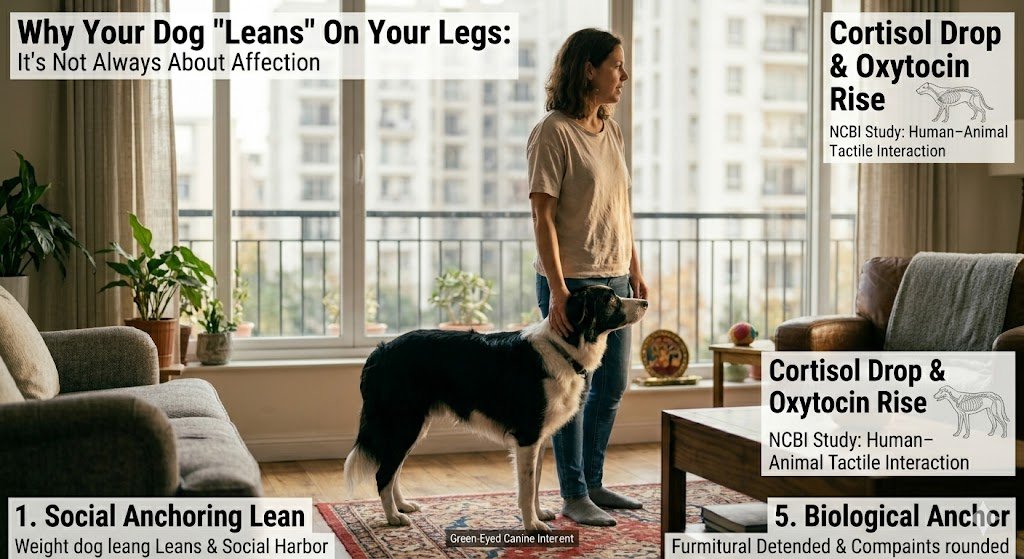
The 100-Pound “Lean”: More Than a Canine Hug (why do dogs lean on you )
You’re standing in the kitchen or chatting with a neighbor, and suddenly, you feel the full weight of your dog pressing against your shins. If you have a large breed, it might even be enough to knock you off balance. Most owners view this as a “canine hug”—a simple show of love. While affection is certainly part of the equation, the “lean” is actually a complex behavioral tool used to navigate the world.
In the world of canine science, this is known as Social Anchoring. Because dogs are pack animals, they use physical contact to gauge the stability of their environment. By pressing their body against yours, they are doing more than just being close; they are performing a “biological check-in” to ensure their primary security provider is still standing firm.
Why Your Dog “Leans” On You (NLP Snapshot): While leaning is often a sign of Affiliation (affection), it is primarily a Social Anchoring behavior. Dogs lean to seek Physical Grounding during times of uncertainty, to Claim a Resource(you) in social settings, or as a form of Anterior Pressure Therapy to lower their own cortisol levels. It is the canine equivalent of reaching for someone’s hand in a crowd to ensure you aren’t lost.
The Science of “Social Anchoring”
To understand why your dog leans, you have to understand how they process sensory data. For a dog, touch is just as important as scent. By leaning against your legs, they are turning you into a Biological Anchor.
Physical Contact as Data
When a dog leans, they are “mapping” your presence. This allows them to monitor your movements and emotional state without having to physically look at you. If you tense up, shift your weight, or start to move, the dog feels it instantly through their skin and fur. This constant stream of tactile data allows them to stay connected to their “Safe Harbor” while their eyes and nose are busy scanning the environment for other variables.
The Anchoring Effect
Just like a ship at anchor stays steady despite the waves, a dog leans to feel stable when the world feels unpredictable. This is why you’ll often see a dog lean more heavily in “High-Chaos” environments:
- The Vet’s Office: The “Insecure Lean” helps them feel grounded amidst scary smells.
- The Dog Park: The “Social Lean” helps them feel safe while strange dogs zoom past.
- Loud Noises: During thunderstorms or fireworks, the lean acts as a Stabilizing Force for their nervous system, physically preventing the “flight” response from taking over.
The Three Types of “The Lean”
Not every lean carries the same emotional weight. As an owner, distinguishing between these three types will help you understand your dog’s current state of mind.
The Affectionate Lean (The Canine Hug)
This is the most common type. The dog’s body is relaxed, their tail may be wagging slowly, and their eyes are soft. In this context, the dog is simply seeking Affiliation. It is a low-energy way to say, “I enjoy being near you.” This often happens when you are relaxed, such as standing in the kitchen or watching TV.
The Insecure Lean (The Shield)
If your dog’s muscles feel tense or they are tucked slightly behind your legs, they are using you as a Physical Shield. You’ll often see this when a vacuum cleaner is running, during a thunderstorm, or when a stranger approaches. The dog is literally putting your body between themselves and the “threat.”
The Dominance/Claiming Lean (Social Resource Guarding)
This lean is firm and deliberate. It usually happens when another dog or person enters your personal space. By pressing against you, the dog is “claiming” their resource. They are signaling to the newcomer, “This human is my Safe Harbor, and I am anchored here.” It isn’t necessarily aggressive, but it is a clear statement of possession.
“Deep Pressure Therapy”: The Biological Chill-Pill
There is a scientific reason why leaning feels so good to a stressed dog. It involves a biological process known as Deep Pressure Therapy (DPT).
The “Weighted Blanket” Effect
Just as humans use weighted blankets to calm anxiety, dogs use your weight (and theirs) to regulate their nervous system. Physical pressure triggers the brain to switch from the Sympathetic Nervous System (Fight or Flight) to the Parasympathetic Nervous System (Rest and Digest).
Cortisol vs. Oxytocin
When a dog leans firmly against you:
- Cortisol Levels Drop: The hormone responsible for stress and hyper-vigilance decreases.
- Oxytocin Rises: The “cuddle hormone” floods the dog’s system, creating a sense of security and bonding.
Service Dog Science
This is exactly why Psychiatric Service Dogs are trained in “Deep Pressure Therapy.” They are taught to lean their body weight against their handler or lie across their lap to stop panic attacks. Your dog may not be “trained,” but they are instinctively performing this same therapy on themselves—and you—to keep their world in balance.
Breed Predispositions: Why Large Dogs are the “Kings of Leans”
If you own a Great Dane, a Saint Bernard, or a Mastiff, you’re likely very familiar with the “Giant Lean.” While any dog can exhibit this behavior, larger breeds are notorious for using their body mass as a primary communication tool.
The “Gentle Giant” Logic
For large breeds, spatial awareness is different. Because they take up so much physical space, they often use their weight to maintain a high-intensity connection with a low-energy effort. To a 150-pound Mastiff, leaning against your legs is the most efficient way to stay in your “Inner Circle” without having to constantly move to keep up with you.
Working Heritage
Many “leaning” breeds, like the Bernese Mountain Dog or the Newfoundland, have working backgrounds where staying close to their human partner was a job requirement. For these dogs, the lean is a vestigial trait from their days as cart-pullers or guardians—a way of saying, “I am here, and I am ready.”
When Leaning Signals a Medical Problem: The Red Flags
As much as we love the “Canine Hug,” it’s critical for every owner to know when a lean is actually a plea for help. If the behavior is sudden or looks “heavy” and uncoordinated, it might be a medical symptom rather than a social one.
Balance and Vestibular Disease
If a dog that never used to lean suddenly starts pressing against you, walls, or furniture just to stay upright, they may be suffering from Vestibular Disease. This is essentially “vertigo” for dogs.
- What to look for: A persistent head tilt, flickering eyes (nystagmus), or a “drunken” gait. In these cases, the dog isn’t leaning for love; they are leaning because the world is spinning.
Weakness and Joint Pain
In senior dogs, leaning can be a way to take the weight off a painful limb. If your dog has Osteoarthritis or hip dysplasia, they may lean against your legs to distribute their weight and reduce the pressure on their joints. [Image highlighting dog joint pain: shifting weight and stiff leaning]
Dr. Emily’s Rule: “If your dog is leaning specifically to stay upright, or if they seem disoriented or ’tilted’ while leaning, this isn’t affection—it’s a neurological or orthopedic red flag. If you see stumbling or eye flickering alongside the lean, schedule a vet visit immediately to rule out vestibular dysfunction or spinal issues.”
Common Questions (FAQ)
Why does my dog lean on me but look away?
This is often called the “Trust Tilt.” In the wild, animals never turn their back on something they don’t trust. By leaning on you while looking at the rest of the room, your dog is signaling that they consider you their “Safe Harbor.” They trust you to have their back, which frees them up to scan the environment for potential threats or interesting smells. It’s the ultimate compliment to your bond.
Should I push them off if they are too heavy?
If the lean is coming from a place of insecurity or affection, pushing them off abruptly can increase their anxiety. Instead, use the “Step Into” technique. Gently take a step toward the dog; this usually causes them to shift their weight and stand on their own four feet. This resets their balance without making them feel rejected.
Does leaning mean they are trying to be “Alpha”?
No. Modern veterinary behaviorism has largely moved past the “Alpha” myth. Leaning is almost always about Social Anchoring or Deep Pressure Therapy. If your dog is leaning, they aren’t trying to dominate you; they are trying to connect with you. If the lean is too forceful, it’s a matter of teaching better “body awareness” and boundaries, not a struggle for power.
Dr. Emily’s Final Take
To be leaned on is to be chosen. In a dog’s world, being a “Biological Anchor” is the highest position a human can hold. It means that when the world gets loud, confusing, or just a bit too big, you are the one thing that feels solid.
At Dog Vet Expert, we encourage you to embrace the lean. Whether it’s a 10-pound Terrier or a 100-pound Mastiff, that physical pressure is a sign that your dog feels safe in your shadow. As long as they are healthy and standing strong, let them lean. You aren’t just supporting their weight; you are supporting their soul.
💤 From Leaning to Sleeping
Does your dog lean against you all day and then sleep right at your feet at night? It’s all part of the same biological need to stay connected to their pack for safety.
Read: Why Does My Dog Sleep Near Me? →🚻 The Shadow Instinct
Leaning is the “static” version of following. Whether they are pressing against your legs or following you into the bathroom, your dog is using you as their primary security anchor.
Learn: Why Dogs Follow You to the Bathroom →Reference
To provide the scientific “backbone” for the Social Anchoring and Deep Pressure Therapy concepts, you should cite research that discusses how tactile contact reduces physiological stress in canines.
- Study Title: Effect of Human–Animal Interaction on Bovine and Canine Cortisol Levels (Specifically the sections on canine tactile stimulation).
- Source: National Center for Biotechnology Information (NCBI) / Frontiers in Psychology.
- Key Finding: Physical contact between humans and dogs has been shown to significantly lower cortisol (stress) and increase oxytocin (bonding) in both species, validating the “Biological Anchor” theory.
- Direct Link: https://www.ncbi.nlm.nih.gov/pmc/articles/PMC5568470/