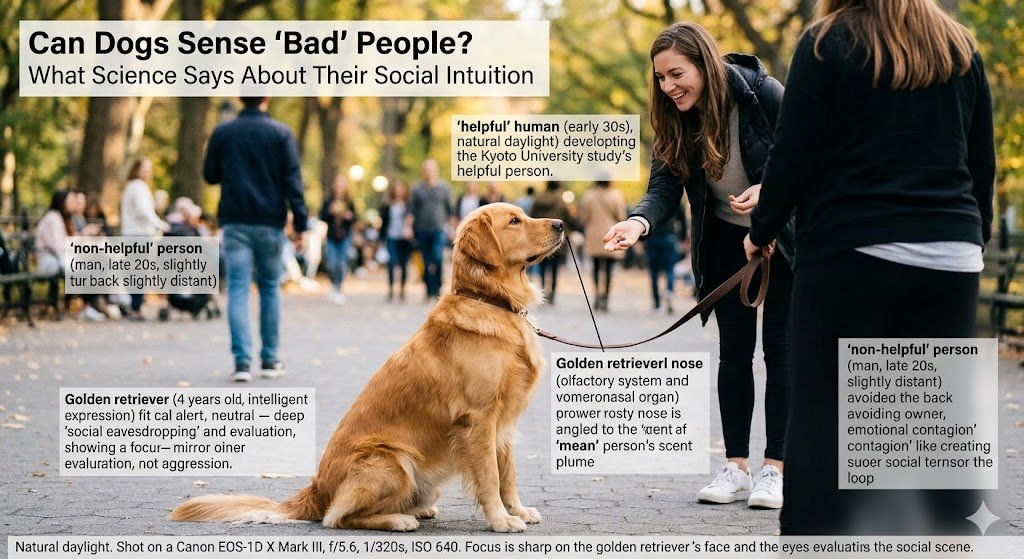
The “Judgmental” Best Friend
It is a scenario that has launched a thousand “my dog is a genius” stories: you meet a new neighbor or a potential date who seems perfectly pleasant, yet your usually gregarious dog refuses to enter the room. They might hide behind your legs, let out a low, vibrational growl, or simply stare with an unblinking, suspicious intensity.
Many owners take this as a sign of supernatural insight—as if the dog can see a “dark cloud” around a person’s character. But is your dog actually a moral psychic? According to the latest research in cognitive ethology, the answer is even more fascinating than a “sixth sense.”
Can Dogs Sense “Bad” People? (NLP Snapshot): While dogs do not possess a moral compass that defines “good” or “evil,” they are world-class experts at Social Eavesdropping. They judge humans based on their observed helpfulness toward others and their chemical “honesty”—the alignment between a person’s outward behavior and their internal physiological state (stress, adrenaline, and cortisol levels).
The Kyoto University Study: “Social Eavesdropping”
One of the most compelling pieces of evidence for canine social intuition comes from Kyoto University in Japan. Researchers wanted to know if dogs could evaluate a person’s character simply by watching how that person treated others.
The “Helpful vs. Mean” Experiment
In the study, dogs watched their owners try to open a container. One person (the “helper”) would assist the owner, while another person (the “non-helper”) would turn away or actively refuse to help. A third person remained a neutral observer.
The Results
When the people offered the dogs a treat afterward, the dogs showed a clear preference for the “helper” or the neutral observer. They significantly avoided the “non-helper.”
- The Takeaway: Dogs perform what scientists call Social Eavesdropping. They gather information about a person’s social value by watching how they interact with the pack.
- The “Jerk” Filter: If a person is rude to you or shows social aggression, your dog isn’t “sensing a soul”—they are logically concluding that this person is a poor social partner for the pack and, therefore, a potential threat.
The Chemical Signature of “Bad” Intentions
While we rely on what we hear and see, a dog’s primary world is built of molecules. They don’t need to see a person act “badly” to feel uneasy; they can often smell the physiological shift that accompanies hostile or deceptive intent.
The Scent of Adrenaline and Cortisol
When a human is experiencing anger, fear, or predatory aggression, their endocrine system releases a cocktail of chemicals, specifically adrenaline and cortisol. These hormones have a distinct scent that is imperceptible to humans but smells like a flashing red light to a dog.
- The “Lie” Detector: If a person is acting overly friendly but is internally feeling aggressive or tense, their chemical signature doesn’t match their body language.
- The Vomeronasal Organ: Using their Jacobson’s organ (vomeronasal organ), dogs can “taste” these chemical shifts in the air. To your dog, a “bad” person smells like a contradiction, which triggers an immediate defensive response.
Mirrors of Your Own Emotion
Sometimes, your dog isn’t judging the stranger at all—they are judging your reaction to the stranger. This phenomenon is known as Emotional Contagion, and it is one of the most powerful bonds in the human-canine relationship.
The Invisible Feedback Loop
Dogs are hyper-attuned to the heartbeat, breathing rate, and muscle tension of their owners. If you meet someone who makes you feel subconsciously uneasy—perhaps because of a past experience or a subtle “vibe”—your body will react before your mind even processes it.
- Your Response: Your grip on the leash tightens slightly, your heart rate increases, and your shoulders stiffen.
- The Dog’s Perception: Your dog feels the tension through the leash and smells the sudden spike in your sweat.
- The Conclusion: The dog assumes you are afraid of the stranger. Therefore, the stranger is a threat.
In these cases, your dog isn’t “sensing” that the person is a villain; they are loyally taking their cues from you. If the “Alpha” is worried, the dog is on guard.
Subtle Body Language “Tells”
In the canine world, “politeness” is defined very differently than it is in human society. Often, a person isn’t “bad,” but their body language is “rude” or “threatening” in dog-speak. Dogs are masters of reading micro-expressions—the split-second facial movements we aren’t even aware we’re making.
Staring vs. Soft Eyes
In the human world, direct eye contact is a sign of honesty. In the dog world, a direct, unblinking stare is a sign of active aggression. A person who “loves dogs” but stares them down while leaning over them is inadvertently acting like a predator. Your dog’s “bad vibe” about that person might simply be a response to what they perceive as a physical challenge.
Stiff Posture and “Unpredictability”
Dogs crave predictability. A person who is stiff, has an unusual gait, or carries a large, unfamiliar object (like an umbrella or a heavy box) can trigger a dog’s “threat detection” system. Furthermore, people who don’t like dogs often hold their breath or freeze when a dog approaches. To a dog, this stillness is suspicious—it’s what a predator does before it strikes.
When Your Dog’s Intuition is “Wrong”
It’s tempting to believe our dogs are infallible judges of character, but their intuition is filtered through their own past experiences and biases. A dog’s “judgment” can be clouded by Associative Learning—the brain’s way of linking a specific trait to a past trauma.
The Bias of Past Trauma
If a dog was once startled by a person wearing a high-visibility vest or someone with a deep, booming voice, they may react “badly” to every person who shares those traits. In these instances, the dog isn’t sensing a “bad soul”; they are having a post-traumatic response to a visual or auditory trigger.
The Difference Between “Bad” and “New”
Often, a dog’s negative reaction is simply a sign of under-socialization. If a dog hasn’t been exposed to a diverse range of people—different ethnicities, ages, or styles of dress—they may react with suspicion toward anyone who looks “different” from their family. This isn’t intuition; it’s a lack of exposure.
Safety First: If your dog’s “intuition” leads to lunging, snapping, or unprovoked aggression, this is a behavioral issue that requires a professional trainer. Never rely solely on a dog’s reaction to judge a person’s character in legal or safety matters.
Common Questions (FAQ)
Can dogs sense a “bad” person through a window or on a screen?
Likely not in the way we imagine. While dogs can recognize human faces on screens, they lose their most powerful tools—olfactory cues and social eavesdropping—in digital or distant interactions. If your dog barks at someone through a window, they aren’t sensing “evil”; they are responding to a territorial intrusion or a visual “trigger” like a hat, a bag, or a strange walking gait.
Why does my dog bark at some strangers but not others?
This usually comes down to micro-signals. One stranger might be making direct eye contact (a threat), while another is looking at their phone (neutral). Additionally, certain scents—like heavy cologne, cigarette smoke, or even the smell of another dog—can make a person “suspicious” to one dog and perfectly fine to another.
Do certain breeds have better “people-judgment”?
While all dogs share the same basic sensory hardware, Guardian breeds (like Rottweilers or Dobermans) are more naturally inclined to look for threats and “judge” strangers. Conversely, Social breeds (like Golden Retrievers) often have a higher threshold for “rude” body language and are more likely to give a “bad” person the benefit of the doubt in exchange for a pat.
Dr. Emily’s Final Take
From a clinical perspective, your dog is an incredible barometer for social honesty, but they aren’t a crystal ball. They don’t have a moral compass; they have a survival compass. When your dog “judges” someone, they are simply processing a massive amount of data—scent, sound, and movement—and comparing it to their internal database of “safe” versus “unsafe.”
Trusting your dog’s intuition is often a wise move, not because the dog is psychic, but because they are picking up on the subtle tension or chemical shifts that your human brain might be ignoring. At Dog Vet Expert, we see the “Judgmental Best Friend” as a beautiful example of the deep evolutionary partnership between our two species. Your dog has your back—just make sure you aren’t the one unintentionally telling them to be on guard!
🔒 The Trust Barrier
Your dog doesn’t have a moral compass; they have a survival compass. Discover why they view you as a ‘Safe Harbor’ while treating even pleasant visitors with instant suspicion.
Read: Why Your Dog Trusts You but Not Visitors →🕵️ Why the Intense Stare?
That unblinking gaze your dog gives a stranger is the same analytical stare they use when you’re in the shower. Learn the psychology behind canine observational behavior.
Learn: Why Dogs Stare in the Shower →Reference
Journal of Neuroscience for research on how dogs process human facial expressions.