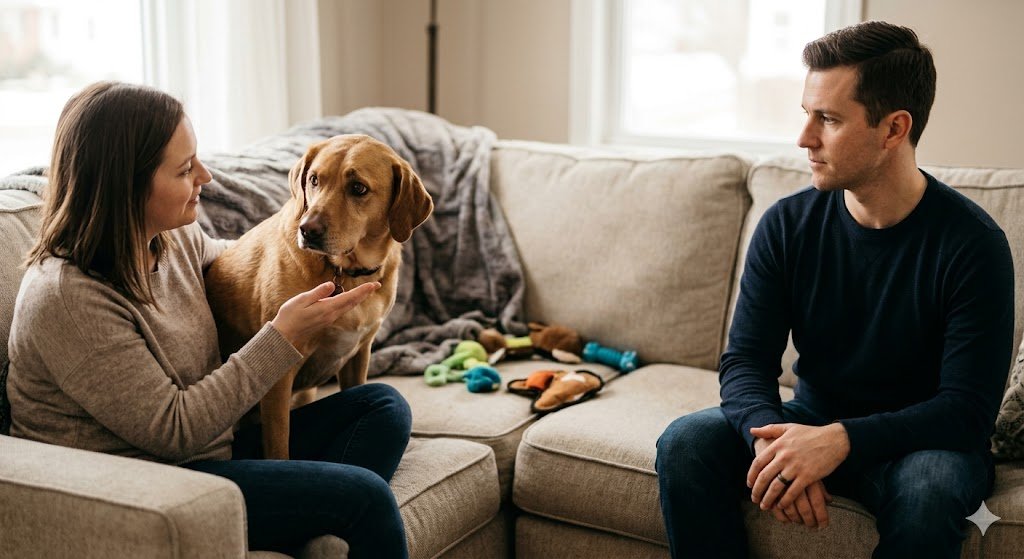
The Love vs. Logic Divide
Why my dog listens to my partner but not me- It is one of the most frustrating experiences a dog parent can have. You are the one who handles the “heavy lifting”—the vet visits, the 6:00 AM walks, and the meticulously measured meals. Yet, when your partner walks into the room and gives a single, quiet command, your dog snaps to attention like a soldier. Meanwhile, when you ask for a “Sit,” your dog looks at you with soulful eyes and continues exactly what they were doing.
This “Selective Hearing” can feel like a personal slight, but in the world of canine psychology, it is rarely about who the dog “loves” more. In fact, the person the dog listens to most is often not the person they cuddle with most.
The “Secondary Favorite” Meaning (NLP Snapshot): A dog’s tendency to obey one person over another is driven by Communication Clarity and the Reliability Quotient. Dogs categorize humans into functional roles: the “Nurturer”(source of affection and comfort) and the “Executive” (source of clear, unwavering boundaries). If you find yourself in the “Secondary Favorite” position for commands, it often means your dog views your relationship as purely social rather than operational.
The Psychology of the “Executive” Figure
To understand why your dog “snaps to” for your partner, we have to look at how dogs process information. Canines are masters of associative learning—they don’t listen to words so much as they predict outcomes based on signals.
The Clarity Coefficient
The “Executive” in the house usually has a high Clarity Coefficient. This means they use fewer words and more consistent body language. While a “Nurturer” might say, “Hey buddy, can you sit down for me please? Come on, sit,” the Executive simply says, “Sit,” once. To a dog, the latter is a clear, high-contrast signal. The former is “white noise” that the dog has learned to tune out.
Energy and Assertiveness
Dogs are evolutionarily tuned to follow calm, assertive energy. If one partner project a “soft” or pleading energy, the dog may interpret this as a lack of leadership. It’s not that the dog is being defiant; it’s that they don’t feel the “weight” of the command. They view your request as an invitation to a negotiation rather than a directed task.
The Follow-Through Factor
This is the most critical element of the Executive figure. If your partner issues a command, they likely wait and ensure the dog completes it before moving on. This creates a 100% Reliability Rate. If you allow your dog to ignore a command because they look “too cute” or you’re in a hurry, you are teaching the dog that your commands are optional. In the dog’s mind, listening to you is a choice; listening to the Executive is a rule.
The “Nurturer” Trap: When Love Blurs the Lines
It feels like a betrayal: you are the person the dog runs to when they are scared, the one they spoon with on the sofa, and the one they greet with the most “wiggletails.” Yet, this deep emotional bond is exactly why they might not listen to you. In canine social structures, there is a distinct difference between a Security Base and a Directional Leader.
Emotional Attunement vs. Operational Obedience
If you are the “Nurturer,” your dog feels a high level of Psychological Safety with you. This is a beautiful thing—it means your bond is unconditional. However, because the dog feels so secure, they also feel safe enough to “test” you. They don’t fear a loss of resources or a change in your affection if they ignore a “Down” command. To them, you are the “Safe Harbor,” not the “Captain.”
The Reward Inconsistency
Nurturers often fall into the “Just Because” trap. You might give treats, belly rubs, or table scraps simply because the dog looks cute. While this builds a loving relationship, it lowers the Value of the Transaction. If the dog gets the “paycheck” (your attention) without having to “work” (obeying a command), they lose the incentive to perform when asked.
Decoding “Selective Hearing” (The Science)
Why does the dog respond to one voice and tune out the other? It isn’t just about who is “the boss”; it’s about how the canine ear and brain process acoustic information.
Tone, Pitch, and Cadence
Research in canine ethology shows that dogs respond more effectively to short, descending frequencies for commands.
- The Executive Tone: Usually involves a deeper, steadied pitch with a “falling” inflection at the end. This mimics the low-frequency growl used by mother dogs to correct puppies.
- The Nurturer Tone: Often higher-pitched and “sing-songy” (upward inflections). While this is great for praise and bonding, it can sound like “play” or “uncertainty” to a dog, making the command feel like a suggestion rather than a requirement.
The “White Noise” Effect
If you talk to your dog throughout the day—narrating your chores or asking them questions—they eventually learn to categorize your voice as background music. This is called Habituation. When you finally do give a serious command, your voice doesn’t “pop” out of the background noise. The partner who speaks to the dog less frequently (or only for specific interactions) has a voice that carries more “novelty” and weight.
The Follow-Through Factor
Science shows that dogs are masters of Probability Mapping. * Person A (Executive): 95% chance I have to sit if they say it.
- Person B (Nurturer): 40% chance I have to sit; 60% chance I can keep sniffing this rug.
The dog isn’t being stubborn; they are being a mathematician. They are simply choosing the path of least resistance based on your historical follow-through.
Can a Dog Have Two “Masters”?
The short answer is yes, but it requires a strategic shift in how the household operates. In canine psychology, a dog doesn’t necessarily need one “Alpha”; they need a predictable environment. If the “Executive” and the “Nurturer” are out of sync, the dog becomes a “situational listener”—someone who obeys depending on who is holding the leash.
Dual-Authority Households
To achieve equal authority, both partners must adopt a Unified Communication Protocol. This means using the exact same verbal cues, hand signals, and—most importantly—the same “pass/fail” criteria for a command. If one person allows a “sloppy sit” (butt half off the ground) and the other demands a “square sit,” the dog will always choose the person with the lower standards.
The Handover Strategy
One of the most effective ways to balance the scales is for the “Executive” to step back. If the dog only listens to your partner, your partner should temporarily stop being the one who gives treats or dinner. By shifting the High-Value Resources to the “Secondary Favorite,” the dog is forced to re-evaluate who holds the keys to the kingdom.
From “Second Choice” to “Equal Authority”
Changing a dog’s perception of you doesn’t happen during a long walk; it happens in the tiny, high-stakes moments of daily life. You can reset the hierarchy by moving from “negotiator” to “leader” through these three steps.
The 5-Minute Drill
Perform short, high-intensity training bursts where only you give commands. During these five minutes, you must be 100% consistent. If you say “Sit” and the dog ignores you, do not repeat yourself. Wait them out or calmly lure them into the position. The goal is to prove to the dog that your “Reliability Quotient” has just gone up.
The “Value Shift”
For one week, you should be the only one who provides “Life Rewards”—opening the door for a walk, putting the food bowl down, or throwing the ball. However, the dog must “pay” for these rewards with a command (e.g., sitting before the door opens). This teaches the dog that you are the Gatekeeper of Fun, not just a source of free snuggles.
Consistency Over Intensity
You don’t need to be loud or “tough.” You just need to be unavoidable. If you ask for a behavior, ensure it happens every single time.
Safety First: If your dog’s refusal to listen stems from fear, cowering, or aggression toward one specific family member, please consult a professional veterinary behaviorist immediately. This may indicate a breakdown in trust or a history of negative reinforcement that needs expert repair.
Common Questions (FAQ)
Does my dog love my partner more than me?
Almost certainly not. In fact, if the dog ignores your commands but cuddles with you constantly, they likely feel a deeper sense of unconditional security with you. They see your partner as a “manager” and you as their “best friend.” While the lack of obedience is frustrating, it is actually a backhanded compliment to the safety they feel in your presence.
Why does my dog only listen to me when I have a treat?
This is the “Bribery vs. Motivation” trap. If you show the treat before giving the command, you aren’t training; you’re negotiating. The dog is deciding if the snack is worth the effort. To fix this, keep treats hidden in a pocket or on a high shelf. Only produce the reward after the dog has successfully completed the task.
Can I fix this if my dog is already an adult?
Absolutely. Dogs are masters of adapting to new social data. By shifting your “Follow-Through Factor” and becoming more consistent with your tone and rewards today, you can change a five-year-old dog’s perception of your authority within weeks. Their brain remains plastic and ready to learn “The New Rules” at any age.
Dr. Emily’s Final Take
From a veterinary perspective, a household with split authority can actually be a source of stress for a dog. Canines crave predictability. When they receive mixed signals—one person being firm and the other being a “soft touch”—the dog’s mental load increases as they try to navigate two different sets of rules.
By moving from the “Secondary Favorite” to an “Equal Authority,” you aren’t just making your life easier; you are making your dog’s life better. A dog that knows exactly what is expected of them, regardless of who is speaking, is a calmer, more confident, and less anxious companion. At Dog Vet Expert, we believe that the best bond is built on a foundation of both deep love and mutual respect.
⭐ Love vs. Leadership
Is your partner the ‘Executive’ or just the ‘Favorite’? Discover the subtle biological reasons why dogs choose one primary anchor for affection and another for instruction.
Read: How Dogs Choose Their Favorite Person →🔒 The Trust Factor
Obedience and trust go hand-in-hand. If your dog doesn’t listen, they may not yet view you as the ‘Safe Harbor’ in the storm. Learn how to bridge the trust gap with visitors and family alike.
Learn: Why Your Dog Trusts You but Not Visitors →Reference
ACVB for professional insights on household behavioral dynamics.