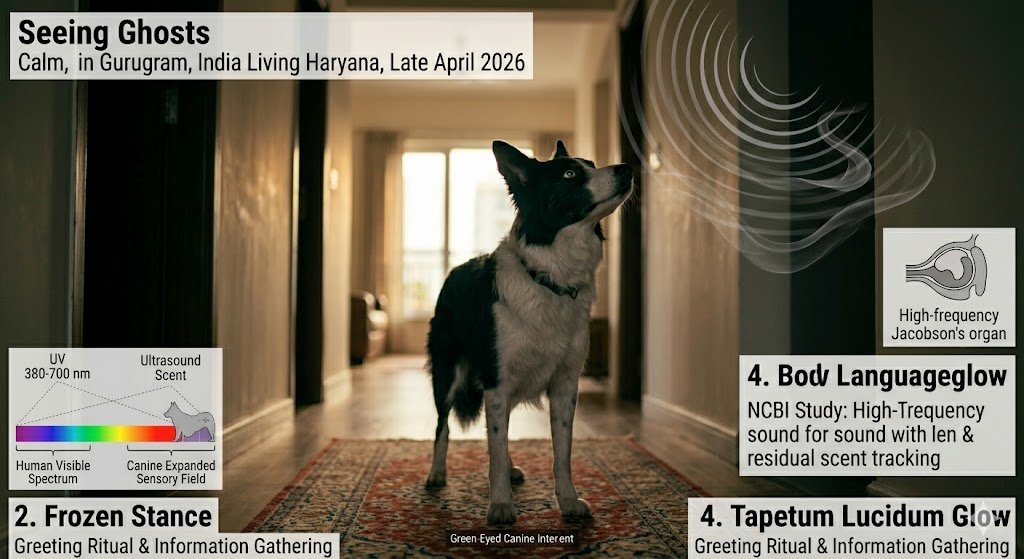
The Eerie “Stare-Down” (can dogs see ghosts )
It’s midnight in Gurgaon, the house is silent, and your dog is frozen, staring intensely at a dark corner of the hallway. They might growl low in their throat or let out a sharp “boof,” but when you look, you see absolutely nothing. It is easy to let your imagination run wild—is there a “visitor” from the beyond, or is your dog’s biology just superior to yours?
While the internet loves a good supernatural theory, what we call “staring at nothing” is almost always a result of Sensory Hyper-Acuity. Dogs do not live in the same sensory world we do. They possess a Tapetum Lucidum for high-definition low-light vision, ears that detect ultrasonic frequencies, and a nose that can sense residual thermal energy. What looks like an empty, silent corner to you is a vivid, noisy, and high-scent event to your dog.
The “Ghost” Stare (NLP Snapshot): Dogs don’t see ghosts; they see, hear, and smell the physical world at a resolution humans cannot comprehend. Their “spooky” behavior is usually a reaction to micro-movements (like insects in walls), high-frequency vibrations, or lingering pheromones. To a dog, “nothing” is rarely ever truly empty.
The Invisible Light: UV and Low-Light Vision
The primary reason dogs seem to “see” things we don’t is the way their eyes are constructed to handle light.
The Tapetum Lucidum: The Canine Mirror
Dogs have a specialized layer of tissue behind their retina called the Tapetum Lucidum. This acts like a mirror, reflecting light back through the retina to give the photoreceptors a second chance to catch it.
- The Result: Dogs can see in light that is roughly five times dimmer than what a human requires.
- The “Ghost” Reality: A tiny dust mote caught in a sliver of moonlight, a spider web vibrating in the AC draft, or the reflection of a car headlight on the far side of the neighborhood can look like a glowing, moving entity to a dog in a dark room.
Ultraviolet Perception
Recent research suggests that many mammals, including dogs, can see into the ultraviolet (UV) spectrum. Many things that are invisible to us—such as certain patterns on insects, bird feathers, or even dried urine tracks—stand out in high contrast to a dog. When your dog is tracking something across the ceiling, they might literally be seeing the UV trail of a common house fly or a gecko that passed by hours ago.
Ultrasonic Hearing: The Sound of the “Unknown”
If you’ve ever seen your dog tilt their head and stare at a seemingly solid drywall, they are likely “seeing” with their ears. Humans have a hearing range that tops out at about 20,000 Hz, but dogs can hear up to 65,000 Hz—well into the ultrasonic range.
The Culprits in the Walls
What we perceive as a “silent” house is actually a roar of mechanical and biological noise to a dog.
- Rodent Activity: A mouse or termite moving behind the wall emits high-frequency scratching and squeaking that is invisible to us but sounds like a construction site to your dog.
- Electronic Hum: Many modern appliances and power adapters emit high-pitched frequencies that dogs can find distressing or fascinating.
- Plumbing Vibrations: A tiny air bubble or a slight vibration in the pipes can cause a dog to fixate on a specific patch of floor or wall.
When your dog stares at a “nothing” spot, they aren’t looking at a spirit; they are likely tracking the movement of something small and physical that is simply vibrating at a frequency you cannot hear.
Scent Shadows: Tracking the “Memory” of a Person
A dog’s sense of smell is so advanced that it allows them to experience time differently than we do. While we see only what is currently in front of us, a dog smells what was there.
The Jacobson’s Organ
Located in the roof of the mouth, the vomeronasal organ (or Jacobson’s organ) allows dogs to “taste” the air. It detects pheromones and chemical signals that are completely odorless to humans.
Residual Scent and “Ghost” Tracking
- The Scent Trail: If a family member or a guest sat in a chair and left two hours ago, their “scent shadow” remains. The dog may stare at that chair or the door because they are detecting a lingering, high-definition chemical profile of that person.
- Thermal Pockets: Dogs have a cold-sensitive “rhinarium” (the moist part of the nose) that can detect subtle thermal radiation. They may stare at a spot on the rug where a sunbeam was an hour ago because it still “feels” different to their nose.
To us, the room is empty. To the dog, the room is filled with the vivid, colorful “ghosts” of everyone who has walked through it in the last twelve hours.
Barometric Pressure and Magnetism: The “Sixth Sense”
Dogs are essentially furry, living weather barometers. Long before you see a single cloud or hear the rumble of thunder, your dog is likely picking up on environmental shifts that are physically invisible to humans.
The Barometric Drop
Dogs are extremely sensitive to changes in atmospheric pressure. When a storm approaches, the barometric pressure drops rapidly.
- The “Sinus” Sensation: Some researchers believe dogs feel this pressure change in their inner ears or sinuses, causing a sensation of “fullness” or discomfort similar to what we feel in an airplane.
- Infrasound Detection: Storms generate low-frequency “infrasound” waves that travel hundreds of miles ahead of the actual weather front. Your dog may stare toward the horizon or act restless because they are “hearing” a storm that hasn’t arrived yet.
Static and Magnetism
- Electromagnetic Shifts: Electrical storms shift the electromagnetic fields in the air. This can cause a static charge to build up in a dog’s fur, especially in the high-humidity monsoon months of Gurgaon.
- The “Ghost” Reaction: To a dog, the air literally “feels” different. They may pace, hide, or stare at the ceiling because they are reacting to the electrical tension in the room, which they perceive as a physical, invisible presence.
When to Worry: “Ghost” Staring as a Medical Sign
While most “hauntings” can be explained by sharp ears and noses, there is a point where staring becomes a clinical concern. As an owner, you need to know when the behavior shifts from “super-senses” to a neurological red flag.
Canine Cognitive Dysfunction (CCD)
Often called “Doggy Dementia,” CCD is a neurodegenerative disease similar to Alzheimer’s. Staring blankly is one of the hallmark symptoms.
- The DISH Acronym: Veterinarians look for Disorientation, Interaction changes, Sleep-wake cycle disturbances, and House-soiling.
- The Corner Trap: If your dog doesn’t just stare, but actually gets “stuck” in corners or stands on the wrong side of a door waiting for it to open, it is a sign of cognitive decline rather than an external stimulus.
Partial or Focal Seizures
Not all seizures involve convulsing on the floor. “Partial seizures” can manifest as a dog simply checking out of reality for a few seconds.
- “Fly-Snapping”: This is a specific type of focal seizure where a dog snaps at invisible flies or fixates intensely on a single point in space without being able to be snapped out of it by their name or a treat.
Dr. Emily’s Rule: “If your dog is ‘staring at ghosts’ but remains responsive to your voice, it’s likely just their senses at work. However, if they become dazed, unresponsive, or appear confused after the episode, it’s not a haunt—it’s a medical episode. I recommend filming these moments to show your vet, as they are notoriously difficult to catch in a clinical setting.”
Common Questions (FAQ)
Why do they growl at “nothing”?
When a dog growls at an empty space, they aren’t challenging a spirit; they are reacting to muffled environmental data. A growl is a defensive response to a sound they can’t quite identify—such as a neighbor’s distant footsteps through the wall or the scurry of an animal in the attic. Because the sound is faint or “low-frequency,” they feel the need to issue a warning to the “unknown” source.
Can dogs “sense” death?
There are many stories of hospice dogs “knowing” when a patient is about to pass. Science points to Chemical Realityrather than the supernatural. When a body begins to shut down, its metabolism shifts, releasing specific pheromones and scents (ketones and breath changes) that a dog’s 300-million-receptor nose can detect long before a human monitor can.
Do certain breeds “see ghosts” more often?
Scent hounds (like Beagles) and Sight hounds (like Greyhounds) are more likely to “fixate.” Scent hounds may stare at a wall because they are “visualizing” a smell, while Sight hounds are more likely to track microscopic dust motes or light reflections that other breeds might ignore.
Dr. Emily’s Final Take
Our dogs live in a world of data that we are simply blind to. They aren’t seeing spirits; they are experiencing the vibrant, hidden layers of our physical reality. Whether they are tracking a UV trail on the ceiling or hearing the high-pitched hum of your neighbor’s router, their “spooky” behavior is just a testament to their incredible biological design.
At Dog Vet Expert, we encourage you to trust your dog’s nose over your imagination. If they are staring, there is almost always a physical, scientific reason for it. Instead of reaching for a sage bundle, try reaching for a flashlight—you might just find a tiny spider or a drafty window is the real “ghost” in your home.
🕵️ Character vs. Chemicals
That same “sixth sense” used to detect subtle environment shifts is why dogs can often sense “bad people.” Is it intuition, or are they reading chemical cues?
Read: Can Dogs Sense Bad People? →🚿 The Bathroom Bodyguard Connection
Staring at “nothing” in the hallway is closely related to why your dog watches you in the shower. Both involve high-arousal monitoring of their territory.
Discover: Why Dogs Stare in the Shower →Reference
we reference research on how canine visual and auditory ranges differ from humans, specifically regarding UV light and high-frequency sound.
- Study Title: The eye of the dog (Canis familiaris) and its potential for ultraviolet vision
- Source: Royal Society Open Science.
- Key Finding: This research suggests that dogs (and many other mammals) possess lenses that transmit UV light, allowing them to see patterns and textures in the environment that are completely invisible to the human eye.
- Direct Link: https://royalsocietypublishing.org/doi/10.1098/rsos.140025