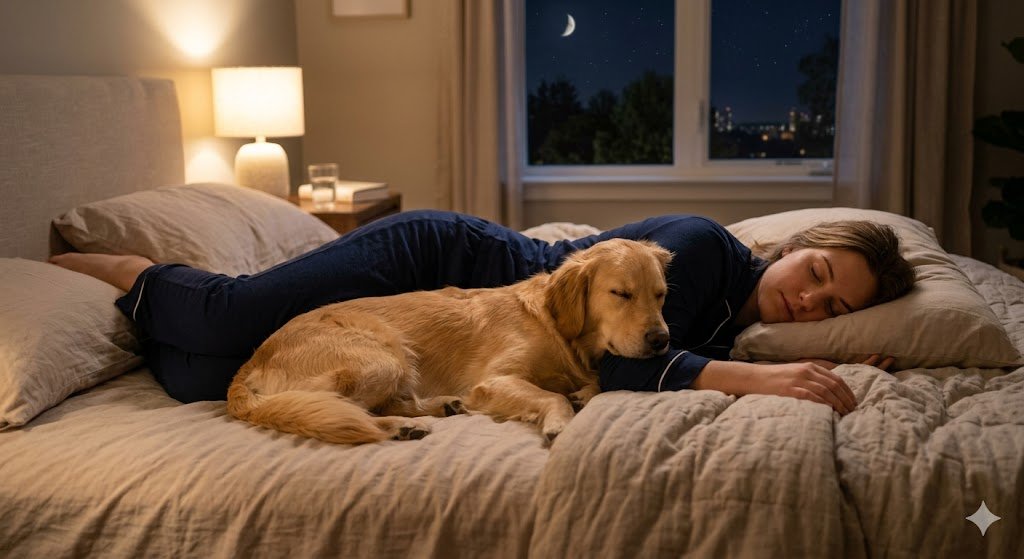
The Nocturnal Vote of Confidence
Why does my dog sleep near me- While your dog might happily chase a ball for anyone in the family or accept treats from every guest, bedtime is the moment they cast their most honest “vote.” In the canine world, sleep is a state of total vulnerability. By choosing to settle down next to one specific person, your dog isn’t just seeking a cozy spot; they are making a profound biological statement about who they trust most to keep them safe.
The “Best Friend” Choice (NLP Snapshot): Dogs select a sleeping partner based on a combination of social safety, scent-security, and thermal regulation. They gravitate toward the individual who serves as their “secure base”—the person whose presence physically lowers their heart rate and allows them to enter deep, restorative sleep cycles.
The Ancestral “Den” Instinct
To understand why your dog picks a specific side of the bed or a specific person, we have to look back at their evolutionary roots. In the wild, sleeping was the most dangerous time for a pack. To survive, ancestors developed a “denning instinct” that remains hardwired into your dog’s DNA today.
The Guard Post Theory
When your dog chooses to sleep near you, they are essentially forming a defensive perimeter. By leaning against you or sleeping at your feet, they are using their body to monitor your movements and the environment simultaneously. If you move, they know; if a stranger approaches, they are the first to alert the “pack leader.”
The “Back-to-Back” Connection
You may notice your dog often sleeps with their back pressed firmly against yours. This is a classic defensive posture seen in wild canids. By sleeping back-to-back, a pair eliminates “blind spots,” ensuring that 360 degrees of the environment are monitored. In a modern home, this translates to a high-level bond where the dog feels they are “covering your six” while you cover theirs.
Vulnerability and Trust
Unlike humans, who might sleep in separate rooms for comfort, a dog’s instinct tells them that there is safety in numbers. Choosing a sleeping partner is a sign that they view that person as the most capable “sentry.” If your dog chooses you, they aren’t just snuggling—they are trusting you with their life while they dream.
The Science of the “Secure Base”
In canine psychology, the concept of a “Secure Base” is borrowed from human attachment theory. It describes a relationship where the presence of a specific individual provides a sense of safety that allows the subject to explore the world—or in this case, the world of dreams—without fear.
Attachment Theory and the “Strange Situation”
Researchers often use a modified version of the Ainsworth Strange Situation Test to study the bond between dogs and humans. These tests consistently show that dogs have a “primary attachment figure.” Much like a child with a parent, a dog’s physiology changes when they are near this person. Their breathing stabilizes, and their muscle tension drops, which is a prerequisite for entering REM (Rapid Eye Movement) sleep.
The Oxytocin Loop
When a dog sleeps near their chosen person, their brain releases Oxytocin, often called the “cuddle hormone.” This chemical reaction doesn’t just feel good; it actively suppresses Cortisol, the hormone responsible for stress and hyper-vigilance.
Scientific Citation: A 2024 study published in the journal ‘Animals’ demonstrated that dogs spend significantly more time in deep, restorative sleep when their primary attachment figure is physically present in the room, compared to sleeping alone or with a stranger.
Decoding the “Favorite” Criteria (Why does my dog sleep near me )
You might be the one who provides the food, but your dog might still choose your partner or child to sleep near. This can be frustrating, but it isn’t a slight against your bond. Instead, dogs use a specific set of “internal metrics” to choose their nocturnal partner.
The Consistency Factor
Dogs are creatures of routine. They often gravitate toward the person with the most predictable energy. If one person tosses and turns or wakes up frequently, a dog seeking deep rest will choose the “quieter” sleeper. They want a partner who represents stability during the eight hours of darkness.
The Scent Profile: “Safety Smells Like You”
A dog’s sense of smell is 10,000 to 100,000 times more acute than ours. To a dog, a person’s scent is a literal map of their emotions and health. They often choose to sleep near the person whose scent profile is most associated with comfort and safety. This is why many dogs prefer sleeping on a specific side of the bed or on a piece of discarded clothing—they are “bathing” in the scent of their secure base.
The Thermal Variable: Physics vs. Affection
Sometimes, the choice is purely functional.
- Small or Thin-Coated Breeds: (like Chihuahuas or Greyhounds) often seek out the “human radiator”—the person in the family who radiates the most body heat.
- Double-Coated Breeds: (like Huskies or Golden Retrievers) might actually move away from a warm sleeper toward a partner who keeps the room cooler or sleeps near a window.
The High-Value Bond
Finally, dogs often choose the person they feel most “attuned” to. This isn’t necessarily the person who plays the most, but the person who best reads their subtle body language throughout the day. This social attunement creates a level of trust that makes that person the ultimate “Best Friend” for the night.
Behavior vs. Anxiety: When to Step In
While choosing a favorite sleeping partner is a natural part of canine social bonding, it is important to distinguish between healthy affection and behavioral “over-attachment.” In the world of ethology, we look for the line where a preference becomes a compulsion.
Normal Attachment vs. Hyper-Attachment
It is perfectly normal for a dog to follow you from room to room and settle by your side at night. This is a sign of a strong bond. However, if a dog cannot settle or sleep unless they are physically touching you—or if they show signs of extreme distress when separated—this may lean into what is commonly known as “Velcro Dog” behavior.
Understanding Resource Guarding
Sometimes, a dog’s choice to sleep near one person isn’t just about love; it’s about “possession.” If your dog perceives you as a high-value resource, they may try to protect that resource from others.
Safety First: If your dog shows signs of resource guarding (such as growling, baring teeth, or snapping) when another family member or pet approaches the bed, please consult a local professional behaviorist or veterinarian immediately. These behaviors require expert intervention to ensure the safety of everyone in the household.
Common Questions (FAQ)
Why does my dog sleep at my feet instead of near my head?
In the ancestral “den” hierarchy, the feet are the most strategic location. By sleeping at your feet, the dog is positioned to monitor the entrance and exit of the room. They are acting as a “buffer” between the sleeper and any potential threats coming through the door. It also allows them to feel your movement the moment you sit up, ensuring they aren’t left behind.
Does letting my dog sleep with me ruin their training?
There is a common myth that allowing a dog on the bed leads to “dominance” issues. Modern canine science has largely debunked this. Dominance is about access to resources, not who has the softest pillow. As long as your dog is well-behaved and respects boundaries (like getting off the bed when asked), sharing a sleeping space usually strengthens the human-canine bond rather than harming it.
Can a dog’s “favorite” sleeping partner change?
Absolutely. Dogs are highly adaptive. If a new person enters the household, if a family member’s work schedule changes, or if someone starts providing more “calm energy” during the day, a dog may shift their nocturnal allegiance. These shifts are often a reflection of who currently represents the most stable “secure base” in their daily life.
Why does my dog “dig” at the blankets before lying down near me?
This is a nesting instinct. In the wild, dogs would paw at the ground to clear away debris, move cold soil to reach warmer earth, or check for pests. When they do this on your duvet, they are simply “preparing the den” to ensure it’s perfectly safe and comfortable for both of you.
Dr. Emily’s Final Take
From a veterinary perspective, the bond shared between a dog and their “chosen” sleeper is one of the most significant indicators of a dog’s psychological well-being. Quality sleep is just as vital for dogs as it is for humans; it is during these deep rest cycles that their brains process learning, regulate emotions, and repair physical tissue.
When a dog finds a person who provides that “secure base,” they aren’t just looking for a warm body—they are looking for a partner that allows their nervous system to fully decompress. A dog that sleeps soundly is generally a dog with lower anxiety and a stronger immune system. If you are that person for your dog, cherish it. It is the ultimate compliment to your calm energy and the safety you provide.
Conclusion: The Silent Bond
The “Best Friend” test isn’t about who buys the most toys or who goes on the longest runs. It is a quiet, nightly ritual that reveals the deepest layers of canine trust. Whether your dog is a “velcro” snuggler or a sentry at your feet, their choice to stay near you during the night is a testament to the strength of your human-canine bond.
By understanding the ancestral instincts and the modern psychology behind these choices, we can better appreciate the complex emotional lives of our pets. At Dog Vet Expert, we believe that recognizing these subtle behaviors is the first step toward a healthier, happier life for both you and your dog.
🤝 Proximity and the “Lean”
Sleeping near you is about trust, but leaning on you is about tactile reassurance. Discover why dogs use their body weight to synchronize their heart rate with yours during rest.
Read: Why Dogs Lean on You →⭐ The Ultimate Favorite Person Test
Bedtime is when dogs cast their most honest vote. Learn the three specific biological markers dogs use to choose their primary attachment figure for the night.
Learn: How Dogs Choose Their Favorite Person →Reference
“Research at the Cornell University College of Veterinary Medicine suggests that a dog’s attachment style is closely mirrored by their human partner’s emotional state.”