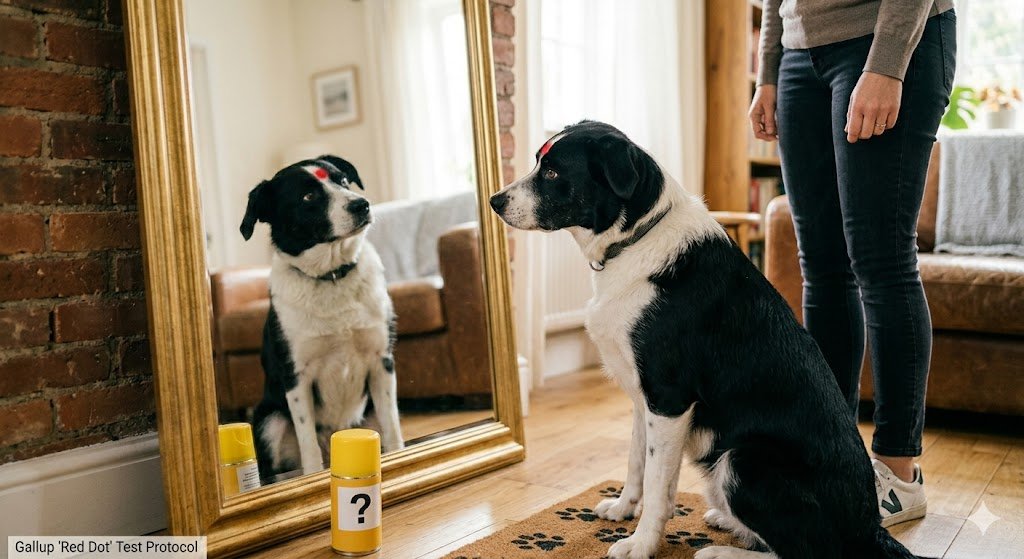
The Mirror Mystery
It is a classic “viral” moment for many pet owners: your puppy catches a glimpse of their reflection for the first time and immediately enters a frantic play-bow, lets out a series of confused barks at the “stranger,” or cautiously creeps behind the glass to find the other dog. Over time, most dogs eventually learn to ignore the mirror entirely, treating it as nothing more than a dull piece of furniture.
This lack of interest often leads people to wonder: are dogs simply not self-aware? Do they lack the cognitive “spark” that allows them to recognize themselves as individuals? For decades, the answer seemed to be “no”—at least according to human-centric science.
Do Dogs Recognize Themselves in Mirrors? (NLP Snapshot): Most dogs fail the visual “Red Dot” test (the standard measure of self-recognition). However, this does not mean they lack self-awareness. Because a dog’s primary sense is smell rather than sight, a mirror is essentially a “broken” sensory experience—it provides a visual image but lacks the olfactory signature required for a dog to verify an identity. Recent breakthroughs suggest dogs have a highly developed “Olfactory Mirror” instead.
The Classic Mirror Test: Why Dogs “Fail”
To understand the debate, we first have to look at the gold standard of animal psychology: the Gallup Mirror Self-Recognition (MSR) test. Developed in the 1970s, this test was designed to determine if an animal possesses a “concept of self.”
The Gallup Protocol
Researchers place a small, odorless red mark (often a dot of dye) on an animal’s body—usually the forehead or ear—in a spot they cannot see without a mirror. The animal is then presented with a mirror. If they see the reflection and immediately touch or try to remove the mark on their own body, they pass. It proves they understand that the “image in the glass” is actually “me.”
The “Hall of Fame” vs. The Canine Reaction
Only a handful of species have consistently passed the red dot test:
- Apes: Chimpanzees, Orangutans, and Gorillas.
- Aquatic Mammals: Bottlenose Dolphins and Orcas.
- Others: Eurasian Magpies and even some species of ants.
Why Dogs Fail: When dogs look in a mirror, they generally treat the reflection as a social stimulus. They may sniff the glass, look for a “scent trail,” or bark. When they realize the “stranger” has no smell and doesn’t react like a real dog, they simply stop caring. To a dog, if it doesn’t have a scent, it isn’t “real”—and therefore, a red dot on a scentless image is irrelevant information.
The “Yellow Snow” Study: Alexandra Horowitz’s Breakthrough
If you wanted to test a human’s self-awareness, you’d use a mirror. If you want to test a dog’s, you have to use their nose. This was the realization of Dr. Alexandra Horowitz, a leading canine cognition researcher. She hypothesized that dogs have an “Olfactory Mirror” rather than a visual one.
The “Scent-Mark” Experiment
Dr. Horowitz designed a clever variation of the red dot test using urine samples. Dogs were presented with several canisters:
- Their own scent.
- Their own scent with an “odor mark” added (a chemical change).
- A stranger’s scent.
The Results
The dogs spent significantly more time investigating the “modified” version of their own scent compared to the clean version. Just as a human would linger at a mirror if they noticed a sudden smudge on their face, the dogs recognized that their “smell-identity” had been tampered with.
The Conclusion: Dogs have a powerful sense of “Self-Scent.” They know exactly what they are supposed to smell like, and they notice when that identity changes. They are self-aware; we were simply testing them in the wrong language.
Body Awareness: The “Mat Test”
Self-awareness isn’t just about identity; it’s also about understanding your physical presence in the world. In 2021, researchers at Eötvös Loránd University in Hungary conducted the “Body as an Obstacle” test to see if dogs understand their own size and weight.
The Challenge
A dog was asked to stand on a small mat. Attached to that mat was a toy. The trainer then commanded the dog to “give” them the toy.
- The Catch: Because the dog was standing on the mat, they couldn’t lift the toy without moving their own body off the mat first.
Passing with Flying Paws
The dogs quickly realized that they were the obstacle. They understood that their physical weight was keeping the toy anchored to the ground. To complete the task, they had to step off the mat—effectively showing they recognize their body as a distinct physical entity that interacts with the environment.
The “Proprioception” Factor: This test proved that dogs possess Proprioception—the unconscious perception of movement and spatial orientation arising from stimuli within the body itself. Even if they don’t care about their “look” in a mirror, they are intimately aware of where their body begins and ends.
Why the Mirror is a “Liar” to a Dog
To a human, a mirror is a source of truth. To a dog, it is a sensory paradox. The reason most dogs eventually ignore mirrors isn’t because they are “failing” a cognitive test; it’s because the mirror is failing their reliability check.
The Multi-Sensory Conflict
For a dog, an identity is a multi-dimensional “file” containing visual, auditory, and most importantly, olfactory data.
- The Sight: There is a dog in front of them.
- The Sound: Silence. No panting, no clicking of claws, no heartbeat.
- The Smell: Glass and cleaning spray.
Sensory Habituation
Because the “mirror dog” provides 50% of the visual data but 0% of the “truth” (the scent), the dog’s brain eventually categorizes the reflection as background noise. They habituate to it, much like we do with the sound of a refrigerator hum. It isn’t that they don’t see it; they simply realized long ago that the “liar in the glass” isn’t worth their energy.
Signs Your Dog is Truly “Self-Aware”
If the mirror isn’t the right measuring stick, how do we know our dogs are self-aware? Look for these “Agency” behaviors in your daily life. They prove your dog understands themselves as an independent actor.
Proprioception and Spatial Awareness
Ever wonder how a large dog can navigate a coffee table full of glass coasters without knocking one over? This is Proprioception. They are aware of where their back paws are without looking at them. This physical “map” of the self is a foundational level of self-awareness.
Social Agency
When your dog nudges your hand to get pets or drops a ball at your feet, they are demonstrating Social Agency. They understand that their action (“The Nudge”) will result in a specific change in your behavior (“The Petting”). This requires an understanding that they are an individual who can influence the world around them.
Resource Ownership
A dog that distinguishes between “my toy” and “the cat’s toy” (even if they choose to steal the cat’s toy anyway) is showing a concept of self-possession. They recognize that certain objects are tethered to their own identity and needs.
Safety First: If your dog becomes obsessed with mirrors—spinning, barking, or lunging at them for extended periods—this may be a sign of Canine Compulsive Disorder (CCD). This behavior is often triggered by stress or lack of mental stimulation. Consult a vet to discuss environmental enrichment strategies.
7. Common Questions (FAQ)
Do puppies react differently to mirrors than adult dogs?
Yes. Puppies are in a critical “socialization” phase where they are learning to identify their own species. An 8-week-old puppy will almost always treat a mirror as a playmate, performing “play-bows” or trying to get behind the glass. As they mature and their olfactory (scent) system becomes their dominant way of processing reality, they eventually realize the reflection is a “scentless dud” and begin to ignore it.
Why does my dog look at me in the mirror?
This is a high-level cognitive skill! If your dog sees your reflection and then turns around to look at the actual you, they are using the mirror as a tool. It shows they understand the mirror’s reflective properties and are using it to track your movements or position without having to move their head.
Can dogs recognize other dogs on TV?
It depends on the TV. Older monitors had a “flicker rate” that looked like a strobe light to dogs. Modern 4K and high-refresh-rate screens, however, look quite realistic to them. While they can recognize the shape and movement of a dog on screen, they are often confused by the lack of scent, which is why some dogs will bark at the TV once and then walk away disappointed.
Dr. Emily’s Final Take
The question “Do dogs recognize themselves?” shouldn’t be answered with a simple yes or no. Instead, we should ask how they recognize themselves. Humans are visual creatures, so we use mirrors. Dogs are olfactory creatures, so they use scent.
Just because a dog doesn’t care about a “red dot” on their forehead doesn’t mean they aren’t brilliant. It just means they aren’t vain! They possess a deep, physical, and scent-based self-awareness that is perfectly adapted to their lives as hunters and companions. At Dog Vet Expert, we believe that understanding your dog’s unique way of “seeing” themselves is the first step toward truly seeing them for the intelligent beings they are.
🕵️ The Observational Stare
Does your dog track your reflection in the glass? This is the same analytical curiosity that leads them to watch you in the shower. Discover the psychology behind why dogs stare when you’re most vulnerable.
Read: Why Dogs Stare in the Shower →👻 Ghosts or Geometry?
When a dog stares at a “scentless” mirror, they feel the same confusion as when they stare at a blank wall. Explore the science behind whether dogs are sensing ghosts or just detecting subtle environmental shifts.
Learn: Can Dogs See Ghosts? →Reference
Eötvös Loránd University study on canine body awareness.